Manktelow Emily, Shigemoto Kazuhiro, Brierley Ian
Division of Virology, Department of Pathology University of Cambridge Tennis Court Road, Cambridge CB2 1QP, UK.
Nucleic Acids Res. 2005 Mar 14;33(5):1553-63. doi: 10.1093/nar/gki299. Print 2005.
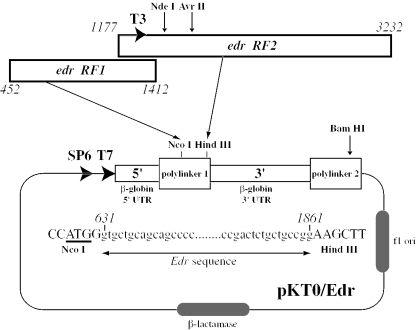
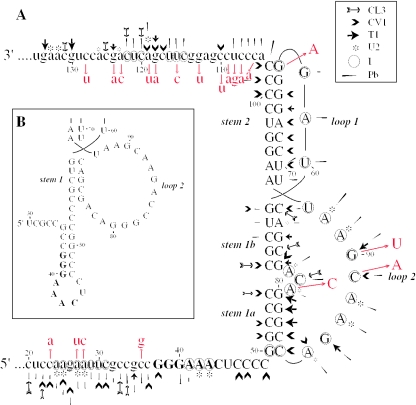
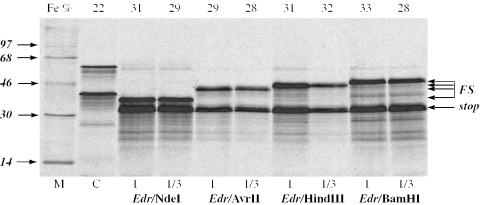
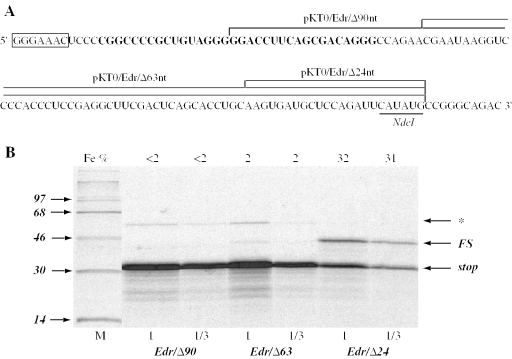
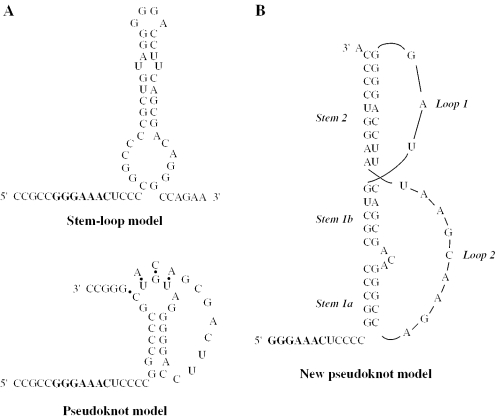
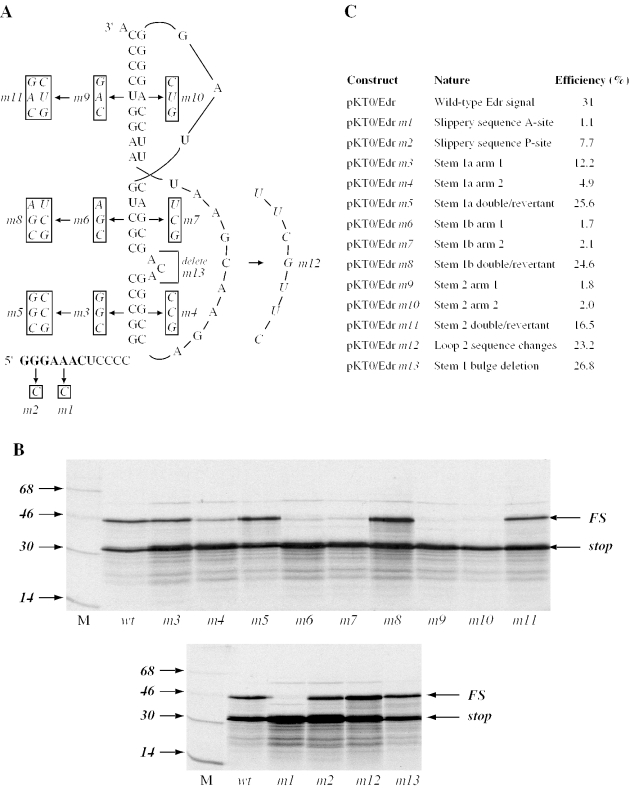
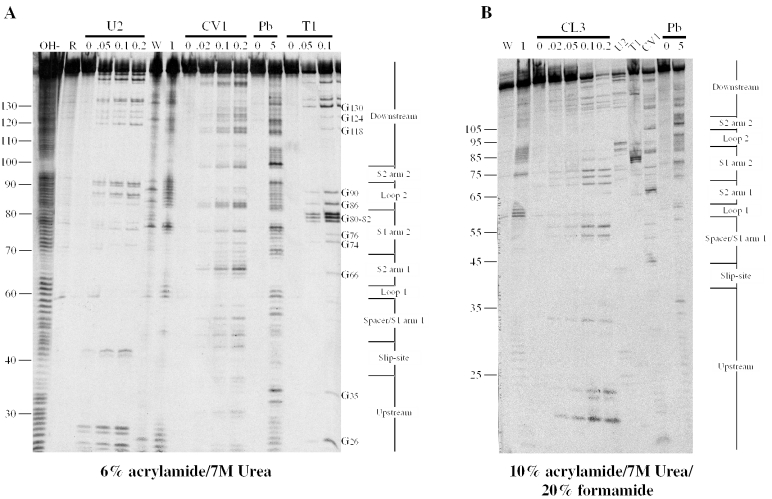
The ribosomal frameshifting signal of the mouse embryonal carcinoma differentiation regulated (Edr) gene represents the sole documented example of programmed -1 frameshifting in mammalian cellular genes [Shigemoto,K., Brennan,J., Walls,E,. Watson,C.J., Stott,D., Rigby,P.W. and Reith,A.D. (2001), Nucleic Acids Res., 29, 4079-4088]. Here, we have employed site-directed mutagenesis and RNA structure probing to characterize the Edr signal. We began by confirming the functionality and magnitude of the signal and the role of a GGGAAAC motif as the slippery sequence. Subsequently, we derived a model of the Edr stimulatory RNA and assessed its similarity to those stimulatory RNAs found at viral frameshift sites. We found that the structure is an RNA pseudoknot possessing features typical of retroviral frameshifter pseudoknots. From these experiments, we conclude that the Edr signal and by inference, the human orthologue PEG10, do not represent a novel 'cellular class' of programmed -1 ribosomal frameshift signal, but rather are similar to viral examples, albeit with some interesting features. The similarity to viral frameshift signals may complicate the design of antiviral therapies that target the frameshift process.
小鼠胚胎癌分化调控(Edr)基因的核糖体移码信号是哺乳动物细胞基因中唯一有文献记载的程序性-1移码实例[重本克、布伦南、沃尔斯、沃森、斯托特、里格比、雷斯(2001年),《核酸研究》,29卷,4079 - 4088页]。在此,我们运用定点诱变和RNA结构探测来表征Edr信号。我们首先确认了该信号的功能和强度以及GGGAAAC基序作为滑序列的作用。随后,我们推导了Edr刺激RNA的模型,并评估了它与在病毒移码位点发现的那些刺激RNA的相似性。我们发现该结构是一个具有逆转录病毒移码假结典型特征的RNA假结。从这些实验中,我们得出结论,Edr信号以及由此推断的人类同源物PEG10,并不代表一种新型的程序性-1核糖体移码信号“细胞类别”,而是与病毒实例相似,尽管有一些有趣的特征。与病毒移码信号的相似性可能会使针对移码过程的抗病毒疗法的设计变得复杂。