Polyak Stephen J, Sullivan Daniel G, Austin Michael A, Dai James Y, Shuhart Margaret C, Lindsay Karen L, Bonkovsky Herbert L, Di Bisceglie Adrian M, Lee William M, Morishima Chihiro, Gretch David R
Virology Division, Department of Laboratory Medicine, University of Washington, Seattle, WA, USA.
Virol J. 2005 Apr 22;2:41. doi: 10.1186/1743-422X-2-41.
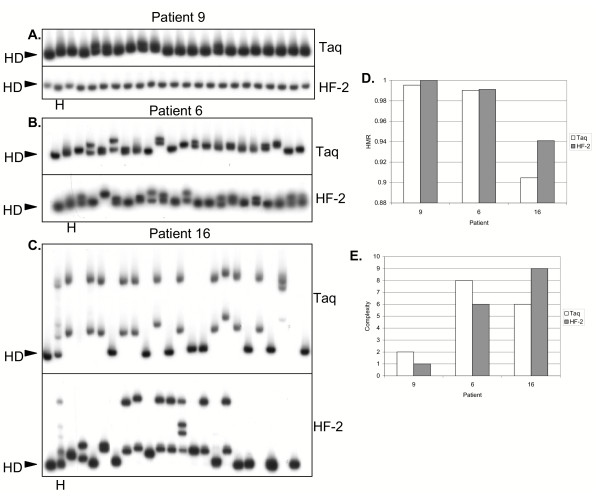
Hepatitis C virus (HCV) circulates as quasispecies (QS), whose evolution is associated with pathogenesis. Previous studies have suggested that the use of thermostable polymerases without proofreading function may contribute to inaccurate assessment of HCV QS. In this report, we compared non-proofreading (Taq) with proofreading (Advantage High Fidelity-2; HF-2) polymerases in the sensitivity, robustness, and HCV QS diversity and complexity in the second envelope glycoprotein gene hypervariable region 1 (E2-HVR1) on baseline specimens from 20 patients in the HALT-C trial and in a small cohort of 12 HCV/HIV co-infected patients. QS diversity and complexity were quantified using heteroduplex mobility assays (HMA).
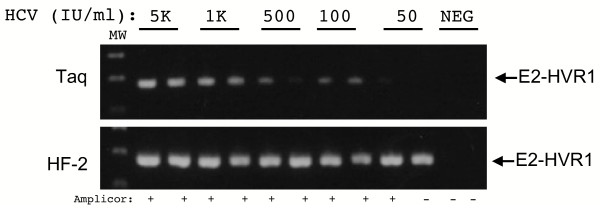
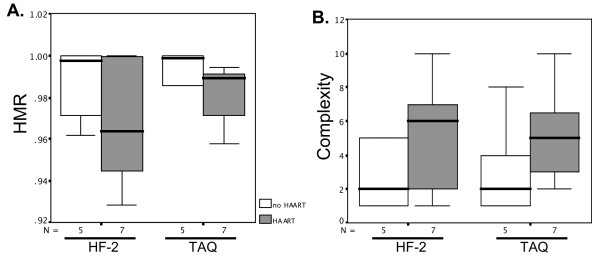
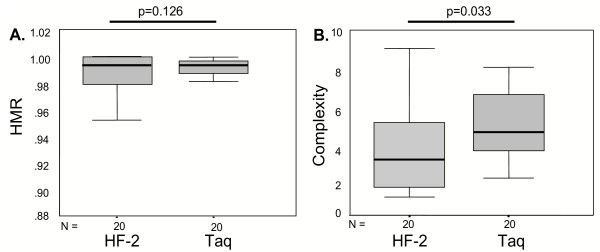
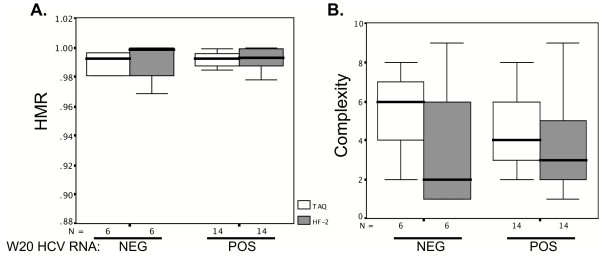
The sensitivities of both enzymes were comparable at 50 IU/ml, although HF-2 was more robust and slightly more sensitive than Taq. Both enzymes generated QS diversity and complexity scores that were correlated (r = 0.68; p < 0.0001, and r = 0.47; p < 0.01; Spearman's rank correlation). QS diversity was similar for both Taq and HF-2 enzymes, although there was a trend for higher diversity in samples amplified by Taq (p = 0.126). Taq amplified samples yielded complexity scores that were significantly higher than HF-2 samples (p = 0.033). HALT-C patients who were HCV positive or negative following 20 weeks of pegylated IFN plus ribavirin therapy had similar QS diversity scores for Taq and HF-2 samples, and there was a trend for higher complexity scores from Taq as compared with HF-2 samples. Among patients with HCV and HIV co-infection, HAART increased HCV QS diversity and complexity as compared with patients not receiving therapy, suggesting that immune reconstitution drives HCV QS evolution. However, diversity and complexity scores were similar for both HF-2 and Taq amplified specimens.
The data suggest that while Taq may overestimate HCV QS complexity, its use does not significantly affect results in cohort-based studies of HCV QS analyzed by HMA. However, the use of proofreading enzymes such as HF-2 is recommended for more accurate characterization of HCV QS in vivo.
丙型肝炎病毒(HCV)以准种(QS)形式传播,其进化与发病机制相关。先前的研究表明,使用无校对功能的热稳定聚合酶可能导致对HCV QS的评估不准确。在本报告中,我们比较了无校对功能的(Taq)和有校对功能的(高保真优势-2;HF-2)聚合酶在灵敏度、稳健性以及来自HALT-C试验中20例患者的基线样本和一小群12例HCV/HIV合并感染患者的第二包膜糖蛋白基因高变区1(E2-HVR1)中的HCV QS多样性和复杂性方面的差异。使用异源双链迁移率分析(HMA)对QS多样性和复杂性进行定量。
两种酶在50 IU/ml时的灵敏度相当,尽管HF-2比Taq更稳健且稍敏感。两种酶产生的QS多样性和复杂性评分具有相关性(r = 0.68;p < 0.0001,以及r = 0.47;p < 0.01;Spearman秩相关)。Taq和HF-2酶的QS多样性相似,尽管Taq扩增的样本有多样性更高的趋势(p = 0.126)。Taq扩增的样本产生的复杂性评分显著高于HF-2样本(p = 0.033)。接受聚乙二醇化干扰素加利巴韦林治疗20周后HCV呈阳性或阴性的HALT-C患者,其Taq和HF-2样本的QS多样性评分相似,并且与HF-2样本相比,Taq的复杂性评分有更高的趋势。在HCV和HIV合并感染的患者中,与未接受治疗的患者相比,高效抗逆转录病毒治疗(HAART)增加了HCV QS的多样性和复杂性,这表明免疫重建驱动了HCV QS的进化。然而,HF-2和Taq扩增的样本的多样性和复杂性评分相似。
数据表明,虽然Taq可能高估HCV QS的复杂性,但其使用在基于队列的通过HMA分析的HCV QS研究中不会显著影响结果。然而,建议使用如HF-2这样的校对酶以更准确地表征体内HCV QS。