Arai Shigeki, Chatake Toshiyuki, Ohhara Takashi, Kurihara Kazuo, Tanaka Ichiro, Suzuki Nobuhiro, Fujimoto Zui, Mizuno Hiroshi, Niimura Nobuo
Neutron Science Research Center, Japan Atomic Energy Research Institute 2-4 Shirakatashirane, Tokai, Ibaraki 319-1195, Japan.
Nucleic Acids Res. 2005 May 24;33(9):3017-24. doi: 10.1093/nar/gki616. Print 2005.
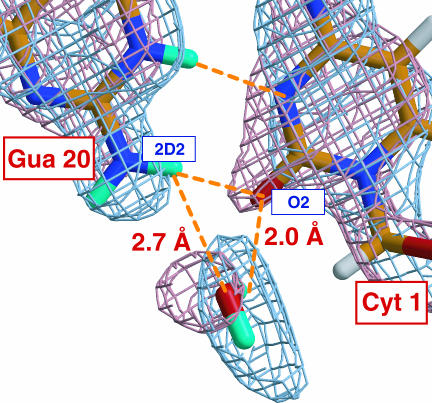
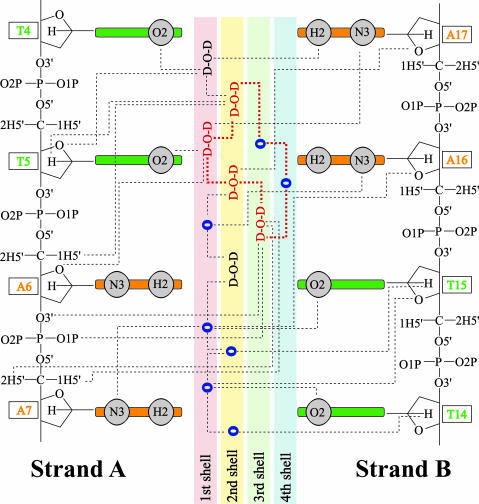
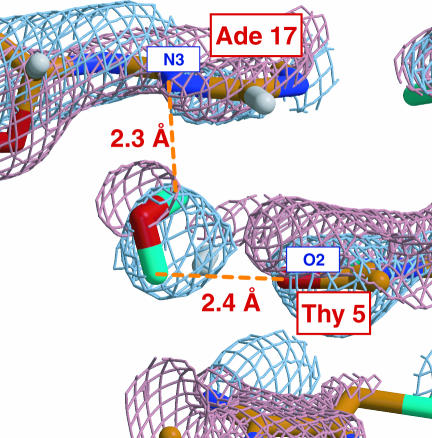
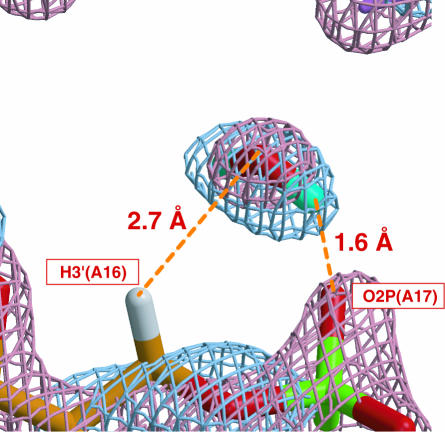
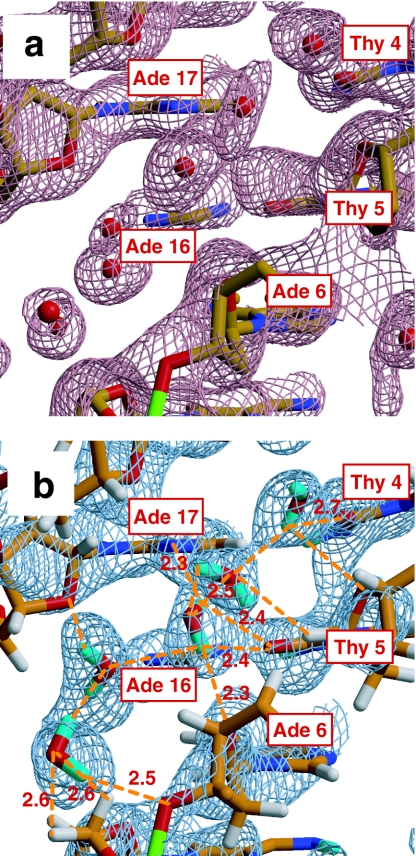
It has long been suspected that the structure and function of a DNA duplex can be strongly dependent on its degree of hydration. By neutron diffraction experiments, we have succeeded in determining most of the hydrogen (H) and deuterium (D) atomic positions in the decameric d(CCATTAATGG)2 duplex. Moreover, the D positions in 27 D2O molecules have been determined. In particular, the complex water network in the minor groove has been observed in detail. By a combined structural analysis using 2.0 A resolution X-ray and 3.0 A resolution neutron data, it is clear that the spine of hydration is built up, not only by a simple hexagonal hydration pattern (as reported in earlier X-ray studies), but also by many other water bridges hydrogen-bonded to the DNA strands. The complexity of the hydration pattern in the minor groove is derived from an extraordinary variety of orientations displayed by the water molecules.
长期以来,人们一直怀疑DNA双链体的结构和功能可能强烈依赖于其水合程度。通过中子衍射实验,我们成功确定了十聚体d(CCATTAATGG)2双链体中大部分氢(H)和氘(D)原子的位置。此外,还确定了27个D2O分子中的D位置。特别是,对小沟中的复杂水网络进行了详细观察。通过结合使用2.0埃分辨率的X射线和3.0埃分辨率的中子数据进行结构分析,很明显,水合骨架不仅由简单的六边形水合模式(如早期X射线研究中所报道的)构成,还由许多与DNA链氢键结合的其他水桥构成。小沟中水合模式的复杂性源于水分子呈现出的极其多样的取向。