• 文献检索
  • 文档翻译
  • 深度研究
  • 学术资讯
  • Suppr Zotero 插件Zotero 插件
  • 邀请有礼
  • 套餐&价格
  • 历史记录
应用&插件
Suppr Zotero 插件Zotero 插件浏览器插件Mac 客户端Windows 客户端微信小程序
定价
高级版会员购买积分包购买API积分包
服务
文献检索文档翻译深度研究API 文档MCP 服务
关于我们
关于 Suppr公司介绍联系我们用户协议隐私条款
关注我们

Suppr 超能文献

核心技术专利:CN118964589B侵权必究
粤ICP备2023148730 号-1Suppr @ 2026

文献检索

告别复杂PubMed语法,用中文像聊天一样搜索,搜遍4000万医学文献。AI智能推荐,让科研检索更轻松。

立即免费搜索

文件翻译

保留排版,准确专业,支持PDF/Word/PPT等文件格式,支持 12+语言互译。

免费翻译文档

深度研究

AI帮你快速写综述,25分钟生成高质量综述,智能提取关键信息,辅助科研写作。

立即免费体验

数学模型使用不同的参数策略来表示麻痹肌肉的力量特性:一项敏感性分析。

Mathematical models use varying parameter strategies to represent paralyzed muscle force properties: a sensitivity analysis.

作者信息

Frey Law Laura A, Shields Richard K

机构信息

Graduate Program in Physical Therapy and Rehabilitation Science, 1-252 Medical Education Bldg,, The University of Iowa, Iowa City, IA, USA.

出版信息

J Neuroeng Rehabil. 2005 May 31;2:12. doi: 10.1186/1743-0003-2-12.

DOI:10.1186/1743-0003-2-12
PMID:15927064
原文链接:https://pmc.ncbi.nlm.nih.gov/articles/PMC1175855/
Abstract

BACKGROUND

Mathematical muscle models may be useful for the determination of appropriate musculoskeletal stresses that will safely maintain the integrity of muscle and bone following spinal cord injury. Several models have been proposed to represent paralyzed muscle, but there have not been any systematic comparisons of modelling approaches to better understand the relationships between model parameters and muscle contractile properties. This sensitivity analysis of simulated muscle forces using three currently available mathematical models provides insight into the differences in modelling strategies as well as any direct parameter associations with simulated muscle force properties.

METHODS

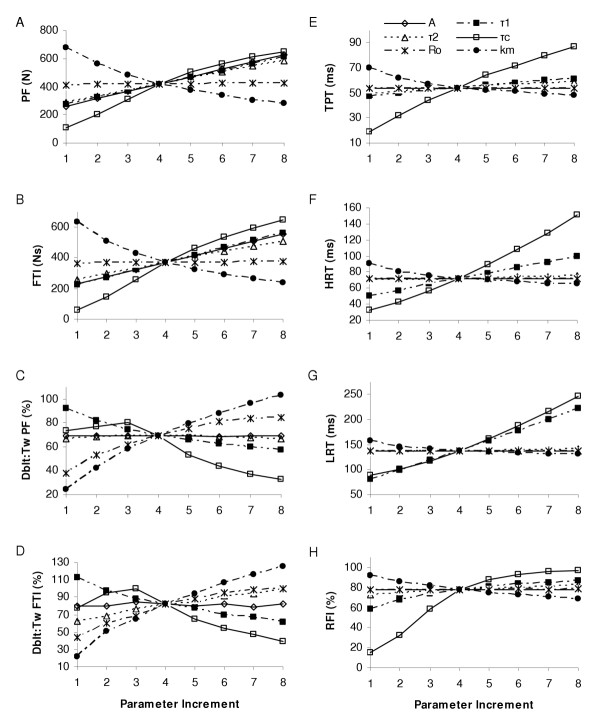
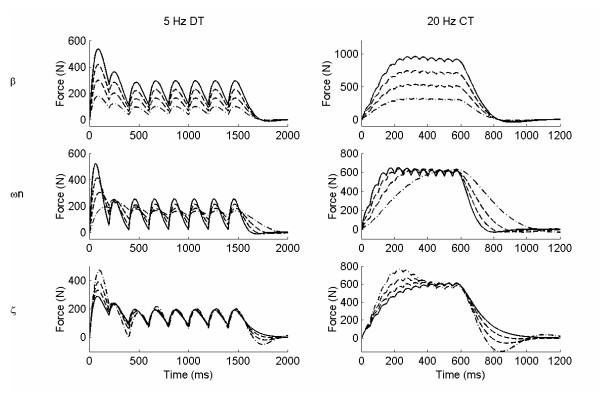
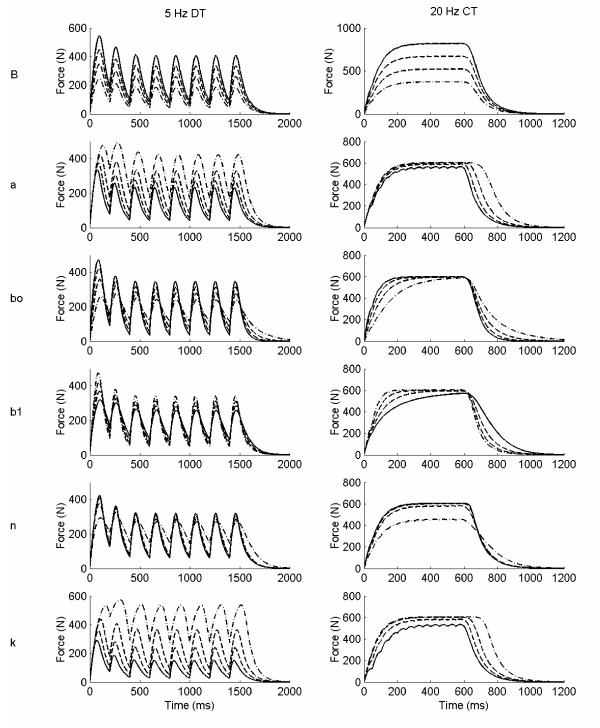
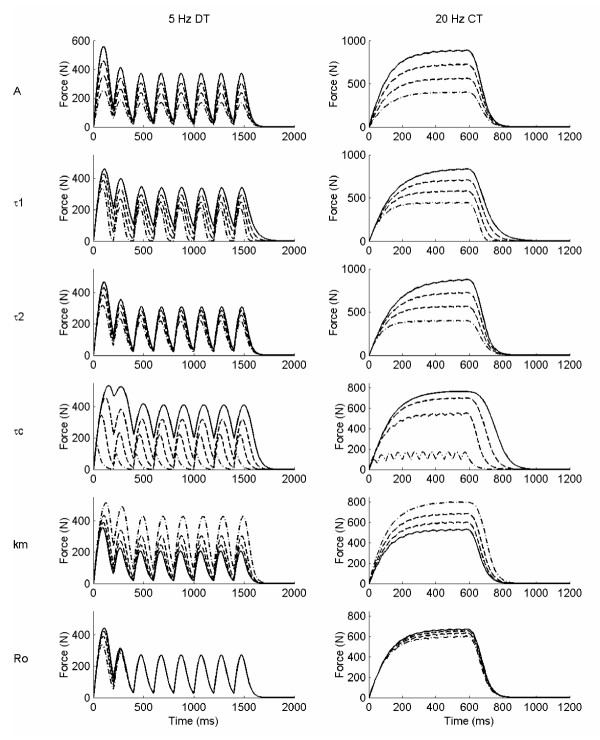
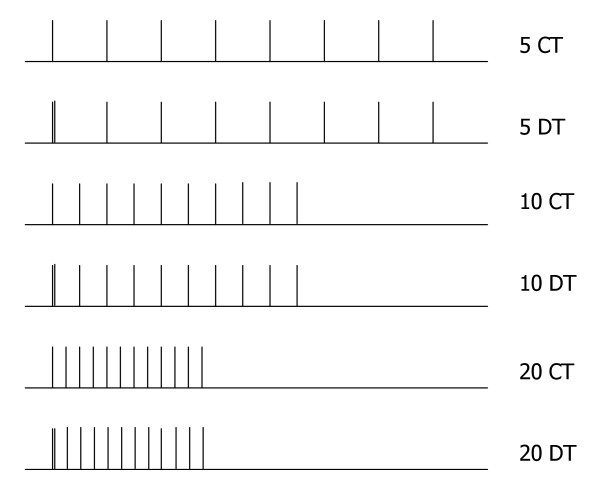
Three mathematical muscle models were compared: a traditional linear model with 3 parameters and two contemporary nonlinear models each with 6 parameters. Simulated muscle forces were calculated for two stimulation patterns (constant frequency and initial doublet trains) at three frequencies (5, 10, and 20 Hz). A sensitivity analysis of each model was performed by altering a single parameter through a range of 8 values, while the remaining parameters were kept at baseline values. Specific simulated force characteristics were determined for each stimulation pattern and each parameter increment. Significant parameter influences for each simulated force property were determined using ANOVA and Tukey's follow-up tests (alpha <or= 0.05), and compared to previously reported parameter definitions.

RESULTS

Each of the 3 linear model's parameters most clearly influence either simulated force magnitude or speed properties, consistent with previous parameter definitions. The nonlinear models' parameters displayed greater redundancy between force magnitude and speed properties. Further, previous parameter definitions for one of the nonlinear models were consistently supported, while the other was only partially supported by this analysis.

CONCLUSION

These three mathematical models use substantially different strategies to represent simulated muscle force. The two contemporary nonlinear models' parameters have the least distinct associations with simulated muscle force properties, and the greatest parameter role redundancy compared to the traditional linear model.

摘要

背景

数学肌肉模型可能有助于确定适当的肌肉骨骼应力,从而在脊髓损伤后安全地维持肌肉和骨骼的完整性。已经提出了几种模型来表示瘫痪肌肉,但尚未对建模方法进行任何系统比较,以更好地理解模型参数与肌肉收缩特性之间的关系。使用三种当前可用的数学模型对模拟肌肉力进行的敏感性分析,有助于深入了解建模策略的差异以及与模拟肌肉力特性的任何直接参数关联。

方法

比较了三种数学肌肉模型:一个具有3个参数的传统线性模型和两个当代非线性模型,每个非线性模型具有6个参数。针对三种频率(5、10和20Hz)下的两种刺激模式(恒定频率和初始双峰序列)计算模拟肌肉力。通过在8个值的范围内改变单个参数来对每个模型进行敏感性分析,而其余参数保持在基线值。针对每种刺激模式和每个参数增量确定特定的模拟力特征。使用方差分析和Tukey后续检验(α≤0.05)确定每个模拟力特性的显著参数影响,并与先前报道的参数定义进行比较。

结果

3个线性模型的每个参数最明显地影响模拟力大小或速度特性,这与先前的参数定义一致。非线性模型的参数在力大小和速度特性之间显示出更大的冗余性。此外,对其中一个非线性模型的先前参数定义得到了一致支持,而另一个仅得到了该分析的部分支持。

结论

这三种数学模型使用截然不同的策略来表示模拟肌肉力。与传统线性模型相比,两个当代非线性模型的参数与模拟肌肉力特性的关联最不明显,且参数作用冗余性最大。
https://cdn.ncbi.nlm.nih.gov/pmc/blobs/2bb6/1175855/ee35279449c6/1743-0003-2-12-7.jpg
https://cdn.ncbi.nlm.nih.gov/pmc/blobs/2bb6/1175855/fd130a8698ac/1743-0003-2-12-1.jpg
https://cdn.ncbi.nlm.nih.gov/pmc/blobs/2bb6/1175855/569b8f05f46a/1743-0003-2-12-2.jpg
https://cdn.ncbi.nlm.nih.gov/pmc/blobs/2bb6/1175855/3b2fd1a13c5c/1743-0003-2-12-3.jpg
https://cdn.ncbi.nlm.nih.gov/pmc/blobs/2bb6/1175855/89e747b2f935/1743-0003-2-12-4.jpg
https://cdn.ncbi.nlm.nih.gov/pmc/blobs/2bb6/1175855/361a6dcffc80/1743-0003-2-12-5.jpg
https://cdn.ncbi.nlm.nih.gov/pmc/blobs/2bb6/1175855/a60160cbad4a/1743-0003-2-12-8.jpg
https://cdn.ncbi.nlm.nih.gov/pmc/blobs/2bb6/1175855/922c6325dff5/1743-0003-2-12-9.jpg
https://cdn.ncbi.nlm.nih.gov/pmc/blobs/2bb6/1175855/88985e15b47a/1743-0003-2-12-6.jpg
https://cdn.ncbi.nlm.nih.gov/pmc/blobs/2bb6/1175855/ee35279449c6/1743-0003-2-12-7.jpg
https://cdn.ncbi.nlm.nih.gov/pmc/blobs/2bb6/1175855/fd130a8698ac/1743-0003-2-12-1.jpg
https://cdn.ncbi.nlm.nih.gov/pmc/blobs/2bb6/1175855/569b8f05f46a/1743-0003-2-12-2.jpg
https://cdn.ncbi.nlm.nih.gov/pmc/blobs/2bb6/1175855/3b2fd1a13c5c/1743-0003-2-12-3.jpg
https://cdn.ncbi.nlm.nih.gov/pmc/blobs/2bb6/1175855/89e747b2f935/1743-0003-2-12-4.jpg
https://cdn.ncbi.nlm.nih.gov/pmc/blobs/2bb6/1175855/361a6dcffc80/1743-0003-2-12-5.jpg
https://cdn.ncbi.nlm.nih.gov/pmc/blobs/2bb6/1175855/a60160cbad4a/1743-0003-2-12-8.jpg
https://cdn.ncbi.nlm.nih.gov/pmc/blobs/2bb6/1175855/922c6325dff5/1743-0003-2-12-9.jpg
https://cdn.ncbi.nlm.nih.gov/pmc/blobs/2bb6/1175855/88985e15b47a/1743-0003-2-12-6.jpg
https://cdn.ncbi.nlm.nih.gov/pmc/blobs/2bb6/1175855/ee35279449c6/1743-0003-2-12-7.jpg

相似文献

1
Mathematical models use varying parameter strategies to represent paralyzed muscle force properties: a sensitivity analysis.数学模型使用不同的参数策略来表示麻痹肌肉的力量特性:一项敏感性分析。
J Neuroeng Rehabil. 2005 May 31;2:12. doi: 10.1186/1743-0003-2-12.
2
Predicting human chronically paralyzed muscle force: a comparison of three mathematical models.预测人类慢性麻痹肌肉力量:三种数学模型的比较
J Appl Physiol (1985). 2006 Mar;100(3):1027-36. doi: 10.1152/japplphysiol.00935.2005. Epub 2005 Nov 23.
3
Mathematical models of human paralyzed muscle after long-term training.长期训练后人类麻痹肌肉的数学模型
J Biomech. 2007;40(12):2587-95. doi: 10.1016/j.jbiomech.2006.12.015. Epub 2007 Feb 20.
4
Development of a mathematical model for predicting electrically elicited quadriceps femoris muscle forces during isovelocity knee joint motion.一种用于预测等速膝关节运动期间电诱发股四头肌肌力的数学模型的开发。
J Neuroeng Rehabil. 2008 Dec 10;5:33. doi: 10.1186/1743-0003-5-33.
5
Fatigue of paralyzed and control thenar muscles induced by variable or constant frequency stimulation.可变或恒定频率刺激诱发的瘫痪和对照鱼际肌疲劳
J Neurophysiol. 2003 Apr;89(4):2055-64. doi: 10.1152/jn.01002.2002. Epub 2002 Dec 11.
6
Mathematical model that predicts the force-intensity and force-frequency relationships after spinal cord injuries.预测脊髓损伤后力强度与力频率关系的数学模型。
Muscle Nerve. 2007 Aug;36(2):214-22. doi: 10.1002/mus.20806.
7
Doublet stimulation protocol to minimize musculoskeletal stress during paralyzed quadriceps muscle testing.双重刺激方案,以在瘫痪股四头肌测试期间将肌肉骨骼压力降至最低。
J Appl Physiol (1985). 2008 Jun;104(6):1574-82. doi: 10.1152/japplphysiol.00892.2007. Epub 2008 Apr 24.
8
Effect of electrical stimulation pattern on the force responses of paralyzed human quadriceps muscles.电刺激模式对瘫痪的人类股四头肌力量反应的影响。
Muscle Nerve. 2007 Apr;35(4):471-8. doi: 10.1002/mus.20717.
9
Contractile properties of single motor units in human toe extensors assessed by intraneural motor axon stimulation.通过神经内运动轴突刺激评估人类趾伸肌单运动单位的收缩特性。
J Neurophysiol. 1996 Jun;75(6):2509-19. doi: 10.1152/jn.1996.75.6.2509.
10
A mathematical model that predicts the force-frequency relationship of human skeletal muscle.一个预测人体骨骼肌力量-频率关系的数学模型。
Muscle Nerve. 2002 Oct;26(4):477-85. doi: 10.1002/mus.10198.

引用本文的文献

1
Applying a muscle fatigue model when optimizing load-sharing between muscles for short-duration high-intensity exercise: A preliminary study.在优化短时间高强度运动中肌肉间负荷分担时应用肌肉疲劳模型:一项初步研究。
Front Physiol. 2023 Apr 24;14:1167748. doi: 10.3389/fphys.2023.1167748. eCollection 2023.
2
Identification of a Modified Wiener-Hammerstein System and Its Application in Electrically Stimulated Paralyzed Skeletal Muscle Modeling.一种改进的维纳-哈默斯坦系统的识别及其在电刺激麻痹骨骼肌建模中的应用。
Automatica (Oxf). 2009 Mar;45(3):736-743. doi: 10.1016/j.automatica.2008.09.023.
3
Development of a mathematical model for predicting electrically elicited quadriceps femoris muscle forces during isovelocity knee joint motion.

本文引用的文献

1
Femoral loads during passive, active, and active-resistive stance after spinal cord injury: a mathematical model.脊髓损伤后被动、主动和主动抗阻站立时的股骨负荷:一个数学模型
Clin Biomech (Bristol). 2004 Mar;19(3):313-21. doi: 10.1016/j.clinbiomech.2003.12.005.
2
Mathematical models for fatigue minimization during functional electrical stimulation.功能性电刺激期间使疲劳最小化的数学模型。
J Electromyogr Kinesiol. 2003 Dec;13(6):575-88. doi: 10.1016/s1050-6411(03)00102-0.
3
A mathematical model that predicts the force-frequency relationship of human skeletal muscle.
一种用于预测等速膝关节运动期间电诱发股四头肌肌力的数学模型的开发。
J Neuroeng Rehabil. 2008 Dec 10;5:33. doi: 10.1186/1743-0003-5-33.
4
Predicting muscle forces of individuals with hemiparesis following stroke.预测中风后偏瘫患者的肌肉力量。
J Neuroeng Rehabil. 2008 Feb 27;5:7. doi: 10.1186/1743-0003-5-7.
5
Mathematical models of human paralyzed muscle after long-term training.长期训练后人类麻痹肌肉的数学模型
J Biomech. 2007;40(12):2587-95. doi: 10.1016/j.jbiomech.2006.12.015. Epub 2007 Feb 20.
6
Predicting human chronically paralyzed muscle force: a comparison of three mathematical models.预测人类慢性麻痹肌肉力量:三种数学模型的比较
J Appl Physiol (1985). 2006 Mar;100(3):1027-36. doi: 10.1152/japplphysiol.00935.2005. Epub 2005 Nov 23.
一个预测人体骨骼肌力量-频率关系的数学模型。
Muscle Nerve. 2002 Oct;26(4):477-85. doi: 10.1002/mus.10198.
4
A predictive fatigue model--II: Predicting the effect of resting times on fatigue.一种预测性疲劳模型——II:预测休息时间对疲劳的影响。
IEEE Trans Neural Syst Rehabil Eng. 2002 Mar;10(1):59-67. doi: 10.1109/TNSRE.2002.1021587.
5
A predictive fatigue model--I: Predicting the effect of stimulation frequency and pattern on fatigue.一种预测性疲劳模型——I:预测刺激频率和模式对疲劳的影响。
IEEE Trans Neural Syst Rehabil Eng. 2002 Mar;10(1):48-58. doi: 10.1109/TNSRE.2002.1021586.
6
Modeling the length dependence of isometric force in human quadriceps muscles.模拟人体股四头肌等长肌力的长度依赖性。
J Biomech. 2002 Jul;35(7):919-30. doi: 10.1016/s0021-9290(02)00049-0.
7
Effects of training on contractile properties of paralyzed quadriceps muscle.训练对瘫痪股四头肌收缩特性的影响。
Muscle Nerve. 2002 Apr;25(4):559-67. doi: 10.1002/mus.10071.
8
Muscular, skeletal, and neural adaptations following spinal cord injury.脊髓损伤后的肌肉、骨骼和神经适应性变化。
J Orthop Sports Phys Ther. 2002 Feb;32(2):65-74. doi: 10.2519/jospt.2002.32.2.65.
9
Phenotypic adaptations in human muscle fibers 6 and 24 wk after spinal cord injury.脊髓损伤后6周和24周人类肌纤维的表型适应性
J Appl Physiol (1985). 2002 Jan;92(1):147-54. doi: 10.1152/japplphysiol.000247.2001.
10
Osteoporosis and risk of fracture in men with spinal cord injury.脊髓损伤男性的骨质疏松症与骨折风险
Spinal Cord. 2001 Apr;39(4):208-14. doi: 10.1038/sj.sc.3101139.