Laidlaw Mark A S, Mielke Howard W, Filippelli Gabriel M, Johnson David L, Gonzales Christopher R
School of Population Health, University of Western Australia, Crawley, Western Australia.
Environ Health Perspect. 2005 Jun;113(6):793-800. doi: 10.1289/ehp.7759.
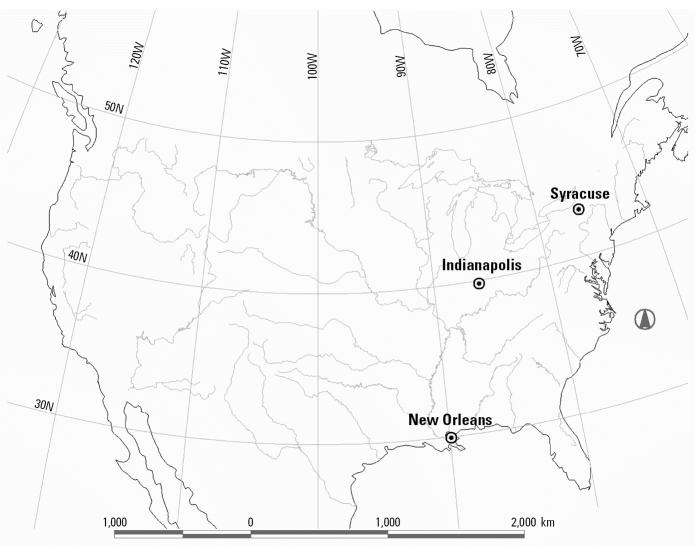
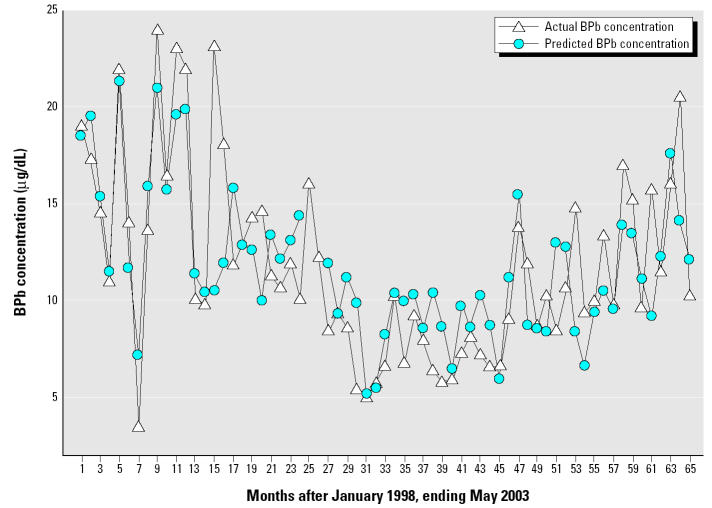
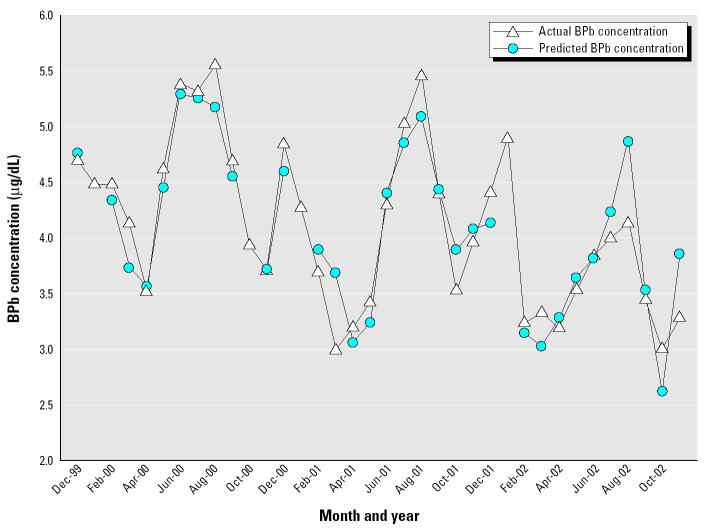
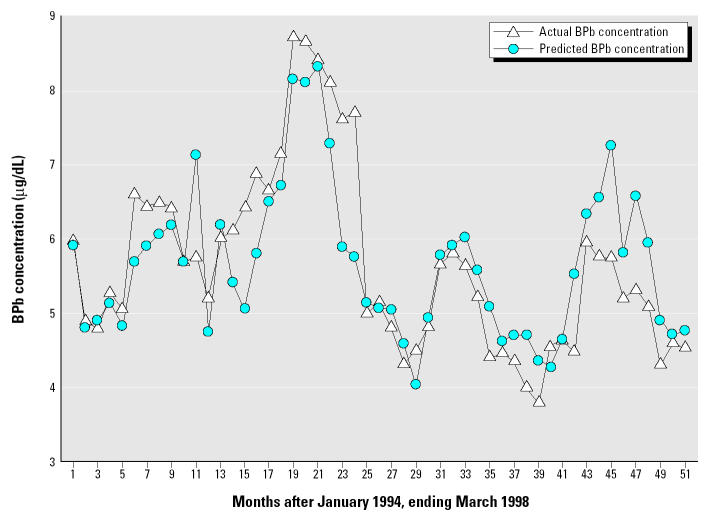
On a community basis, urban soil contains a potentially large reservoir of accumulated lead. This study was undertaken to explore the temporal relationship between pediatric blood lead (BPb), weather, soil moisture, and dust in Indianapolis, Indiana; Syracuse, New York; and New Orleans, Louisiana. The Indianapolis, Syracuse, and New Orleans pediatric BPb data were obtained from databases of 15,969, 14,467, and 2,295 screenings, respectively, collected between December 1999 and November 2002, January 1994 and March 1998, and January 1998 and May 2003, respectively. These average monthly child BPb levels were regressed against several independent variables: average monthly soil moisture, particulate matter < 10 microm in diameter (PM10), wind speed, and temperature. Of temporal variation in urban children's BPb, 87% in Indianapolis (R2 = 0.87, p = 0.0004), 61% in Syracuse (R2 = 0.61, p = 0.0012), and 59% in New Orleans (R2 = 0.59, p = 0.0000078) are explained by these variables. A conceptual model of urban Pb poisoning is suggested: When temperature is high and evapotranspiration maximized, soil moisture decreases and soil dust is deposited. Under these combined weather conditions, Pb-enriched PM10 dust disperses in the urban environment and causes elevated Pb dust loading. Thus, seasonal variation of children's Pb exposure is probably caused by inhalation and ingestion of Pb brought about by the effect of weather on soils and the resulting fluctuation in Pb loading.
从社区层面来看,城市土壤中蓄积着大量潜在的铅。本研究旨在探究印第安纳州印第安纳波利斯市、纽约州锡拉丘兹市和路易斯安那州新奥尔良市儿童血铅水平(BPb)与天气、土壤湿度及灰尘之间的时间关系。印第安纳波利斯市、锡拉丘兹市和新奥尔良市的儿童血铅数据分别取自1999年12月至2002年11月、1994年1月至1998年3月以及1998年1月至2003年5月期间收集的数据库,筛查数量分别为15969例、14467例和2295例。将这些儿童血铅水平的月平均值与几个自变量进行回归分析:月平均土壤湿度、直径小于10微米的颗粒物(PM10)、风速和温度。这些变量解释了印第安纳波利斯市城市儿童血铅水平87%的时间变化(R2 = 0.87,p = 0.0004),锡拉丘兹市的61%(R2 = 0.61,p = 0.0012),以及新奥尔良市的59%(R2 = 0.59,p = 0.0000078)。由此提出了一个城市铅中毒的概念模型:当温度较高且蒸散作用达到最大值时,土壤湿度降低,土壤灰尘沉积。在这些综合天气条件下,富含铅的PM10灰尘在城市环境中扩散,导致铅尘负荷增加。因此,儿童铅暴露的季节性变化可能是由于天气对土壤的影响以及由此导致的铅负荷波动,使得儿童吸入和摄入铅所致。