Samuels Noah
Maccabi Healthcare Services, 130 Rachmilevich Street, Jerusalem 97791, Israel.
BMC Public Health. 2005 Jun 6;5:60. doi: 10.1186/1471-2458-5-60.
Viral hepatitis is highly endemic in Israel, with the hepatitis A virus (HAV) responsible for most cases. Improved socioeconomic factors, as well as the universal vaccination of infants (introduced in 1999) has resulted in a decline in infection rates in Israel. This study examines the benefits of routine testing for anti-HAV IgG in high-risk population.
A retrospective examination of the files of teenage and adult patients (aged 16-99 years; mean 33.9) in two primary care clinics found 1,017 patients who had been tested for anti-HAV IgG antibodies for either general healthcare screening or ongoing follow-up for chronic illness. Seropositive patients were then asked regarding recall of past hepatitis (i.e. jaundice, regardless of viral etiology); post-exposure prophylaxis with immune serum immunoglobulin (ISG); and active immunization with inactivated virus. Seronegative patients were subsequently sent for active immunization.
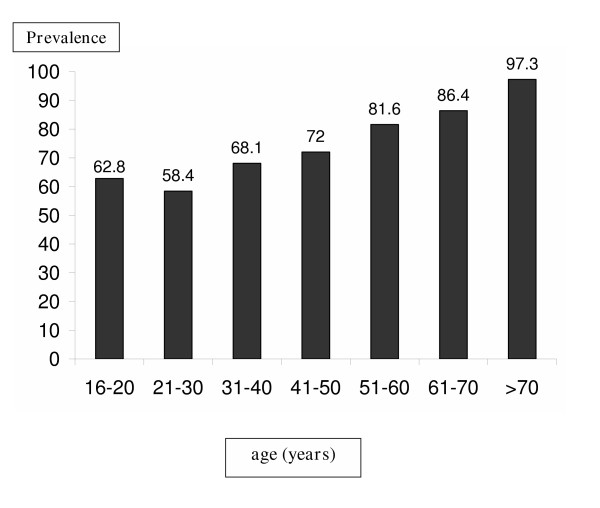
Of the 1,017 patient records studied (503 male, 514 female), a total of 692 were seropositive (354 males, 338 females; P = 0.113). Seropositivity rates increased with age (p < 0.005), and were highest among those born in Middle Eastern countries other than Israel (91.3%) and lowest among immigrants from South America (44.1%; P < 0.005). 456 of the seropositive patients were interviewed, of whom only 91 recalled past illness while 103 remembered receiving post-exposure prophylaxis (ISG) and 8 active vaccination. Those who were unaware of past infection were more likely to have been vaccinated with ISG than those who were aware (26.3% vs. 7.7%; p < 0.005).
The relatively high prevalence rate of anti-HAV seropositivity in our study may me due to the fact that the study was conducted in a primary care clinic or that it took place in Jerusalem, a relatively poor and densely populated Israeli city. Most of the seropostive patients had no recollection of prior infection, which can be explained by the fact that most hepatitis A infections occur during childhood and are asymptomatic. Routine testing for anti-HAV IgG in societies endemic for HAV would help prevent seropositive patients from receiving either post-exposure or preventive immunization and target seronegative patients for preventive vaccination.
病毒性肝炎在以色列高度流行,大多数病例由甲型肝炎病毒(HAV)引起。社会经济因素的改善以及婴儿普遍接种疫苗(1999年开始)导致以色列的感染率有所下降。本研究探讨了在高危人群中常规检测抗-HAV IgG的益处。
对两家初级保健诊所中青少年和成年患者(年龄16 - 99岁;平均33.9岁)的病历进行回顾性检查,发现1017名患者因一般健康筛查或慢性病持续随访而接受了抗-HAV IgG抗体检测。然后询问血清阳性患者是否记得过去患过肝炎(即黄疸,无论病毒病因);是否接受过免疫血清免疫球蛋白(ISG)的暴露后预防;以及是否接种过灭活病毒的主动免疫。随后将血清阴性患者送去进行主动免疫。
在研究的1017份患者记录中(503名男性,514名女性),共有692人血清呈阳性(354名男性,338名女性;P = 0.113)。血清阳性率随年龄增长而升高(p < 0.005), 在出生于以色列以外中东国家的人群中最高(91.3%),在来自南美洲的移民中最低(44.1%;P < 0.005)。对692名血清阳性患者中的456人进行了访谈,其中只有91人记得过去患过病,103人记得接受过暴露后预防(ISG),8人记得接受过主动免疫。不知道过去感染的人比知道的人更有可能接受过ISG疫苗接种(26.3%对7.7%;p < 0.005)。
我们研究中抗-HAV血清阳性率相对较高,可能是因为研究在初级保健诊所进行,或者是在耶路撒冷这个相对贫穷且人口密集的以色列城市进行。大多数血清阳性患者不记得以前感染过,这可以用大多数甲型肝炎感染发生在儿童期且无症状来解释。在甲型肝炎流行的社会中,常规检测抗-HAV IgG将有助于防止血清阳性患者接受暴露后或预防性免疫,并将血清阴性患者作为预防性疫苗接种的目标人群。