Liu Jidong, Valencia-Sanchez Marco Antonio, Hannon Gregory J, Parker Roy
Cold Spring Harbor Laboratory, Watson School of Biological Sciences, 1 Bungtown Road, Cold Spring Harbor, NY 11724, USA.
Nat Cell Biol. 2005 Jul;7(7):719-23. doi: 10.1038/ncb1274. Epub 2005 Jun 5.
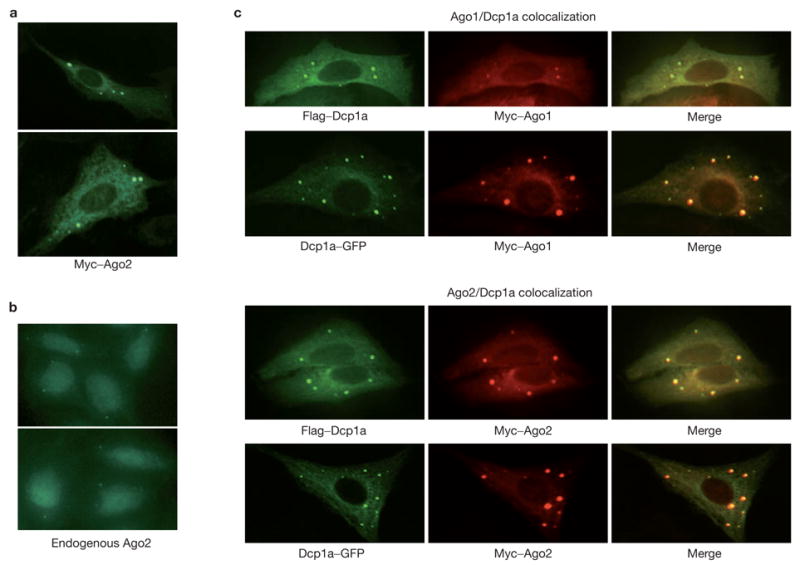
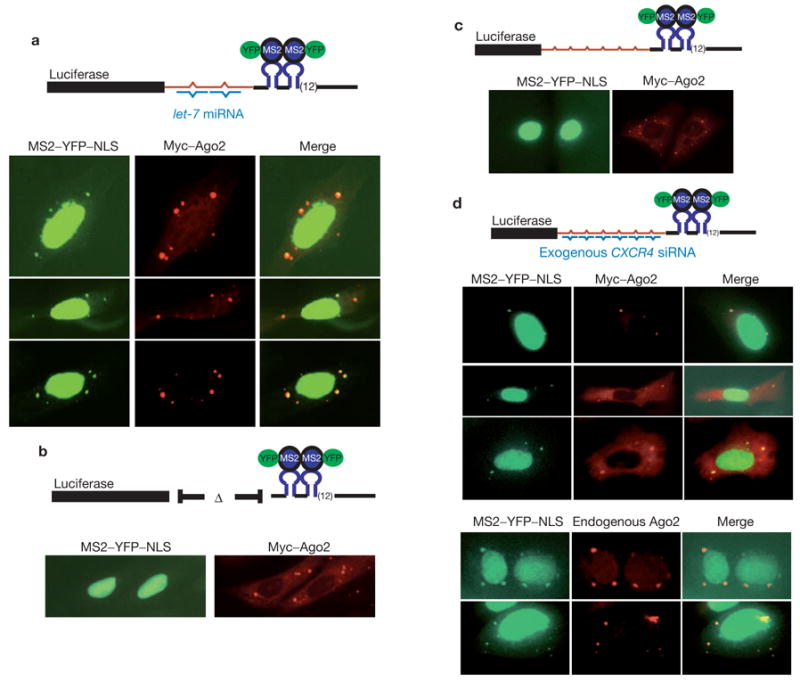
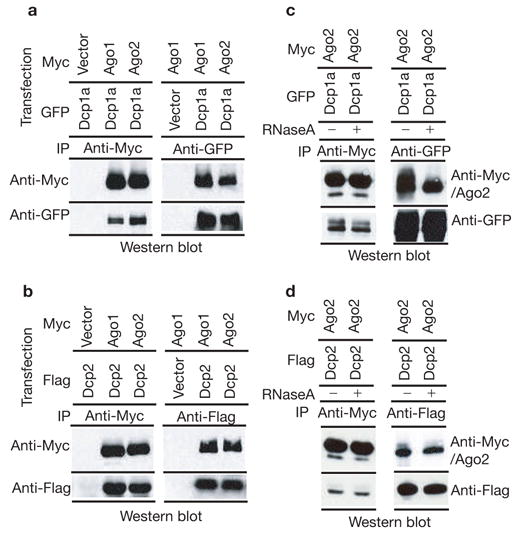
Small RNAs, including small interfering RNAs (siRNAs) and microRNAs (miRNAs) can silence target genes through several different effector mechanisms. Whereas siRNA-directed mRNA cleavage is increasingly understood, the mechanisms by which miRNAs repress protein synthesis are obscure. Recent studies have revealed the existence of specific cytoplasmic foci, referred to herein as processing bodies (P-bodies), which contain untranslated mRNAs and can serve as sites of mRNA degradation. Here we demonstrate that Argonaute proteins--the signature components of the RNA interference (RNAi) effector complex, RISC--localize to mammalian P-bodies. Moreover, reporter mRNAs that are targeted for translational repression by endogenous or exogenous miRNAs become concentrated in P-bodies in a miRNA-dependent manner. These results provide a link between miRNA function and mammalian P-bodies and suggest that translation repression by RISC delivers mRNAs to P-bodies, either as a cause or as a consequence of inhibiting protein synthesis.
小RNA,包括小干扰RNA(siRNA)和微小RNA(miRNA),可通过几种不同的效应机制使靶基因沉默。虽然人们对siRNA介导的mRNA切割的理解越来越深入,但miRNA抑制蛋白质合成的机制仍不清楚。最近的研究揭示了特定细胞质聚集体的存在,本文将其称为加工小体(P小体),其中含有未翻译的mRNA,可作为mRNA降解的场所。在这里,我们证明了AGO蛋白——RNA干扰(RNAi)效应复合物RISC的标志性组分——定位于哺乳动物的P小体。此外,被内源性或外源性miRNA靶向进行翻译抑制的报告mRNA以miRNA依赖的方式聚集在P小体中。这些结果在miRNA功能与哺乳动物P小体之间建立了联系,并表明RISC介导的翻译抑制将mRNA输送到P小体,这可能是抑制蛋白质合成的原因或结果。