Selim Magdy, Savitz Sean, Linfante Italo, Caplan Louis, Schlaug Gottfried
Department of Neurology, Beth Israel Deaconess Medical Center, Boston, USA.
BMC Neurol. 2005 Jun 10;5(1):10. doi: 10.1186/1471-2377-5-10.
Recent trials suggest that angiotensin-converting enzyme inhibitors (ACEI) are effective in prevention of ischemic stroke, as measured by reduced stroke incidence. We aimed to compare stroke severity between stroke patients who were taking ACEI before their stroke onset and those who were not, to examine the effects of pretreatment with ACEI on ischemic stroke severity.
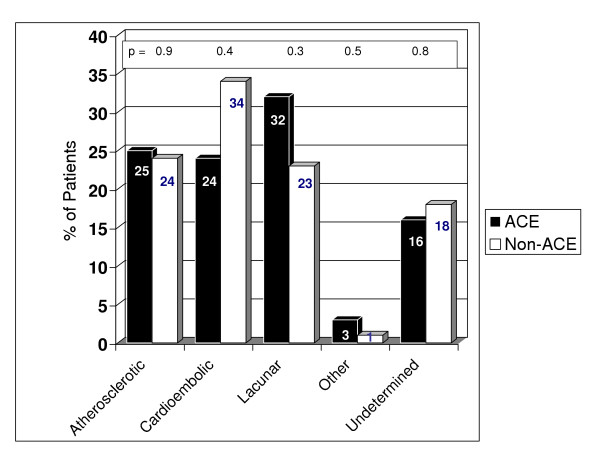
We retrospectively studied 126 consecutive patients presenting within 24 hours of ischemic stroke onset, as confirmed by diffusion-weighted magnetic resonance imaging (DWI). We calculated the NIHSS score at presentation, as the primary measure of clinical stroke severity, and categorized stroke severity as mild (NIHSS [less than or equal to] 7), moderate (NIHSS 8-13) or severe (NIHSS [greater than or equal to] 14). We analyzed demographic data, risk-factor profile, blood pressure (BP) and medications on admissions, and determined stroke mechanism according to TOAST criteria. We also measured the volumes of admission diffusion- and perfusion-weighted (DWI /PWI) magnetic resonance imaging lesions, as a secondary measure of ischemic tissue volume. We compared these variables among patients on ACEI and those who were not.
Thirty- three patients (26%) were on ACE-inhibitors. The overall median baseline NIHSS score was 5.5 (range 2-21) among ACEI-treated patients vs. 9 (range 1-36) in non-ACEI patients (p = 0.036). Patients on ACEI prior to their stroke had more mild and less severe strokes, and smaller DWI and PWI lesion volumes compared to non-ACEI treated patients. However, none of these differences were significant. Predictably, a higher percentage of patients on ACEI had a history of heart failure (p = 0.03). Age, time-to-imaging or neurological evaluation, risk-factor profile, concomitant therapy with lipid lowering, other antihypertensives or antithrombotic agents, or admission BP were comparable between the two groups.
Our results suggest that ACE-inhibitors may reduce the clinical severity of stroke, as measured by NIHSS score. Further, larger-scale, prospective studies are needed to validate our findings, and to elucidate the mechanism(s) of ACEImediated benefits in patients with ischemic stroke.
近期试验表明,血管紧张素转换酶抑制剂(ACEI)在预防缺血性卒中方面有效,衡量标准为卒中发病率降低。我们旨在比较卒中发作前服用ACEI的卒中患者与未服用者之间的卒中严重程度,以研究ACEI预处理对缺血性卒中严重程度的影响。
我们回顾性研究了126例在缺血性卒中发作24小时内就诊的连续患者,经弥散加权磁共振成像(DWI)确诊。我们计算了就诊时的美国国立卫生研究院卒中量表(NIHSS)评分,作为临床卒中严重程度的主要衡量指标,并将卒中严重程度分为轻度(NIHSS≤7)、中度(NIHSS 8 - 13)或重度(NIHSS≥14)。我们分析了人口统计学数据、危险因素概况、入院时的血压(BP)和用药情况,并根据TOAST标准确定卒中机制。我们还测量了入院时弥散加权和灌注加权(DWI/PWI)磁共振成像病变的体积,作为缺血组织体积的次要衡量指标。我们比较了服用ACEI的患者和未服用者之间的这些变量。
33例患者(26%)服用ACE抑制剂。ACEI治疗组患者的总体基线NIHSS评分中位数为5.5(范围2 - 21),未服用ACEI组患者为9(范围1 - 36)(p = 0.036)。与未接受ACEI治疗的患者相比,卒中发作前服用ACEI的患者轻度卒中更多、重度卒中更少,DWI和PWI病变体积更小。然而,这些差异均无统计学意义。不出所料,服用ACEI的患者中心力衰竭病史的比例更高(p = 0.03)。两组在年龄、成像或神经学评估时间、危险因素概况、降脂、其他抗高血压或抗血栓药物的联合治疗或入院血压方面具有可比性。
我们的结果表明,ACE抑制剂可能会降低以NIHSS评分衡量的卒中临床严重程度。此外,需要进行更大规模的前瞻性研究来验证我们的发现,并阐明ACEI对缺血性卒中患者有益的机制。