Presta Ivan, Arturi Franco, Ferretti Elisabetta, Mattei Tiziana, Scarpelli Daniela, Tosi Emanuele, Scipioni Angela, Celano Marilena, Gulino Alberto, Filetti Sebastiano, Russo Diego
Dipartimento di Medicina Sperimentale e Clinica G. Salvatore, University of Catanzaro Magna Graecia, Catanzaro, Italy.
BMC Cancer. 2005 Jul 19;5:80. doi: 10.1186/1471-2407-5-80.
Recovery of iodide uptake in thyroid cancer cells by means of obtaining the functional expression of the sodium/iodide symporter (NIS) represents an innovative strategy for the treatment of poorly differentiated thyroid cancer. However, the NIS gene expression alone is not always sufficient to restore radioiodine concentration ability in these tumour cells.
In this study, the anaplastic thyroid carcinoma ARO cells were stably transfected with a Pax8 gene expression vector. A quantitative RT-PCR was performed to assess the thyroid specific gene expression in selected clones. The presence of NIS protein was detected by Western blot and localized by immunofluorescence. A iodide uptake assay was also performed to verify the functional effect of NIS induction and differentiation switch.
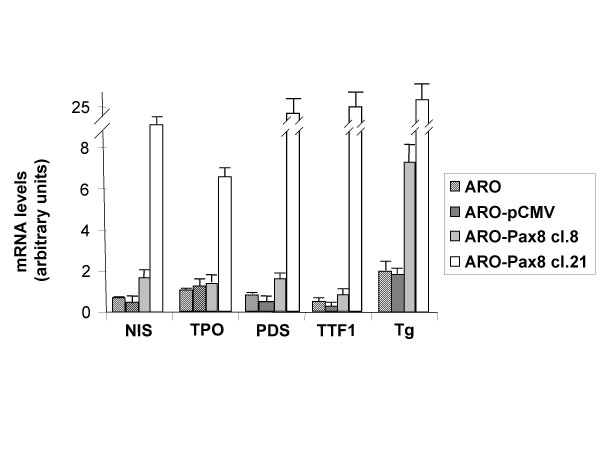
The clones overexpressing Pax8 showed the re-activation of several thyroid specific genes including NIS, Pendrin, Thyroglobulin, TPO and TTF1. In ARO-Pax8 clones NIS protein was also localized both in cell cytoplasm and membrane. Thus, the ability to uptake the radioiodine was partially restored, associated to a high rate of efflux. In addition, ARO cells expressing Pax8 presented a lower rate of cell growth.
These finding demonstrate that induction of Pax8 expression may determine a re-differentiation of thyroid cancer cells, including a partial recovery of iodide uptake, fundamental requisite for a radioiodine-based therapeutic approach for thyroid tumours.
通过获得钠/碘同向转运体(NIS)的功能表达来恢复甲状腺癌细胞对碘的摄取,是治疗低分化甲状腺癌的一种创新策略。然而,仅NIS基因表达并不总是足以恢复这些肿瘤细胞摄取放射性碘的能力。
在本研究中,将Pax8基因表达载体稳定转染至间变性甲状腺癌ARO细胞。进行定量逆转录聚合酶链反应(RT-PCR)以评估所选克隆中甲状腺特异性基因的表达。通过蛋白质免疫印迹法检测NIS蛋白的存在,并通过免疫荧光法进行定位。还进行了碘摄取试验以验证NIS诱导和分化转换的功能效应。
过表达Pax8的克隆显示出几种甲状腺特异性基因的重新激活,包括NIS、Pendrin、甲状腺球蛋白、甲状腺过氧化物酶(TPO)和甲状腺转录因子1(TTF1)。在ARO-Pax8克隆中,NIS蛋白也定位于细胞质和细胞膜。因此,摄取放射性碘的能力部分恢复,但伴有高外流率。此外,表达Pax8的ARO细胞呈现较低的细胞生长速率。
这些发现表明,Pax8表达的诱导可能决定甲状腺癌细胞的再分化,包括碘摄取的部分恢复,这是基于放射性碘的甲状腺肿瘤治疗方法的基本必要条件。