Van der Auwera Géraldine A, Andrup Lars, Mahillon Jacques
Université Catholique de Louvain, Croix du Sud 2/12, B-1348 Louvain-la-Neuve, Belgium.
BMC Genomics. 2005 Jul 26;6:103. doi: 10.1186/1471-2164-6-103.
Bacillus cereus, Bacillus anthracis and Bacillus thuringiensis belong to the genetically close-knit Bacillus cereus sensu lato group, a family of rod-shaped Gram-positive bacteria. pAW63 is the first conjugative plasmid from the B. cereus group to be completely sequenced.
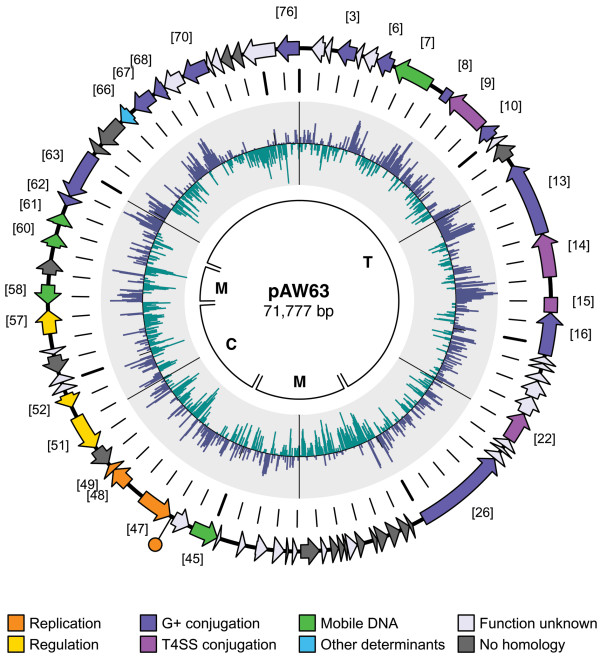
The 71,777 bp nucleotide sequence of pAW63 reveals a modular structure, including a 42 kb tra region encoding homologs of the Type IV secretion systems components VirB11, VirB4 and VirD4, as well as homologs of Gram-positive conjugation genes from Enterococcus, Lactococcus, Listeria, Streptococcus and Staphylococcus species. It also firmly establishes the existence of a common backbone between pAW63, pXO2 from Bacillus anthracis and pBT9727 from the pathogenic Bacillus thuringiensis serovar konkukian strain 97-27. The alignment of these three plasmids highlights the presence of well conserved segments, in contrast to distinct regions of high sequence plasticity. The study of their specific differences has provided a three-point reference framework that can be exploited to formulate solid hypotheses concerning the functionalities and the molecular evolution of these three closely related plasmids. This has provided insight into the chronology of their divergence, and led to the discovery of two Type II introns on pAW63, matching copies of the mobile element IS231L in different loci of pXO2 and pBT9727, and the identification on pXO2 of a 37 kb pathogenicity island (PAI) containing the anthrax capsule genes.
The complete sequence determination of pAW63 has led to a functional map of the plasmid yielding insights into its conjugative apparatus, which includes T4SS-like components, as well as its resemblance to other large plasmids of Gram-positive bacteria. Of particular interest is the extensive homology shared between pAW63 and pXO2, the second virulence plasmid of B. anthracis, as well as pBT9727 from the pathogenic strain B. thuringiensis serovar konkukian strain 97-27.
蜡样芽孢杆菌、炭疽芽孢杆菌和苏云金芽孢杆菌属于亲缘关系密切的蜡样芽孢杆菌广义组,这是一类杆状革兰氏阳性细菌家族。pAW63是蜡样芽孢杆菌组中首个被完全测序的接合质粒。
pAW63的71777 bp核苷酸序列显示出模块化结构,包括一个42 kb的tra区域,该区域编码IV型分泌系统组件VirB11、VirB4和VirD4的同源物,以及来自肠球菌、乳球菌、李斯特菌、链球菌和葡萄球菌属革兰氏阳性菌接合基因的同源物。它还明确证实了pAW63、炭疽芽孢杆菌的pXO2和致病性苏云金芽孢杆菌血清型 konkukian菌株97 - 27的pBT9727之间存在共同的主干。这三个质粒的比对突出了保守片段的存在,与之形成对比的是具有高度序列可塑性的不同区域。对它们特定差异的研究提供了一个三点参考框架,可用于就这三个密切相关质粒的功能和分子进化提出可靠的假设。这为它们的分歧时间顺序提供了见解,并导致在pAW63上发现了两个II型内含子,与pXO2和pBT9727不同位点的移动元件IS231L的匹配拷贝相匹配,以及在pXO2上鉴定出一个包含炭疽荚膜基因的37 kb致病岛(PAI)。
pAW63的完整序列测定产生了该质粒的功能图谱,从而深入了解其接合装置,该装置包括类似IV型分泌系统的组件,以及它与革兰氏阳性菌其他大质粒的相似性。特别值得关注的是pAW63与炭疽芽孢杆菌的第二个毒力质粒pXO2以及致病性苏云金芽孢杆菌血清型konkukian菌株97 - 27的pBT9727之间广泛的同源性。