Metpally Raghu Prasad Rao, Sowdhamini Ramanathan
National Centre for Biological Sciences, Tata Institute of Fundamental Research, UAS-GKVK Campus, Bellary Road, Bangalore 560065, INDIA.
BMC Genomics. 2005 Aug 10;6:106. doi: 10.1186/1471-2164-6-106.
The cell-membrane G-protein coupled receptors (GPCRs) are one of the largest known superfamilies and are the main focus of intense pharmaceutical research due to their key role in cell physiology and disease. A large number of putative GPCRs are 'orphans' with no identified natural ligands. The first step in understanding the function of orphan GPCRs is to identify their ligands. Phylogenetic clustering methods were used to elucidate the chemical nature of receptor ligands, which led to the identification of natural ligands for many orphan receptors. We have clustered human and Drosophila receptors with known ligands and orphans through cross genome phylogenetic analysis and hypothesized higher relationship of co-clustered members that would ease ligand identification, as related receptors share ligands with similar structure or class.
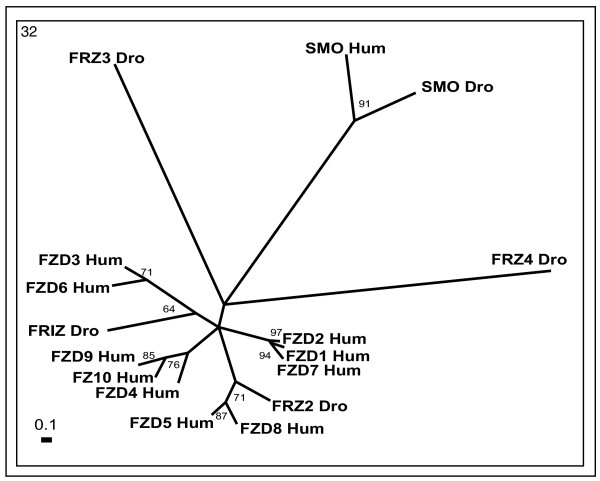
Cross-genome phylogenetic analyses were performed to identify eight major groups of GPCRs dividing them into 32 clusters of 371 human and 113 Drosophila proteins (excluding olfactory, taste and gustatory receptors) and reveal unexpected levels of evolutionary conservation across human and Drosophila GPCRs. We also observe that members of human chemokine receptors, involved in immune response, and most of nucleotide-lipid receptors (except opsins) do not have counterparts in Drosophila. Similarly, a group of Drosophila GPCRs (methuselah receptors), associated in aging, is not present in humans.
Our analysis suggests ligand class association to 52 unknown Drosophila receptors and 95 unknown human GPCRs. A higher level of phylogenetic organization was revealed in which clusters with common domain architecture or cellular localization or ligand structure or chemistry or a shared function are evident across human and Drosophila genomes. Such analyses will prove valuable for identifying the natural ligands of Drosophila and human orphan receptors that can lead to a better understanding of physiological and pathological roles of these receptors.
细胞膜G蛋白偶联受体(GPCRs)是已知最大的超家族之一,由于其在细胞生理学和疾病中的关键作用,成为药物研究的主要焦点。大量假定的GPCRs是“孤儿”受体,尚未鉴定出天然配体。理解孤儿GPCRs功能的第一步是鉴定其配体。系统发育聚类方法被用于阐明受体配体的化学性质,从而鉴定出许多孤儿受体的天然配体。我们通过跨基因组系统发育分析,将具有已知配体的人类和果蝇受体与孤儿受体进行聚类,并假设共同聚类成员之间具有更高的相关性,这将有助于配体鉴定,因为相关受体共享结构或类别相似的配体。
进行跨基因组系统发育分析,以鉴定GPCRs的八个主要类别,将其分为32个簇,包含371个人类蛋白和113个果蝇蛋白(不包括嗅觉、味觉和味觉受体),并揭示了人类和果蝇GPCRs之间意想不到的进化保守水平。我们还观察到,参与免疫反应的人类趋化因子受体成员以及大多数核苷酸 - 脂质受体(视蛋白除外)在果蝇中没有对应物。同样,一组与衰老相关的果蝇GPCRs(玛士撒拉受体)在人类中不存在。
我们的分析表明配体类别与52个未知的果蝇受体和95个未知的人类GPCRs相关。揭示了更高水平的系统发育组织,其中在人类和果蝇基因组中,具有共同结构域结构、细胞定位、配体结构或化学性质或共享功能的簇很明显。这种分析对于鉴定果蝇和人类孤儿受体的天然配体将是有价值的,这有助于更好地理解这些受体的生理和病理作用。