Törnblom Susanne Abelin, Maul Holger, Klimaviciute Aurelija, Garfield Robert E, Byström Birgitta, Malmström Anders, Ekman-Ordeberg Gunvor
Division of Obstetrics and Gynaecology, Department of Woman and Child Health, Karolinska University Hospital, Karolinska Institute, 171 76 Stockholm, Sweden.
Reprod Biol Endocrinol. 2005 Aug 10;3:33. doi: 10.1186/1477-7827-3-33.
Preterm birth is the primary cause of the neonatal mortality and morbidity. There will be no preterm birth without a cervical softening. Nitric oxide (NO) is shown to be a mediator of term cervical ripening. The aim of this study was to investigate mRNA expression of the three isomers of NO synthases (NOS) and to identify them by immunohistochemistry in the human cervix at preterm birth compared to term.
The three isomers of NOS--inducible (iNOS), endothelial (eNOS) and neuronal (bNOS)--were investigated in the human cervix. The expression of mRNA was determined using Real-Time Multiplex RT-PCR. The localisation of synthases in the cervical tissue was analysed using immunohistochemistry. Cervical biopsies were obtained from 4 groups of women without clinical signs of infection: preterm (PTL), term labour (TL), preterm not in labour (PTnotL) and term not in labour (TnotL) patients. One-Way ANOVA, Kruskal-Wallis, Student t-test or Mann-Whitney test were applied as appropriate to determine statistically significant differences among the groups.
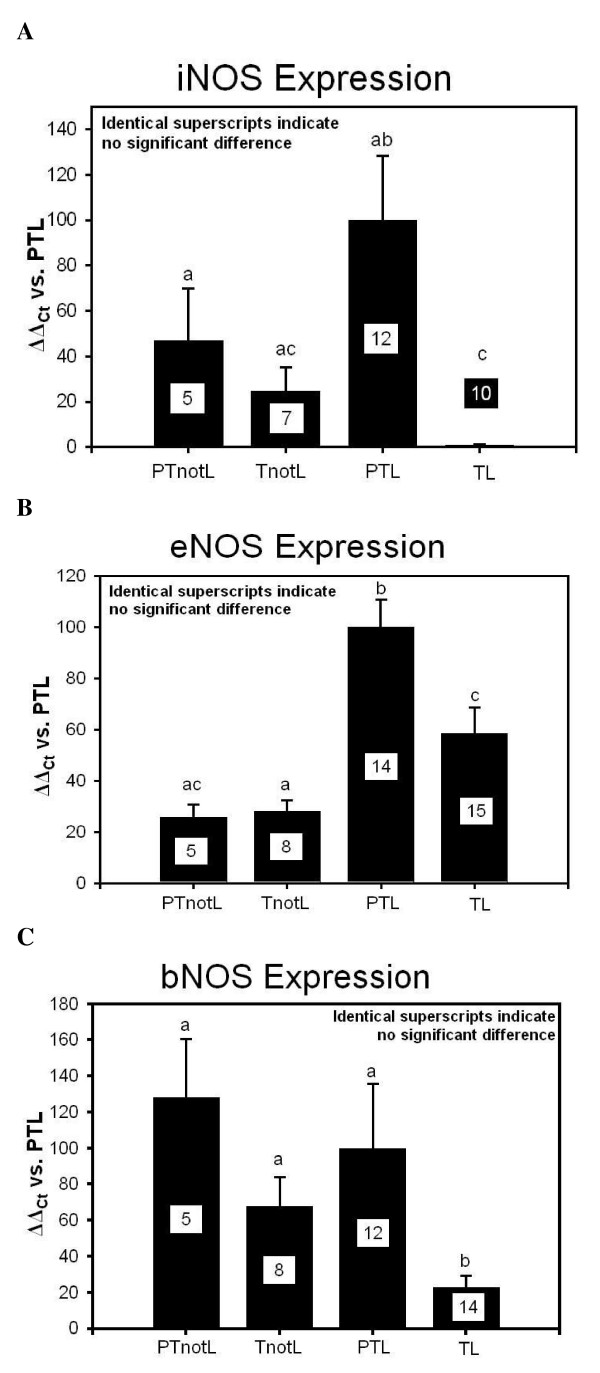
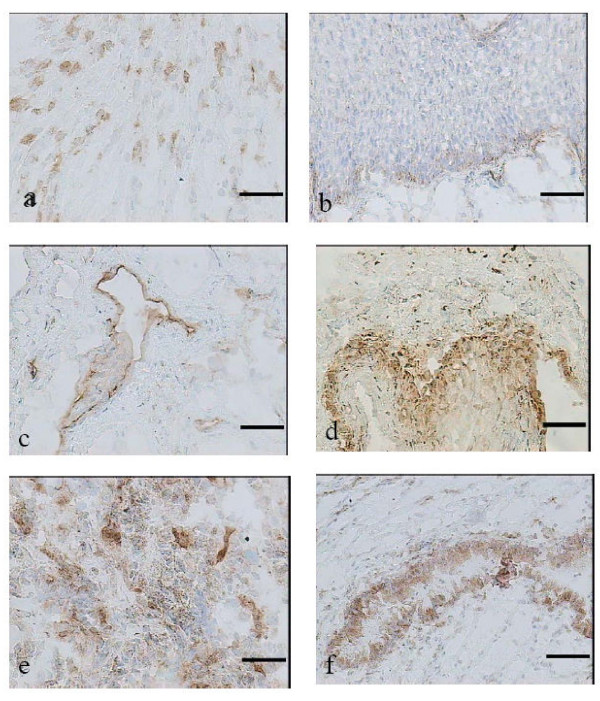
Patients in preterm labour had significantly (p < 0.01) higher mRNA levels of all the three NOS isomers compared to those in term labour. Women not in labour, irrespective of gestational age, thus with unripe cervices, had significantly lower eNOS mRNA levels compared to those in labour (p < 0.01). Immunoreactivity for all three NO synthases was observed in each examined sample in all groups. The bNOS staining was the most prominent.
The mRNA levels were higher in the preterm labour group compared to the women at term labour. The significant increase of the eNOS mRNA expression, from the unripe to the favourable cervical state during labour, may indicate a role of eNOS and supports the role of NO in the cervical ripening process. All the three synthases were identified by immunohistochemistry in all the groups of study.
早产是新生儿死亡和发病的主要原因。没有宫颈软化就不会发生早产。一氧化氮(NO)被证明是足月宫颈成熟的介质。本研究的目的是调查一氧化氮合酶(NOS)三种异构体的mRNA表达,并通过免疫组织化学在早产与足月时的人宫颈中对其进行鉴定。
在人宫颈中研究NOS的三种异构体——诱导型(iNOS)、内皮型(eNOS)和神经型(bNOS)。使用实时多重逆转录聚合酶链反应(Real-Time Multiplex RT-PCR)测定mRNA的表达。使用免疫组织化学分析合酶在宫颈组织中的定位。从4组无感染临床体征的女性中获取宫颈活检组织:早产(PTL)、足月分娩(TL)、未临产的早产(PTnotL)和未临产的足月(TnotL)患者。根据情况应用单因素方差分析、Kruskal-Wallis检验、学生t检验或Mann-Whitney检验来确定各组之间的统计学显著差异。
与足月分娩的患者相比,早产患者的所有三种NOS异构体的mRNA水平均显著升高(p < 0.01)。无论孕周如何,未临产的女性,即宫颈未成熟的女性,其eNOS mRNA水平显著低于临产女性(p < 0.01)。在所有组的每个检测样本中均观察到所有三种NO合酶的免疫反应性。bNOS染色最为明显。
与足月分娩的女性相比,早产组的mRNA水平更高。eNOS mRNA表达从未成熟到临产时有利的宫颈状态显著增加,这可能表明eNOS的作用,并支持NO在宫颈成熟过程中的作用。通过免疫组织化学在所有研究组中均鉴定出所有三种合酶。