• 文献检索
  • 文档翻译
  • 深度研究
  • 学术资讯
  • Suppr Zotero 插件Zotero 插件
  • 邀请有礼
  • 套餐&价格
  • 历史记录
应用&插件
Suppr Zotero 插件Zotero 插件浏览器插件Mac 客户端Windows 客户端微信小程序
定价
高级版会员购买积分包购买API积分包
服务
文献检索文档翻译深度研究API 文档MCP 服务
关于我们
关于 Suppr公司介绍联系我们用户协议隐私条款
关注我们

Suppr 超能文献

核心技术专利:CN118964589B侵权必究
粤ICP备2023148730 号-1Suppr @ 2026

文献检索

告别复杂PubMed语法,用中文像聊天一样搜索,搜遍4000万医学文献。AI智能推荐,让科研检索更轻松。

立即免费搜索

文件翻译

保留排版,准确专业,支持PDF/Word/PPT等文件格式,支持 12+语言互译。

免费翻译文档

深度研究

AI帮你快速写综述,25分钟生成高质量综述,智能提取关键信息,辅助科研写作。

立即免费体验

从动脉脉搏记录中识别和分离搏动的算法。

Algorithm for identifying and separating beats from arterial pulse records.

作者信息

Treo Ernesto F, Herrera Myriam C, Valentinuzzi Max E

机构信息

Departamento de Bioingeniería, Instituto Superior de Investigaciones Biológicas, Consejo Nacional de Investigaciones Científicas y Técnicas, Universidad Nacional de Tucumán, Argentina.

出版信息

Biomed Eng Online. 2005 Aug 11;4:48. doi: 10.1186/1475-925X-4-48.

DOI:10.1186/1475-925X-4-48
PMID:16095532
原文链接:https://pmc.ncbi.nlm.nih.gov/articles/PMC1215493/
Abstract

BACKGROUND

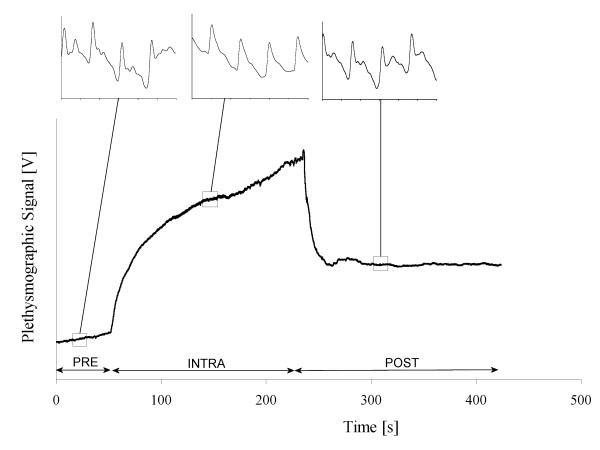
This project was designed as an epidemiological aid-selecting tool for a small country health center with the general objective of screening out possible coronary patients. Peripheral artery function can be non-invasively evaluated by impedance plethysmography. Changes in these vessels appear as good predictors of future coronary behavior. Impedance plethysmography detects volume variations after simple occlusive maneuvers that may show indicative modifications in arterial/venous responses. Averaging of a series of pulses is needed and this, in turn, requires proper determination of the beginning and end of each beat. Thus, the objective here is to describe an algorithm to identify and separate out beats from a plethysmographic record. A secondary objective was to compare the output given by human operators against the algorithm.

METHODS

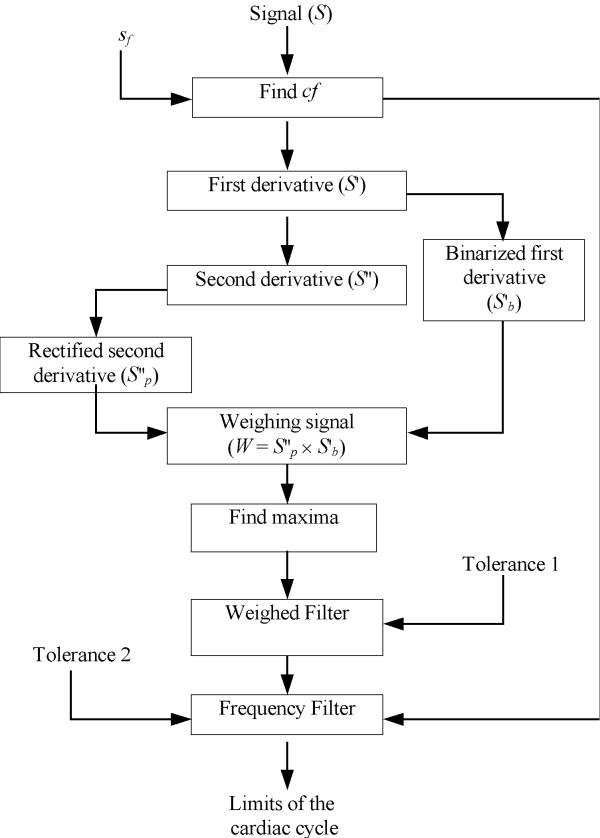
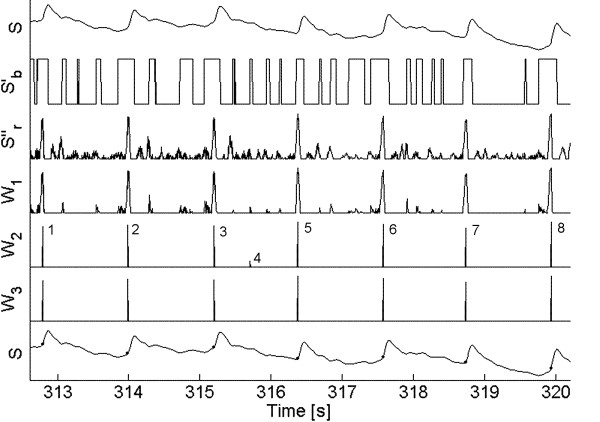
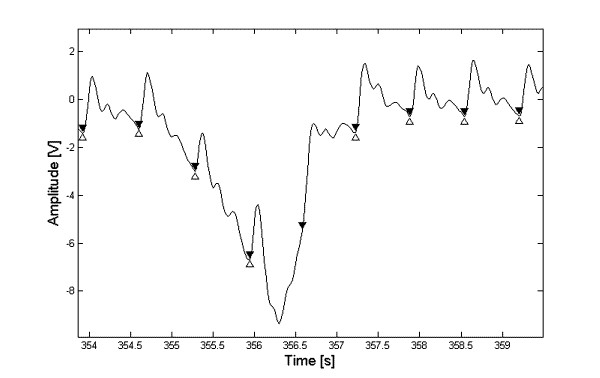
The identification algorithm detected the beat's onset and end on the basis of the maximum rising phase, the choice of possible ventricular systolic starting points considering cardiac frequency, and the adjustment of some tolerance values to optimize the behavior. Out of 800 patients in the study, 40 occlusive records (supradiastolic- subsystolic) were randomly selected without any preliminary diagnosis. Radial impedance plethysmographic pulse and standard ECG were recorded digitizing and storing the data. Cardiac frequency was estimated with the Power Density Function and, thereafter, the signal was derived twice, followed by binarization of the first derivative and rectification of the second derivative. The product of the two latter results led to a weighing signal from which the cycles' onsets and ends were established. Weighed and frequency filters are needed along with the pre-establishment of their respective tolerances. Out of the 40 records, 30 seconds strands were randomly chosen to be analyzed by the algorithm and by two operators. Sensitivity and accuracy were calculated by means of the true/false and positive/negative criteria. Synchronization ability was measured through the coefficient of variation and the median value of correlation for each patient. These parameters were assessed by means of Friedman's ANOVA and Kendall Concordance test.

RESULTS

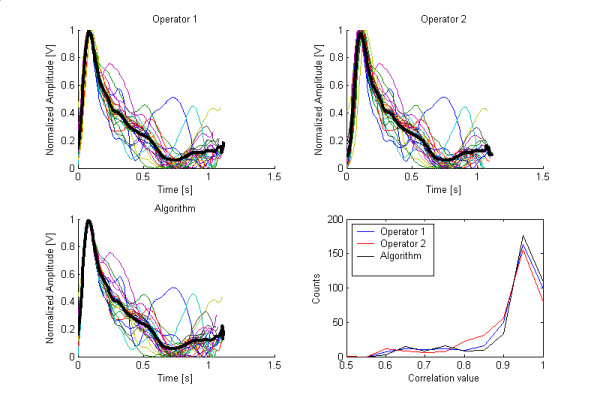
Sensitivity was 97% and 91% for the two operators, respectively, while accuracy was cero for both of them. The synchronism variability analysis was significant (p < 0.01) for the two statistics, showing that the algorithm produced the best result.

CONCLUSION

The proposed algorithm showed good performance as expressed by its high sensitivity. The correlation analysis demonstrated that, from the synchronism point of view, the algorithm performed the best detection. Patients with marked arrhythmic processes are not good candidates for this kind of analysis. At most, they would be singled out by the algorithm and, thereafter, to be checked by an operator.
https://cdn.ncbi.nlm.nih.gov/pmc/blobs/47ff/1215493/0196a682d987/1475-925X-4-48-7.jpg
https://cdn.ncbi.nlm.nih.gov/pmc/blobs/47ff/1215493/070514db4f2c/1475-925X-4-48-1.jpg
https://cdn.ncbi.nlm.nih.gov/pmc/blobs/47ff/1215493/e1d4eadc9580/1475-925X-4-48-2.jpg
https://cdn.ncbi.nlm.nih.gov/pmc/blobs/47ff/1215493/2abf3dda4949/1475-925X-4-48-3.jpg
https://cdn.ncbi.nlm.nih.gov/pmc/blobs/47ff/1215493/f3c273a19fb6/1475-925X-4-48-4.jpg
https://cdn.ncbi.nlm.nih.gov/pmc/blobs/47ff/1215493/3b550aaf95df/1475-925X-4-48-5.jpg
https://cdn.ncbi.nlm.nih.gov/pmc/blobs/47ff/1215493/fe2d84356a4a/1475-925X-4-48-6.jpg
https://cdn.ncbi.nlm.nih.gov/pmc/blobs/47ff/1215493/0196a682d987/1475-925X-4-48-7.jpg
https://cdn.ncbi.nlm.nih.gov/pmc/blobs/47ff/1215493/070514db4f2c/1475-925X-4-48-1.jpg
https://cdn.ncbi.nlm.nih.gov/pmc/blobs/47ff/1215493/e1d4eadc9580/1475-925X-4-48-2.jpg
https://cdn.ncbi.nlm.nih.gov/pmc/blobs/47ff/1215493/2abf3dda4949/1475-925X-4-48-3.jpg
https://cdn.ncbi.nlm.nih.gov/pmc/blobs/47ff/1215493/f3c273a19fb6/1475-925X-4-48-4.jpg
https://cdn.ncbi.nlm.nih.gov/pmc/blobs/47ff/1215493/3b550aaf95df/1475-925X-4-48-5.jpg
https://cdn.ncbi.nlm.nih.gov/pmc/blobs/47ff/1215493/fe2d84356a4a/1475-925X-4-48-6.jpg
https://cdn.ncbi.nlm.nih.gov/pmc/blobs/47ff/1215493/0196a682d987/1475-925X-4-48-7.jpg
摘要

背景

本项目旨在为一个小国的健康中心设计一种流行病学辅助筛选工具,总体目标是筛查出可能的冠心病患者。外周动脉功能可通过阻抗体积描记法进行无创评估。这些血管的变化似乎是未来冠心病病情的良好预测指标。阻抗体积描记法通过简单的闭塞操作检测体积变化,这些变化可能显示出动脉/静脉反应的指示性改变。需要对一系列脉搏进行平均,这反过来又需要正确确定每个搏动的开始和结束。因此,这里的目标是描述一种从体积描记记录中识别和分离搏动的算法。第二个目标是将人工操作员给出的输出与该算法进行比较。

方法

识别算法基于最大上升阶段、考虑心率的可能心室收缩起始点的选择以及调整一些容差值以优化性能来检测搏动的起始和结束。在该研究的800名患者中,随机选择40份闭塞记录(舒张末期 - 收缩期),没有任何初步诊断。记录桡动脉阻抗体积描记脉搏和标准心电图,将数据数字化并存储。用功率密度函数估计心率,然后对信号进行两次求导,接着对一阶导数进行二值化处理,对二阶导数进行整流。后两个结果的乘积产生一个加权信号,从该信号中确定周期的起始和结束。需要加权滤波器和频率滤波器,并预先设定它们各自的容差。在这40份记录中,随机选择30秒的片段由该算法和两名操作员进行分析。通过真/假和正/负标准计算灵敏度和准确性。通过变异系数和每个患者的相关中位数来测量同步能力。这些参数通过弗里德曼方差分析和肯德尔和谐检验进行评估。

结果

两名操作员的灵敏度分别为97%和91%,而两人的准确性均为零。对于这两个统计量,同步性变异性分析具有显著性(p < 0.01),表明该算法产生了最佳结果。

结论

所提出的算法表现出良好的性能,其高灵敏度表明了这一点。相关性分析表明,从同步性角度来看,该算法的检测效果最佳。有明显心律失常过程的患者不适合进行这种分析。最多,他们会被该算法筛选出来,然后由操作员进行检查。

相似文献

1
Algorithm for identifying and separating beats from arterial pulse records.从动脉脉搏记录中识别和分离搏动的算法。
Biomed Eng Online. 2005 Aug 11;4:48. doi: 10.1186/1475-925X-4-48.
2
An automatic beat detection algorithm for pressure signals.一种用于压力信号的自动搏动检测算法。
IEEE Trans Biomed Eng. 2005 Oct;52(10):1662-70. doi: 10.1109/TBME.2005.855725.
3
Automatic detection and quantification of sleep apnea using heart rate variability.利用心率变异性自动检测和量化睡眠呼吸暂停。
J Electrocardiol. 2010 Nov-Dec;43(6):535-41. doi: 10.1016/j.jelectrocard.2010.07.003. Epub 2010 Aug 17.
4
An algorithm for robust and efficient location of T-wave ends in electrocardiograms.一种用于稳健且高效地定位心电图中T波终点的算法。
IEEE Trans Biomed Eng. 2006 Dec;53(12 Pt 1):2544-52. doi: 10.1109/TBME.2006.884644.
5
Validity and reproducibility of arterial pulse wave velocity measurement using new device with oscillometric technique: a pilot study.使用新型示波技术设备测量动脉脉搏波速度的有效性和可重复性:一项初步研究。
Biomed Eng Online. 2005 Aug 23;4:49. doi: 10.1186/1475-925X-4-49.
6
A new approach to QRS segmentation based on wavelet bases and adaptive threshold technique.一种基于小波基和自适应阈值技术的QRS波分割新方法。
Med Eng Phys. 2007 Jan;29(1):26-37. doi: 10.1016/j.medengphy.2006.01.008. Epub 2006 Feb 24.
7
ECG signal analysis through hidden Markov models.通过隐马尔可夫模型进行心电图信号分析。
IEEE Trans Biomed Eng. 2006 Aug;53(8):1541-9. doi: 10.1109/TBME.2006.877103.
8
QRS template matching for recognition of ventricular ectopic beats.用于识别室性早搏的QRS模板匹配
Ann Biomed Eng. 2007 Dec;35(12):2065-76. doi: 10.1007/s10439-007-9368-9. Epub 2007 Sep 1.
9
ECG beat detection using a geometrical matching approach.使用几何匹配方法进行心电图搏动检测。
IEEE Trans Biomed Eng. 2007 Apr;54(4):641-50. doi: 10.1109/TBME.2006.889944.
10
Automated ischemic beat classification using genetic algorithms and multicriteria decision analysis.使用遗传算法和多准则决策分析的自动缺血性心搏分类
IEEE Trans Biomed Eng. 2004 Oct;51(10):1717-25. doi: 10.1109/TBME.2004.828033.

引用本文的文献

1
Extraction of heart rate variability from smartphone photoplethysmograms.从智能手机光电容积脉搏波图中提取心率变异性
Comput Math Methods Med. 2015;2015:516826. doi: 10.1155/2015/516826. Epub 2015 Jan 12.
2
The mixability of angiographic contrast with arterial blood.造影剂与动脉血的可混合性。
Med Phys. 2009 Nov;36(11):5064-78. doi: 10.1118/1.3243079.

本文引用的文献

1
An arrhythmia classification system based on the RR-interval signal.一种基于RR间期信号的心律失常分类系统。
Artif Intell Med. 2005 Mar;33(3):237-50. doi: 10.1016/j.artmed.2004.03.007.
2
The effect of contacting force on photoplethysmographic signals.接触力对光电容积脉搏波信号的影响。
Physiol Meas. 2004 Oct;25(5):1323-35. doi: 10.1088/0967-3334/25/5/020.
3
Beat-to-beat analysis of pressure wave morphology for pre-symptomatic detection of orthostatic intolerance during head-up tilt.在头高位倾斜期间,通过对压力波形态进行逐搏分析以对直立不耐受进行症状前检测。
J Am Coll Cardiol. 2004 Nov 2;44(9):1891-7. doi: 10.1016/j.jacc.2004.07.046.
4
Monitoring of arterial stiffness indices by applanation tonometry and pulse wave analysis: reproducibility at low blood pressures.通过压平式眼压测量法和脉搏波分析监测动脉僵硬度指标:低血压时的可重复性。
J Clin Monit Comput. 2004 Apr;18(2):137-44. doi: 10.1023/b:jocm.0000032809.71793.b8.
5
HEART: an automated beat-to-beat cardiovascular analysis package using Matlab.HEART:一个使用Matlab的逐搏心血管自动分析软件包。
Comput Biol Med. 2004 Jul;34(5):371-88. doi: 10.1016/S0010-4825(03)00087-8.
6
Beat-to-beat noninvasive stroke volume from arterial pressure and Doppler ultrasound.基于动脉压和多普勒超声的逐搏无创每搏输出量
Eur J Appl Physiol. 2003 Sep;90(1-2):131-7. doi: 10.1007/s00421-003-0901-8. Epub 2003 Jul 8.
7
Time course of forearm arterial compliance changes during reactive hyperemia.
Am J Physiol Heart Circ Physiol. 2001 Sep;281(3):H1093-103. doi: 10.1152/ajpheart.2001.281.3.H1093.
8
Comparison of endothelial function evaluated by strain gauge plethysmography and brachial artery ultrasound.应变容积描记法与肱动脉超声评估内皮功能的比较。
Atherosclerosis. 2001 Sep;158(1):53-9. doi: 10.1016/s0021-9150(01)00406-3.
9
Pulse wave analysis.脉搏波分析
Br J Clin Pharmacol. 2001 Jun;51(6):507-22. doi: 10.1046/j.0306-5251.2001.01400.x.
10
A noninvasive measurement of reactive hyperemia that can be used to assess resistance artery endothelial function in humans.一种可用于评估人体阻力动脉内皮功能的反应性充血的非侵入性测量方法。
Am J Cardiol. 2001 Jan 1;87(1):121-5, A9. doi: 10.1016/s0002-9149(00)01288-1.