Eisenberg Eli, Adamsky Konstantin, Cohen Lital, Amariglio Ninette, Hirshberg Abraham, Rechavi Gideon, Levanon Erez Y
School of Physics and Astronomy, Raymond and Beverly Sackler Faculty of Exact Sciences, TAU, Tel Aviv 69978, Israel.
Nucleic Acids Res. 2005 Aug 12;33(14):4612-7. doi: 10.1093/nar/gki771. Print 2005.
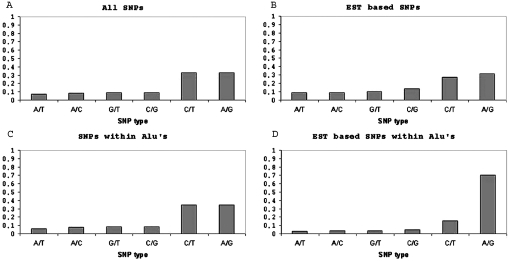
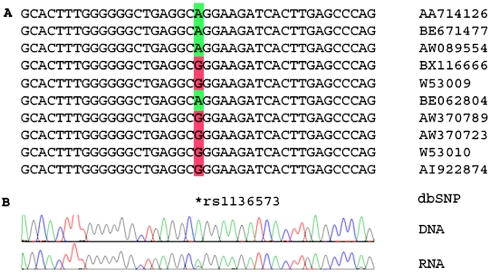
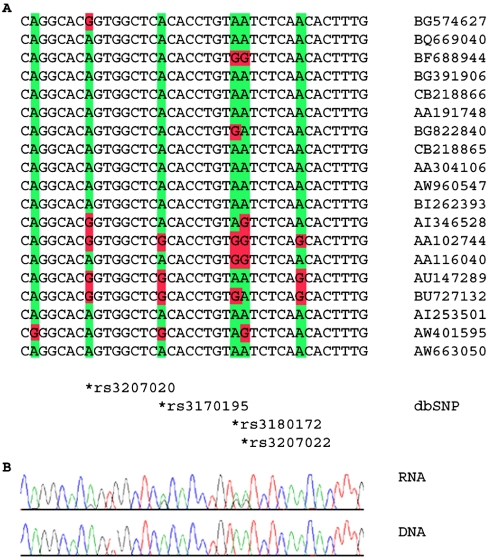
The relationship between human inherited genomic variations and phenotypic differences has been the focus of much research effort in recent years. These studies benefit from millions of single-nucleotide polymorphism (SNP) records available in public databases, such as dbSNP. The importance of identifying false dbSNP records increases with the growing role played by SNPs in linkage analysis for disease traits. In particular, the emerging understanding of the abundance of DNA and RNA editing calls for a careful distinction between inherited SNPs and somatic DNA and RNA modifications. In order to demonstrate that some of the SNP database records are actually somatic modification, we focus on one type of these modifications, namely A-to-I RNA editing, and present evidence for hundreds of dbSNP records that are actually editing sites. We provide a list of 102 RNA editing sites previously annotated in dbSNP database as SNPs, and experimentally validate seven of these. Interestingly, we show how dbSNP can serve as a starting point to look for new editing sites. Our results, for this particular type of RNA editing, demonstrate the need for a careful analysis of SNP databases in light of the increasing recognition of the significance of somatic sequence modifications.
人类遗传基因组变异与表型差异之间的关系近年来一直是众多研究工作的重点。这些研究受益于公共数据库(如dbSNP)中数百万条单核苷酸多态性(SNP)记录。随着SNP在疾病性状连锁分析中所起的作用日益增强,识别错误dbSNP记录的重要性也日益增加。特别是,对DNA和RNA编辑丰富性的新认识要求仔细区分遗传SNP与体细胞DNA和RNA修饰。为了证明某些SNP数据库记录实际上是体细胞修饰,我们聚焦于其中一种修饰类型,即A-to-I RNA编辑,并给出了数百条实际上是编辑位点的dbSNP记录的证据。我们提供了一份在dbSNP数据库中先前被注释为SNP的102个RNA编辑位点列表,并对其中7个进行了实验验证。有趣的是,我们展示了dbSNP如何能够作为寻找新编辑位点的起点。针对这种特定类型的RNA编辑,我们的结果表明,鉴于对体细胞序列修饰重要性的认识不断提高,有必要对SNP数据库进行仔细分析。