Lee John, Gravel Michel, Zhang Rulin, Thibault Pierre, Braun Peter E
Department of Biochemistry, McGill University, Montreal, Quebec, Canada.
J Cell Biol. 2005 Aug 15;170(4):661-73. doi: 10.1083/jcb.200411047.
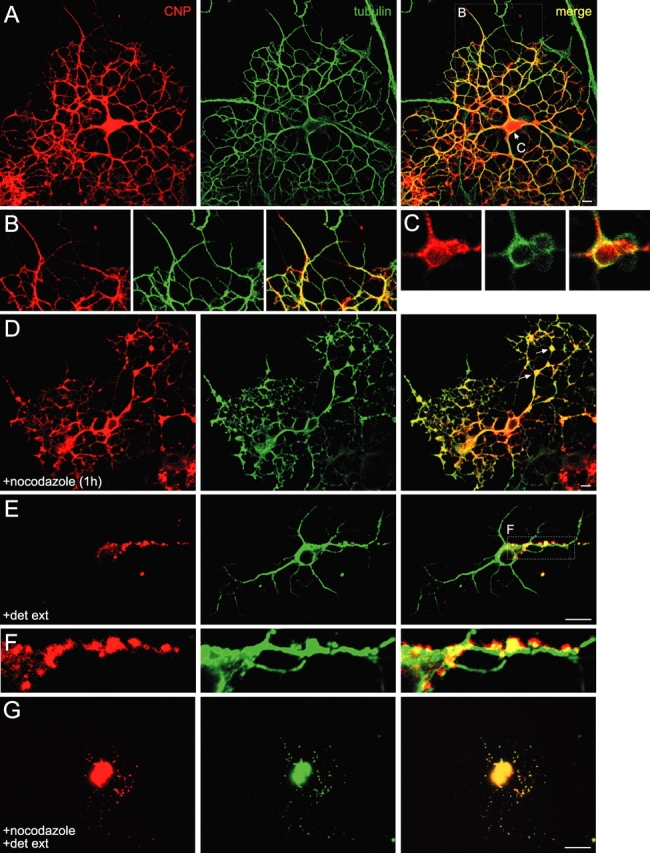
Oligodendrocytes (OLs) extend arborized processes that are supported by microtubules (MTs) and microfilaments. Little is known about proteins that modulate and interact with the cytoskeleton during myelination. Several lines of evidence suggest a role for 2',3'-cyclic nucleotide 3'-phosphodiesterase (CNP) in mediating process formation in OLs. In this study, we report that tubulin is a major CNP-interacting protein. In vitro, CNP binds preferentially to tubulin heterodimers compared with MTs and induces MT assembly by copolymerizing with tubulin. CNP overexpression induces dramatic morphology changes in both glial and nonglial cells, resulting in MT and F-actin reorganization and formation of branched processes. These morphological effects are attributed to CNP MT assembly activity; branched process formation is either substantially reduced or abolished with the expression of loss-of-function mutants. Accordingly, cultured OLs from CNP-deficient mice extend smaller outgrowths with less arborized processes. We propose that CNP is an important component of the cytoskeletal machinery that directs process outgrowth in OLs.
少突胶质细胞(OLs)伸出由微管(MTs)和微丝支持的树状突起。关于在髓鞘形成过程中调节细胞骨架并与之相互作用的蛋白质,我们了解甚少。几条证据表明2',3'-环核苷酸3'-磷酸二酯酶(CNP)在介导OLs的突起形成中起作用。在本研究中,我们报告微管蛋白是一种主要的与CNP相互作用的蛋白质。在体外,与微管相比,CNP优先结合微管蛋白异二聚体,并通过与微管蛋白共聚诱导微管组装。CNP的过表达诱导神经胶质细胞和非神经胶质细胞发生显著的形态变化,导致微管和F-肌动蛋白重组以及分支突起的形成。这些形态学效应归因于CNP的微管组装活性;功能丧失突变体的表达会使分支突起的形成显著减少或消失。因此,来自CNP缺陷小鼠的培养OLs伸出的生长物较小,分支突起较少。我们提出CNP是细胞骨架机制的一个重要组成部分,它指导OLs的突起生长。