Dandona Rakhi, Dandona Lalit, Gutierrez Juan Pablo, Kumar Anil G, McPherson Sam, Samuels Fiona, Bertozzi Stefano M
Health Studies Area, Centre for Human Development, Administrative Staff College of India, Hyderabad, India.
BMC Public Health. 2005 Aug 20;5:87. doi: 10.1186/1471-2458-5-87.
Heterosexual contact is the most common mode of HIV transmission in India that is largely linked to sex work. We assessed the non-use of condoms in sex work and with regular sex partners by female sex workers (FSWs), and identified its associations that could assist in planning HIV prevention programmes.
Detailed documentation of various aspects of sex work, and sexual behaviour with regular sex partners, was done through confidential interviews for 6,648 FSWs in 13 districts in the Indian state of Andhra Pradesh. Multivariate analysis was done to understand condom non-use with clients.
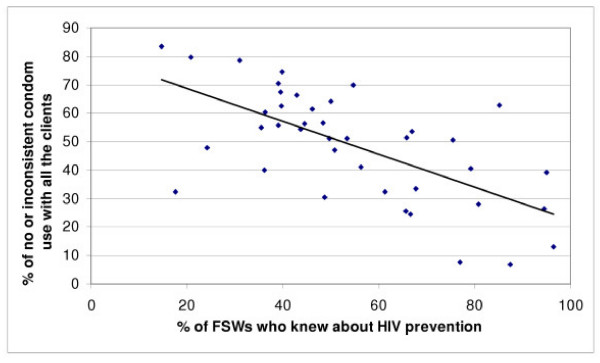
5,010 (75.4%), 1,499 (22.5%), and 139 (2.1%) FSWs were street-, home-, and brothel-based, respectively. Of the total 6,648 FSWs, 6,165 (92.7%) had penetrative vaginal/anal sex with at least one client in the last 15 days, and of these 2,907 (47.2%; 95% CI 41.2-53.2%) reported non-use of condom with at least one of her last three clients. Lack of knowledge that HIV could be prevented (odds ratio 5.01; 95% CI 4.38-5.73), no access to free condoms (odds ratio 3.45; 95% CI 2.99-3.98), being street-based as compared with brothel-based (odds ratio 3.36; 95% CI 1.87-6.04), and no participation in FSW support groups (odds ratio 2.02; 95% CI 1.50-2.70) were the most significant predictors of condom non-use with clients. Other associations included lower social support, lower income, age >24 years, illiteracy, and living in medium-size urban or rural areas. Of the 2582 who had penetrative sex with regular sex partner within the last 7 days, 2428 (94%; 95% CI 92.1-95.9%) had not used condom at last sex, and 1032 (41.8%) had neither used condom consistently with clients nor with regular sex partner.
About half the FSWs do not use condom consistently with their clients in this Indian state putting them at high risk of HIV infection. Non-brothel-based FSWs, who form the majority of sex workers in India, were at a significantly higher risk of HIV infection as compared with brothel-based FSWs. With their high vulnerability, the success of expansion of HIV prevention efforts will depend on achieving and sustaining an environment that enables HIV prevention with the non-brothel based FSWs.
异性接触是印度最常见的艾滋病毒传播方式,这在很大程度上与性工作有关。我们评估了女性性工作者(FSW)在性工作中以及与固定性伴侣发生性行为时不使用避孕套的情况,并确定了其相关因素,这有助于规划艾滋病毒预防项目。
通过对印度安得拉邦13个地区的6648名女性性工作者进行保密访谈,详细记录了性工作的各个方面以及与固定性伴侣的性行为。进行多变量分析以了解与客户发生性行为时不使用避孕套的情况。
分别有5010名(75.4%)、1499名(22.5%)和139名(2.1%)女性性工作者以街头、家中和妓院为工作场所。在总共6648名女性性工作者中,6165名(92.7%)在过去15天内与至少一名客户发生过阴道/肛门插入式性行为,其中2907名(47.2%;95%置信区间41.2 - 53.2%)报告在与最后三名客户中的至少一名发生性行为时未使用避孕套。对艾滋病毒可预防缺乏了解(优势比5.01;95%置信区间4.38 - 5.73)、无法获得免费避孕套(优势比3.45;95%置信区间2.99 - 3.98)、与妓院工作的女性性工作者相比以街头为工作场所(优势比3.36;95%置信区间1.87 - 6.04)以及未参加女性性工作者支持小组(优势比2.02;95%置信区间1.50 - 2.70)是与客户发生性行为时不使用避孕套的最显著预测因素。其他相关因素包括社会支持较低、收入较低、年龄>24岁、文盲以及生活在中等规模城市或农村地区。在过去7天内与固定性伴侣发生插入式性行为的2582人中,2428人(94%;95%置信区间92.1 - 95.9%)在上次性行为时未使用避孕套,1032人(41.8%)既未与客户也未与固定性伴侣始终使用避孕套。
在这个印度邦,约一半的女性性工作者在与客户发生性行为时未始终使用避孕套,这使她们面临感染艾滋病毒的高风险。与妓院工作的女性性工作者相比,非妓院工作的女性性工作者(她们占印度性工作者的大多数)感染艾滋病毒的风险显著更高。鉴于她们的高脆弱性,扩大艾滋病毒预防工作的成功将取决于营造并维持一个能让非妓院工作的女性性工作者进行艾滋病毒预防的环境。