Ramanathan Shreena, Nagarajan Karikalan, Ramakrishnan Lakshmi, Mainkar Mandar K, Goswami Prabuddhagopal, Yadav Diwakar, Sen Shrabanti, George Bitra, Rachakulla Harikumar, Subramanian Thilakavathi, Paranjape Ramesh S
Department of M&E, Knowledge Network, DAKSH, FHI 360, New Delhi, India.
National AIDS Research Institute (NARI), Pune, Maharashtra, India.
BMJ Open. 2014 Nov 19;4(11):e005166. doi: 10.1136/bmjopen-2014-005166.
Self-reported anal intercourse by female sex workers (FSWs) documented in recent studies from India range between 11.9% and 22%. However, comparable data on anal intercourse and condom use from male clients of FSWs is lacking. Using data from a bio-behavioural survey (2009-2010), we examined prevalence of anal intercourse, male clients' self-reported inconsistent condom use during anal intercourse with FSWs, and correlates of this behaviour in India's high HIV prevalence southern states (Andhra Pradesh, Maharashtra and Tamil Nadu combined).
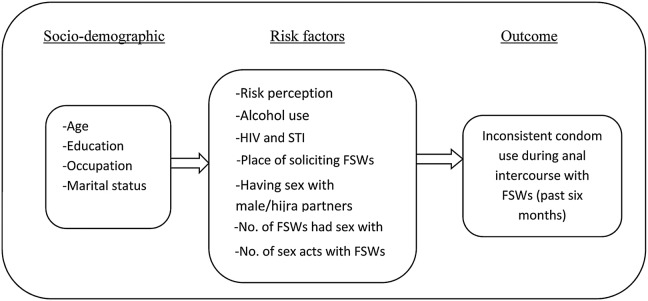
Using two-stage time location cluster sampling, we recruited 4803 clients of FSWs, ages 18-60 years, who had purchased sex from an FSW in the past month. After obtaining informed consent, respondents were interviewed and tested for HIV and sexually transmitted infections (syphilis, gonorrhoea and chlamydia). Logistic regression analysis was used to identify the factors associated with inconsistent condom use during anal intercourse (in the past 6 months) with FSWs.
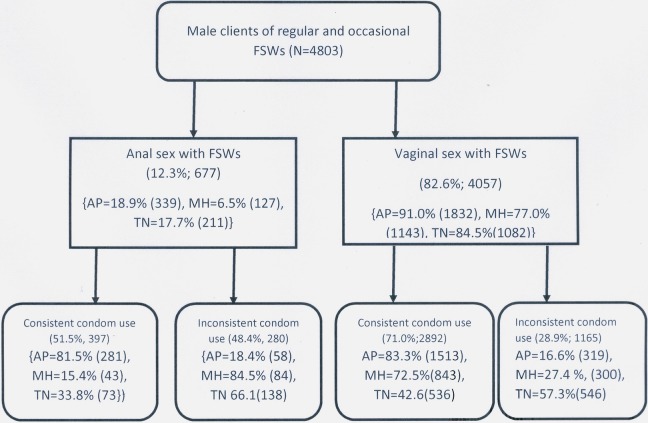
Overall, 12.3% clients reported anal intercourse in the past 6 months, of whom 48.4% used condoms inconsistently. Clients of FSWs who were ages 26 years or older (AOR 2.68, p=0.032); employed as manual labourers (AOR 2.43, p=0.013); consumed alcohol (AOR 2.63, p=0.001); reported five or more sex acts with FSWs in the past month (AOR 2.53, p=0.031); and perceived themselves to be at higher risk for HIV (AOR 4.82, p=0.001) were more likely to inconsistently use condoms during anal intercourse.
The results suggest that sex workers and their clients commonly practice anal intercourse, but a relatively high proportion of clients do not consistently use condoms, leading to a greater risk of acquiring HIV and its further transmission to other male and female sexual partners. Given the multidirectional risk, safer sex communication on heterosexual anal intercourse must be incorporated into HIV prevention programmes.
印度近期研究记录的女性性工作者(FSW)自我报告的肛交比例在11.9%至22%之间。然而,缺乏来自FSW男性客户的肛交及使用避孕套情况的可比数据。利用一项生物行为调查(2009 - 2010年)的数据,我们研究了印度艾滋病毒高流行的南部各邦(安得拉邦、马哈拉施特拉邦和泰米尔纳德邦合并)肛交的流行情况、男性客户自我报告的与FSW进行肛交时避孕套使用不一致的情况,以及这种行为的相关因素。
我们采用两阶段时间地点整群抽样方法,招募了4803名年龄在18 - 60岁之间、过去一个月内从FSW购买过性服务的FSW男性客户。在获得知情同意后,对受访者进行访谈,并检测其艾滋病毒和性传播感染(梅毒、淋病和衣原体)情况。采用逻辑回归分析来确定与过去6个月内与FSW进行肛交时避孕套使用不一致相关的因素。
总体而言,12.3%的客户报告在过去6个月内有过肛交,其中48.4%的人使用避孕套不一致。年龄在26岁及以上的FSW男性客户(调整后比值比[AOR]为2.68,p = 0.032);从事体力劳动者(AOR为2.43,p = 0.013);饮酒者(AOR为2.63,p = 0.001);报告过去一个月内与FSW有五次或更多性行为者(AOR为2.53,p = 0.031);以及认为自己感染艾滋病毒风险较高者(AOR为4.82,p = 0.001)在肛交时更有可能不一致地使用避孕套。
结果表明,性工作者及其客户普遍进行肛交,但相当一部分客户没有始终如一地使用避孕套,这导致感染艾滋病毒的风险增加,并进一步传播给其他男性和女性性伴侣。鉴于这种多方向的风险,关于异性肛交的安全性行为宣传必须纳入艾滋病毒预防计划。