Swerdlow Neal R, Geyer Mark A, Shoemaker Jody M, Light Gregory A, Braff David L, Stevens Karen E, Sharp Richard, Breier Michelle, Neary Alaina, Auerbach Pamela P
Department of Psychiatry, UCSD School of Medicine, La Jolla, CA 92093-0804, USA.
Neuropsychopharmacology. 2006 Mar;31(3):506-15. doi: 10.1038/sj.npp.1300841.
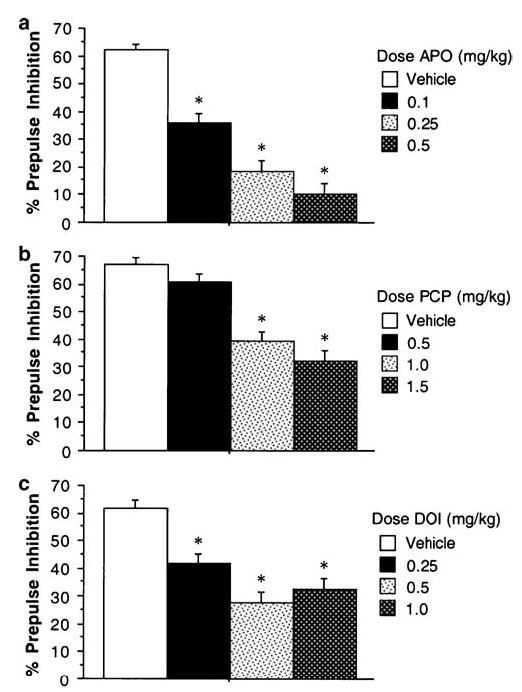
Prepulse inhibition of startle ('PPI'), a cross-species measure of sensorimotor gating, is impaired in schizophrenia patients. Suppression of P50 event-related potentials (ERPs) in response to the second of two clicks ('P50 gating') is also impaired in schizophrenia. Suppression of N40 ERPs to the second of two clicks ('N40 gating') is thought by some to be a rat homolog of human P50 gating. Emerging evidence suggests differences in the neurobiology of deficits detected by PPI vs P50 (or N40) gating. We recorded PPI and N40 gating contemporaneously in rats, to assess convergence and divergence in the neurochemical regulation of these measures. Dose-response studies examined the effects of apomorphine (APO), phencyclidine (PCP) or the 5HT2A agonist DOI on PPI, and on motor responses to stimuli (S1 and S2) that elicit N40 gating. Effects of optimal drug doses on PPI and N40 gating were then assessed in other rats with implanted cortical surface electrodes. APO, PCP and DOI caused dose-dependent disruptions of both PPI and gating of motor responses to N40 stimuli. Reduced PPI reflected diminished prepulse effectiveness, demonstrated by increased startle levels on prepulse+pulse trials. In contrast, reduced gating of motor responses to N40 stimuli reflected a reduced motor response to S1. In separate rats, robust PPI, N40 potentials and N40 gating could be detected within one test. PPI and N40 gating were disrupted by APO, PCP, and DOI. Again, drug effects on PPI reflected increased startle on prepulse+pulse trials, while those on N40 gating reflected reduced ERP responses to S1. In conclusion, when PPI and N40 gating were studied concurrently in rats, drug effects on PPI reflected reduced inhibition of startle by the prepulse, while diminished N40 gating reflected S1 response suppression. Despite similarities in drug sensitivity, these results suggest that distinct neurobiological mechanisms underlie drug-induced deficits in PPI and N40 gating.
惊吓前脉冲抑制(“PPI”)是一种跨物种的感觉运动门控测量指标,在精神分裂症患者中受损。对两次点击中的第二次点击做出反应时,P50事件相关电位(ERP)的抑制(“P50门控”)在精神分裂症中也受损。一些人认为,对两次点击中的第二次点击的N40 ERP抑制(“N40门控”)是人类P50门控的大鼠同源物。新出现的证据表明,PPI与P50(或N40)门控检测到的缺陷在神经生物学上存在差异。我们在大鼠中同时记录PPI和N40门控,以评估这些测量指标在神经化学调节方面的趋同和差异。剂量反应研究考察了阿扑吗啡(APO)、苯环利定(PCP)或5HT2A激动剂DOI对PPI以及对引发N40门控的刺激(S1和S2)的运动反应的影响。然后在其他植入皮质表面电极的大鼠中评估最佳药物剂量对PPI和N40门控的影响。APO、PCP和DOI导致PPI以及对N40刺激的运动反应门控出现剂量依赖性破坏。PPI降低反映了前脉冲有效性降低,这在预脉冲+脉冲试验中惊吓水平增加得到证明。相比之下,对N40刺激的运动反应门控降低反映了对S1的运动反应降低。在另外的大鼠中,在一次测试中可以检测到强烈的PPI、N40电位和N40门控。PPI和N40门控被APO、PCP和DOI破坏。同样,药物对PPI的影响反映在预脉冲+脉冲试验中惊吓增加,而对N40门控的影响反映在ERP对S1的反应降低。总之,当在大鼠中同时研究PPI和N40门控时,药物对PPI的影响反映了前脉冲对惊吓抑制的降低,而N40门控降低反映了S1反应抑制。尽管在药物敏感性方面存在相似性,但这些结果表明,PPI和N40门控中药物诱导的缺陷背后存在不同的神经生物学机制。