Franklin Renty B, Feng Pei, Milon B, Desouki Mohamed M, Singh Keshav K, Kajdacsy-Balla André, Bagasra Omar, Costello Leslie C
Department of Biomedical Sciences, Dental School, University of Maryland, Baltimore, Md, USA.
Mol Cancer. 2005 Sep 9;4:32. doi: 10.1186/1476-4598-4-32.
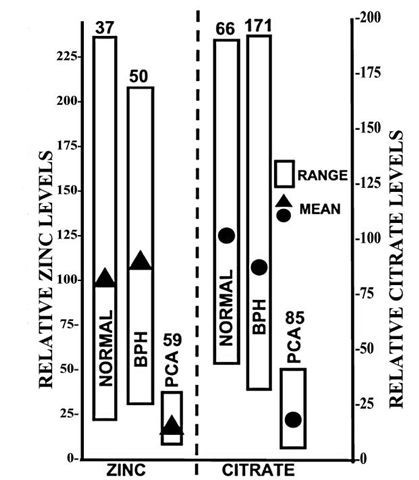
The genetic and molecular mechanisms responsible for and associated with the development and progression of prostate malignancy are largely unidentified. The peripheral zone is the major region of the human prostate gland where malignancy develops. The normal peripheral zone glandular epithelium has the unique function of accumulating high levels of zinc. In contrast, the ability to accumulate zinc is lost in the malignant cells. The lost ability of the neoplastic epithelial cells to accumulate zinc is a consistent factor in their development of malignancy. Recent studies identified ZIP1 (SLC39A1) as an important zinc transporter involved in zinc accumulation in prostate cells. Therefore, we investigated the possibility that down-regulation of hZIP1 gene expression might be involved in the inability of malignant prostate cells to accumulate zinc. To address this issue, the expression of hZIP1 and the depletion of zinc in malignant versus non-malignant prostate glands of prostate cancer tissue sections were analyzed. hZIP1 expression was also determined in malignant prostate cell lines.
hZIP1 gene expression, ZIP1 transporter protein, and cellular zinc were prominent in normal peripheral zone glandular epithelium and in benign hyperplastic glands (also zinc accumulating glands). In contrast, hZIP1 gene expression and transporter protein were markedly down-regulated and zinc was depleted in adenocarcinomatous glands and in prostate intra-epithelial neoplastic foci (PIN). These changes occur early in malignancy and are sustained during its progression in the peripheral zone. hZIP1 is also expressed in the malignant cell lines LNCaP, PC-3, DU-145; and in the nonmalignant cell lines HPr-1 and BPH-1.
The studies clearly establish that hZIP1 gene expression is down regulated and zinc is depleted in adenocarcinomatous glands. The fact that all the malignant cell lines express hZIP1 indicates that the down-regulation in adenocarcinomatous glands is likely due to in situ gene silencing. These observations, coupled with the numerous and consistent reports of loss of zinc accumulation in malignant cells in prostate cancer, lead to the plausible proposal that down regulation of hZIP1 is a critical early event in the development prostate cancer.
导致前列腺恶性肿瘤发生和进展的遗传及分子机制在很大程度上尚不明确。外周区是人类前列腺发生恶性肿瘤的主要区域。正常外周区腺上皮具有积累高水平锌的独特功能。相比之下,恶性细胞失去了积累锌的能力。肿瘤上皮细胞积累锌能力的丧失是其发生恶性肿瘤的一个持续因素。最近的研究确定ZIP1(SLC39A1)是参与前列腺细胞锌积累的一种重要锌转运蛋白。因此,我们研究了hZIP1基因表达下调可能与恶性前列腺细胞无法积累锌有关的可能性。为解决这个问题,分析了前列腺癌组织切片中恶性与非恶性前列腺腺体内hZIP1的表达及锌的缺失情况。还在恶性前列腺细胞系中测定了hZIP1的表达。
hZIP1基因表达、ZIP1转运蛋白及细胞内锌在正常外周区腺上皮和良性增生腺体(也是积累锌的腺体)中很显著。相比之下,hZIP1基因表达和转运蛋白在腺癌腺体及前列腺上皮内瘤变灶(PIN)中明显下调,且锌缺失。这些变化在恶性肿瘤早期就会出现,并在其在外周区进展过程中持续存在。hZIP1也在恶性细胞系LNCaP、PC - 3、DU - 145以及非恶性细胞系HPr - 1和BPH - 1中表达。
这些研究清楚地表明,腺癌腺体中hZIP1基因表达下调且锌缺失。所有恶性细胞系均表达hZIP1这一事实表明,腺癌腺体中的下调可能是由于原位基因沉默。这些观察结果,再加上众多一致报道的前列腺癌恶性细胞中锌积累丧失的情况,得出一个合理的推测,即hZIP1下调是前列腺癌发生过程中的一个关键早期事件。