Desouki Mohamed M, Geradts Joseph, Milon Beatrice, Franklin Renty B, Costello Leslie C
Dept of Pathology and Lab Medicine, Medical University of South Carolina, Charleston, SC, USA.
Mol Cancer. 2007 Jun 5;6:37. doi: 10.1186/1476-4598-6-37.
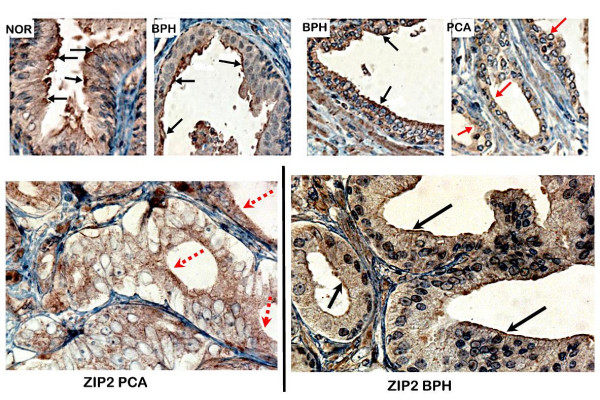
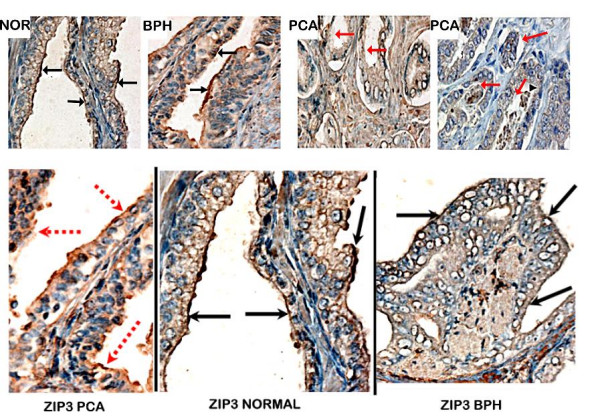
The normal human prostate glandular epithelium has the unique function of accumulating high levels of zinc. In prostate cancer this capability is lost as an early event in the development of the malignant cells. The mechanism and factors responsible for the ability of the normal epithelial cells to accumulate zinc and the loss of this capability in the malignant cells need to be identified. We previously reported that Zip1 is an important zinc uptake transporter in prostate cells and is down regulated in the malignant cells in situ along with the depletion of zinc levels. In this report we investigated the expression of two other Zip family zinc transporters, Zip2 and Zip3 in malignant versus nonmalignant (normal and BPH) glands. Zip2 and Zip3 relative protein levels were determined by immunohistochemistry analysis of human prostate tissue sections.
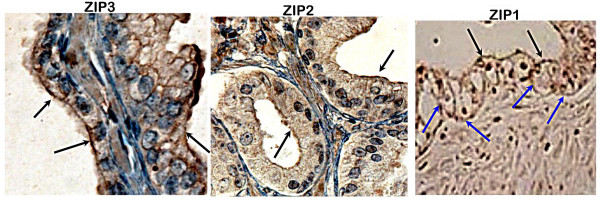
Normal and BPH glandular epithelium consistently exhibited the strong presence of both Zip 2 and Zip3; whereas both transporters consistently were essentially non-detectable in the malignant glands. This represents the first report of the expression of Zip3 in human prostate tissue; and more importantly, reveals that ZiP2 and Zip3 are down regulated in malignant cells in situ as we also had demonstrated for Zip1. Zip2 and Zip3 transporter proteins were localized predominantly at the apical cell membrane, which is in contrast to the Zip1 localization at the basolateral membrane. Zip2 and Zip3 seemingly are associated with the re-uptake of zinc from prostatic fluid.
These results coupled with previous reports implicate Zip2 and Zip3 along with Zip1 as important zinc uptake transporters involved in the unique ability of prostate cells to accumulate high cellular zinc levels. Zip1 is important for the extraction of zinc from circulation as the primary source of cellular zinc. Zip 2 and Zip3 appear to be important for retention of the zinc in the cellular compartment. The down regulation of all three transporters in the malignant cells is consistent with the loss of zinc accumulation in these cells. Since zinc imposes tumor suppressor effects, the silencing of the gene expression for these transporters is a required event for the manifestation of the malignant activities of the neoplastic cells. This now provides new insights into the genetic/molecular events associated with the development of prostate cancer; and supports our concept of Zip1, and now Zip2 and Zip3, as tumor suppressor genes and zinc as a tumor suppressor agent.
正常人类前列腺腺上皮具有积累高水平锌的独特功能。在前列腺癌中,这种能力在恶性细胞发展的早期就丧失了。需要确定正常上皮细胞积累锌的能力以及恶性细胞中这种能力丧失的机制和相关因素。我们之前报道过,Zip1是前列腺细胞中一种重要的锌摄取转运体,在原位恶性细胞中随着锌水平的耗尽而下调。在本报告中,我们研究了另外两种Zip家族锌转运体Zip2和Zip3在恶性与非恶性(正常和良性前列腺增生)腺体中的表达情况。通过对人前列腺组织切片进行免疫组织化学分析来确定Zip2和Zip3的相对蛋白水平。
正常和良性前列腺增生腺上皮始终显示Zip2和Zip3均大量存在;而在恶性腺体中这两种转运体始终基本检测不到。这是关于Zip3在人前列腺组织中表达的首次报道;更重要的是,揭示了Zip2和Zip3在原位恶性细胞中也像我们对Zip1所证明的那样下调。Zip2和Zip3转运蛋白主要定位于顶端细胞膜,这与Zip1定位于基底外侧膜形成对比。Zip2和Zip3似乎与从前列腺液中重新摄取锌有关。
这些结果与之前的报道表明,Zip2、Zip3以及Zip1都是参与前列腺细胞积累高细胞锌水平独特能力的重要锌摄取转运体。Zip1对于从循环中提取锌作为细胞锌的主要来源很重要。Zip2和Zip3似乎对于锌在细胞内的保留很重要。所有这三种转运体在恶性细胞中的下调与这些细胞中锌积累的丧失是一致的。由于锌具有肿瘤抑制作用,这些转运体基因表达的沉默是肿瘤细胞恶性活动表现所必需的事件。这现在为与前列腺癌发展相关的遗传/分子事件提供了新的见解;并支持我们将Zip1以及现在的Zip2和Zip3视为肿瘤抑制基因以及将锌视为肿瘤抑制因子的概念。