Drzezga Alexander, Grimmer Timo, Peller Martin, Wermke Marc, Siebner Hartwig, Rauschecker Josef P, Schwaiger Markus, Kurz Alexander
Department of Nuclear Medicine, Technische Universität München, Munich, Germany.
PLoS Med. 2005 Oct;2(10):e288. doi: 10.1371/journal.pmed.0020288. Epub 2005 Sep 20.
Successful cognitive performance depends not only on the activation of specific neuronal networks but also on selective suppression of task-irrelevant modalities, i.e., deactivation of non-required cerebral regions. This ability to suppress the activation of specific brain regions has, to our knowledge, never been systematically evaluated in patients with Alzheimer disease (AD). The aim of the current study was to evaluate both cerebral activation and deactivation in (1) healthy volunteers, (2) patients with mild cognitive impairment (MCI) who are at risk for AD, and (3) patients with moderate AD during active navigation, representing a cognitive task typically affected in AD.
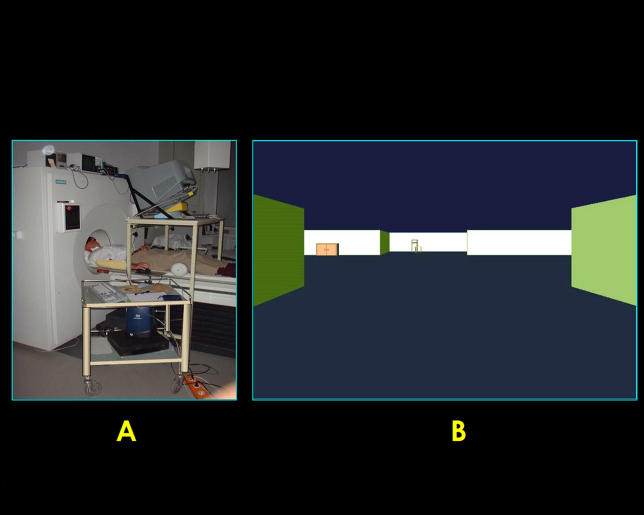
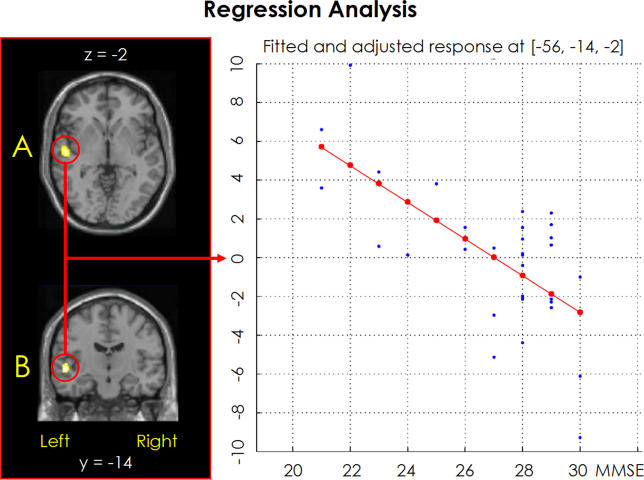
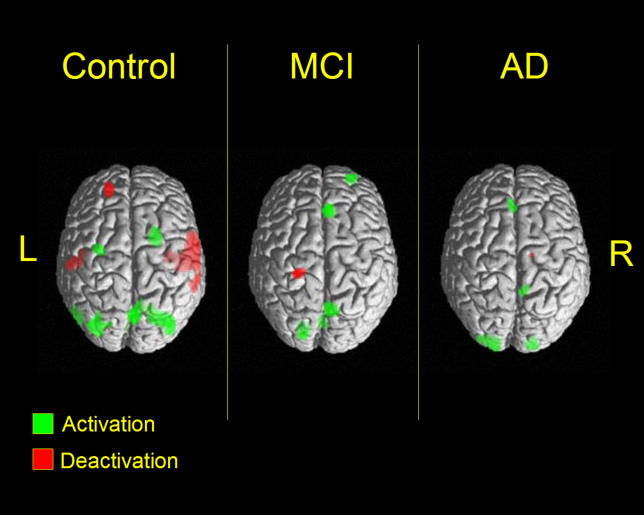
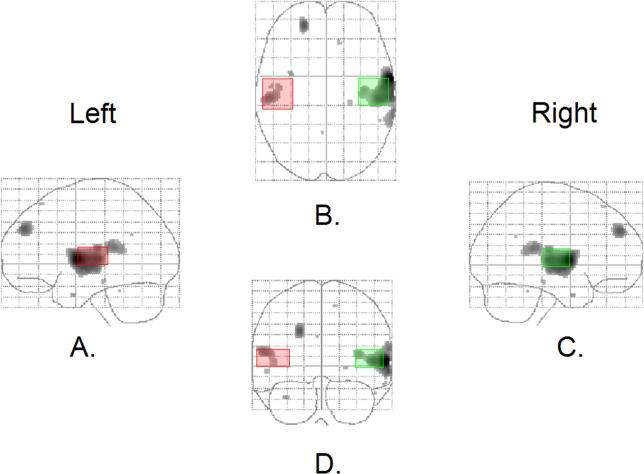
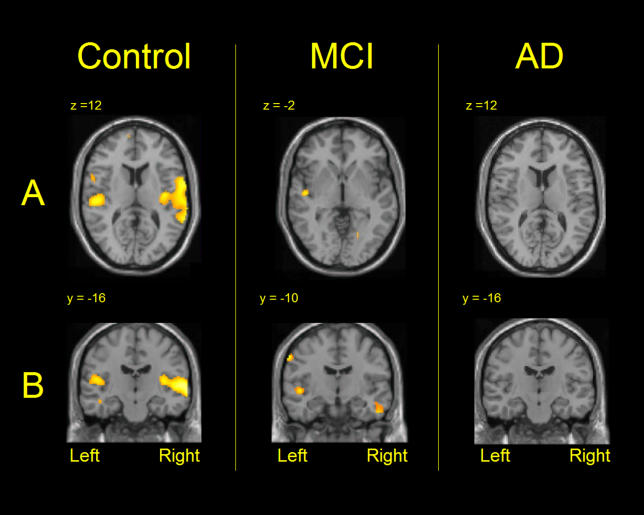
Changes in regional cerebral blood flow (rCBF) were assessed with PET imaging during an active navigation task in a 3D virtual-reality environment. The task was based on visual cues exclusively; no auditory cues were provided. Age-matched groups of healthy individuals, patients with MCI, and patients with AD were examined. Specific differences in the activation patterns were observed in the three groups, with stronger activation of cerebellar portions and visual association cortex in controls and stronger activation of primary visual and frontal cortical areas in patients with MCI and AD. Highly significant bilateral decrease of rCBF in task-irrelevant auditory cortical regions was detected in healthy individuals during performance of the task. This rCBF decrease was interpreted as a cross-modal inhibitory effect. It was diminished in patients with MCI and completely absent in patients with AD. A regression analysis across all individuals revealed a clear positive relation between cognitive status (mini mental state examination score) and the extent of auditory cortical deactivation.
During active navigation, a high level of movement automation and an involvement of higher-order cerebral association functions were observed in healthy controls. Conversely, in patients with MCI and AD, increased cognitive effort and attention towards movement planning, as well as stronger involvement of lower-order cerebral systems, was found. Successful cognitive performance in healthy individuals is associated with deactivation of task-irrelevant cerebral regions, whereas the development of AD appears to be characterized by a progressive impairment of cross-modal cerebral deactivation functions. These changes may cause the generally decreased ability of patients with AD to direct attention primarily to the relevant cognitive modality.
成功的认知表现不仅取决于特定神经网络的激活,还取决于对与任务无关的模态的选择性抑制,即非必需脑区的失活。据我们所知,阿尔茨海默病(AD)患者的这种抑制特定脑区激活的能力从未得到系统评估。本研究的目的是评估(1)健康志愿者、(2)有AD风险的轻度认知障碍(MCI)患者以及(3)中度AD患者在主动导航过程中的脑激活和失活情况,主动导航是一项在AD中通常会受到影响的认知任务。
在3D虚拟现实环境中的主动导航任务期间,用PET成像评估局部脑血流(rCBF)的变化。该任务仅基于视觉线索;未提供听觉线索。对年龄匹配的健康个体、MCI患者和AD患者组进行了检查。在三组中观察到激活模式的特定差异,对照组中小脑部分和视觉联合皮层的激活更强,MCI和AD患者中初级视觉和额叶皮层区域的激活更强。在健康个体执行任务期间,在与任务无关的听觉皮层区域检测到rCBF高度显著的双侧降低。这种rCBF降低被解释为跨模态抑制效应。在MCI患者中这种效应减弱,在AD患者中则完全不存在。对所有个体的回归分析显示认知状态(简易精神状态检查评分)与听觉皮层失活程度之间存在明显的正相关。
在主动导航期间,健康对照组中观察到高水平的运动自动化和高阶脑联合功能的参与。相反,在MCI和AD患者中,发现对运动规划的认知努力和注意力增加,以及低阶脑系统的更强参与。健康个体的成功认知表现与任务无关脑区的失活相关,而AD的发展似乎以跨模态脑失活功能的渐进性损害为特征。这些变化可能导致AD患者通常将注意力主要指向相关认知模态的能力普遍下降。