Petersén Asa, Stewénius Ylva, Björkqvist Maria, Gisselsson David
Department of Experimental Medical Science, Wallenberg Neuroscience Center, Lund University, Sweden.
BMC Cell Biol. 2005 Sep 13;6:34. doi: 10.1186/1471-2121-6-34.
Huntington's disease (HD) is a hereditary neurodegenerative disorder caused by a CAG repeat expansion in the HD gene. The huntingtin protein expressed from HD has an unknown function but is suggested to interact with proteins involved in the cell division machinery. The R6/2 transgenic mouse is the most widely used model to study HD. In R6/2 fibroblast cultures, a reduced mitotic index and high frequencies of multiple centrosomes and aneuploid cells have recently been reported. Aneuploidy is normally a feature closely connected to neoplastic disease. To further explore this unexpected aspect of HD, we studied cultures derived from 6- and 12-week-old R6/2 fibroblasts, skeletal muscle cells, and liver cells.
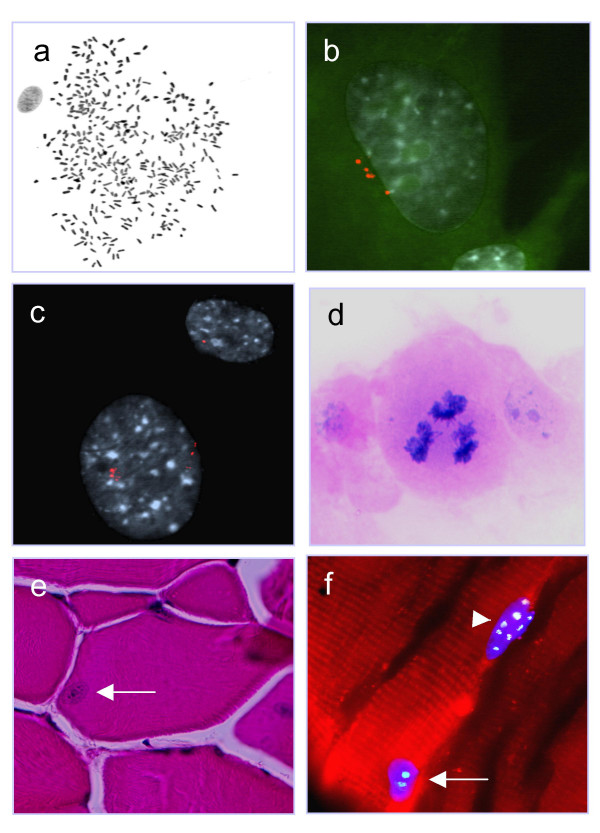
Cytogenetic analyses revealed a high frequency of polyploid cells in cultures from both R6/2 and wild-type mice with the greatest proportions of polyploid cells in cultures derived from skeletal muscle cells of both genotypes. The presence of polyploid cells in skeletal muscle in vivo was confirmed by fluorescence in situ hybridisation with centromeric probes. Enlarged and supernumerary centrosomes were found in cultures from both R6/2 and wild-type mice. However, no aneuploid cells could be found in any of the tissues.
We conclude that polyploid cells are found in fibroblast and skeletal muscle cultures derived from both R6/2 and wild-type littermate mice and that aneuploidy is unlikely to be a hallmark of HD.
亨廷顿舞蹈症(HD)是一种遗传性神经退行性疾病,由HD基因中的CAG重复序列扩增引起。由HD基因表达的亨廷顿蛋白功能未知,但提示其与参与细胞分裂机制的蛋白质相互作用。R6/2转基因小鼠是研究HD最广泛使用的模型。最近报道,在R6/2成纤维细胞培养物中,有丝分裂指数降低,多中心体和非整倍体细胞的频率较高。非整倍体通常是与肿瘤性疾病密切相关的一个特征。为了进一步探索HD这一意外方面,我们研究了来自6周龄和12周龄R6/2成纤维细胞、骨骼肌细胞和肝细胞的培养物。
细胞遗传学分析显示,R6/2小鼠和野生型小鼠的培养物中多倍体细胞频率较高,两种基因型的骨骼肌细胞培养物中多倍体细胞比例最高。通过着丝粒探针荧光原位杂交证实了体内骨骼肌中存在多倍体细胞。在R6/2小鼠和野生型小鼠的培养物中均发现了扩大的和多余的中心体。然而,在任何组织中均未发现非整倍体细胞。
我们得出结论,在来自R6/2小鼠和野生型同窝小鼠的成纤维细胞和骨骼肌培养物中均发现了多倍体细胞,并且非整倍体不太可能是HD的标志。