Ince Can
Department of Physiology, Academic Medical Center, University of Amsterdam, Amsterdam, The Netherlands.
Crit Care. 2005;9 Suppl 4(Suppl 4):S13-9. doi: 10.1186/cc3753. Epub 2005 Aug 25.
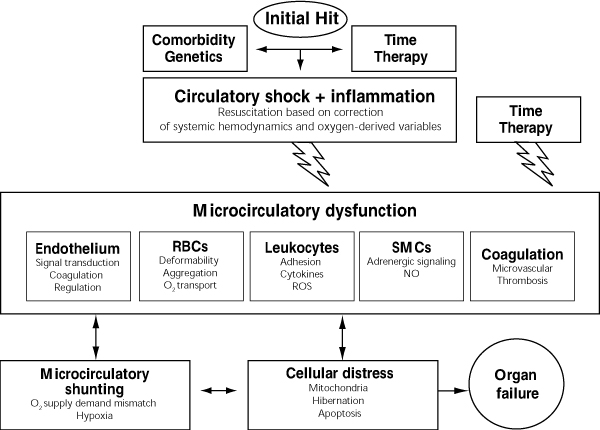
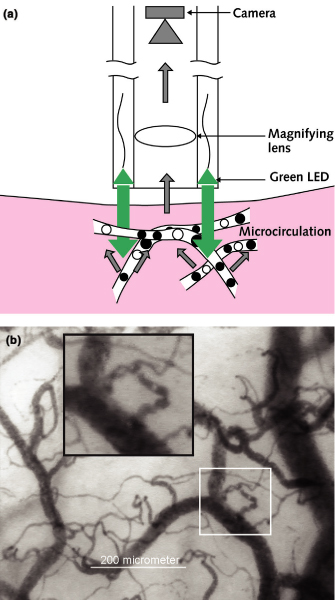
Regional tissue distress caused by microcirculatory dysfunction and mitochondrial depression underlies the condition in sepsis and shock where, despite correction of systemic oxygen delivery variables, regional hypoxia and oxygen extraction deficit persist. We have termed this condition microcirculatory and mitochondrial distress syndrome (MMDS). Orthogonal polarization spectral imaging allowed the first clinical observation of the microcirculation in human internal organs, and has identified the pivotal role of microcirculatory abnormalities in defining the severity of sepsis, a condition not revealed by systemic hemodynamic or oxygen-derived variables. Recently, sublingual sidestream dark-field (SDF) imaging has been introduced, allowing observation of the microcirculation in even greater detail. Microcirculatory recruitment is needed to ensure adequate microcirculatory perfusion and the oxygenation of tissue cells that follows. In sepsis, where inflammation-induced autoregulatory dysfunction persists and oxygen need is not matched by supply, the microcirculation can be recruited by reducing pathological shunting, promoting microcirculatory perfusion, supporting pump function, and controlling hemorheology and coagulation. Resuscitation following MMDS must include focused recruitment of hypoxic-shunted microcirculatory units and/or resuscitation of the mitochondria. A combination of agents is required for successful rescue of the microcirculation. Single compounds such as activated protein C, which acts on multiple pathways, can be expected to be beneficial in rescuing the microcirculation in sepsis.
脓毒症和休克状态下,微循环功能障碍和线粒体抑制所导致的局部组织损伤是其病理基础,即便全身氧输送变量得到纠正,局部缺氧和氧摄取不足依旧存在。我们将这种状态称为微循环和线粒体功能障碍综合征(MMDS)。正交极化光谱成像首次实现了对人体内脏微循环的临床观察,并确定了微循环异常在界定脓毒症严重程度方面的关键作用,而这一情况是全身血流动力学或氧衍生变量所无法揭示的。近来,舌下侧流暗视野(SDF)成像技术被引入,能够更详细地观察微循环。需要进行微循环募集,以确保足够的微循环灌注以及随之而来的组织细胞氧合。在脓毒症中,炎症诱导的自身调节功能障碍持续存在,氧需求与供应不匹配,此时可通过减少病理性分流、促进微循环灌注、支持泵功能以及控制血液流变学和凝血来募集微循环。MMDS后的复苏必须包括对缺氧分流的微循环单位进行针对性募集和/或线粒体复苏。成功挽救微循环需要多种药物联合使用。单一化合物,如作用于多条途径的活化蛋白C,有望对脓毒症中的微循环挽救有益。