Mackenzie Constanze A, Lockridge Ada, Keith Margaret
Faculty of Medicine, University of Ottawa, Ottawa, Ontario, Canada.
Environ Health Perspect. 2005 Oct;113(10):1295-8. doi: 10.1289/ehp.8479.
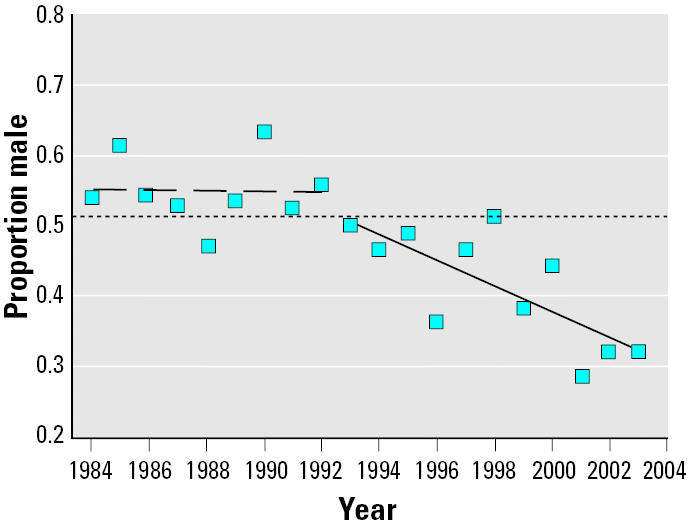
Members of the Aamjiwnaang First Nation community near Sarnia, Ontario, Canada, voiced concerns that there appeared to be fewer male children in their community in recent years. In response to these concerns, we assessed the sex ratio (proportion of male births) of the Aamjiwnaang First Nation over the period 1984-2003 as part of a community-based participatory research project. The trend in the proportion of male live births of the Aamjiwnaang First Nation has been declining continuously from the early 1990s to 2003, from an apparently stable sex ratio prior to this time. The proportion of male births (m) showed a statistically significant decline over the most recent 10-year period (1994-2003) (m = 0.412, p = 0.008) with the most pronounced decrease observed during the most recent 5 years (1999-2003) (m = 0.348, p = 0.006). Numerous factors have been associated with a decrease in the proportion of male births in a population, including a number of environmental and occupational chemical exposures. This community is located within the Great Lakes St. Clair River Area of Concern and is situated immediately adjacent to several large petrochemical, polymer, and chemical industrial plants. Although there are several potential factors that could be contributing to the observed decrease in sex ratio of the Aamjiwnaang First Nation, the close proximity of this community to a large aggregation of industries and potential exposures to compounds that may influence sex ratios warrants further assessment into the types of chemical exposures for this population. A community health survey is currently under way to gather more information about the health of the Aamjiwnaang community and to provide additional information about the factors that could be contributing to the observed decrease in the proportion of male births in recent years.
加拿大安大略省萨尼亚市附近的阿穆吉瓦纳昂第一民族社区的成员表达了担忧,称近年来他们社区的男童数量似乎有所减少。针对这些担忧,作为一项基于社区的参与性研究项目的一部分,我们评估了1984年至2003年期间阿穆吉瓦纳昂第一民族的性别比(男婴出生比例)。阿穆吉瓦纳昂第一民族男婴出生比例的趋势自20世纪90年代初至2003年一直在持续下降,在此之前性别比显然较为稳定。在最近的10年期间(1994 - 2003年),男婴出生比例(m)呈现出统计学上的显著下降(m = 0.412,p = 0.008),其中在最近的5年(1999 - 2003年)下降最为明显(m = 0.348,p = 0.006)。人口中男婴出生比例下降与许多因素有关,包括一些环境和职业性化学物质暴露。该社区位于五大湖圣克莱尔河关注区域内,紧邻几家大型石化、聚合物和化工工厂。尽管有几个潜在因素可能导致了阿穆吉瓦纳昂第一民族观察到的性别比下降,但该社区与大量工业聚集区的紧密相邻以及可能接触到可能影响性别比的化合物,这使得有必要进一步评估该人群的化学物质暴露类型。目前正在进行一项社区健康调查,以收集更多关于阿穆吉瓦纳昂社区健康的信息,并提供有关可能导致近年来观察到的男婴出生比例下降的因素的更多信息。