McBeth John, Chiu Yee H, Silman Alan J, Ray David, Morriss Richard, Dickens Chris, Gupta Anindya, Macfarlane Gary J
Arthritis Research Campaign (ARC) Epidemiology Unit, School of Epidemiology and Health Sciences, University of Manchester, Manchester, United Kingdom.
Arthritis Res Ther. 2005;7(5):R992-R1000. doi: 10.1186/ar1772. Epub 2005 Jun 17.
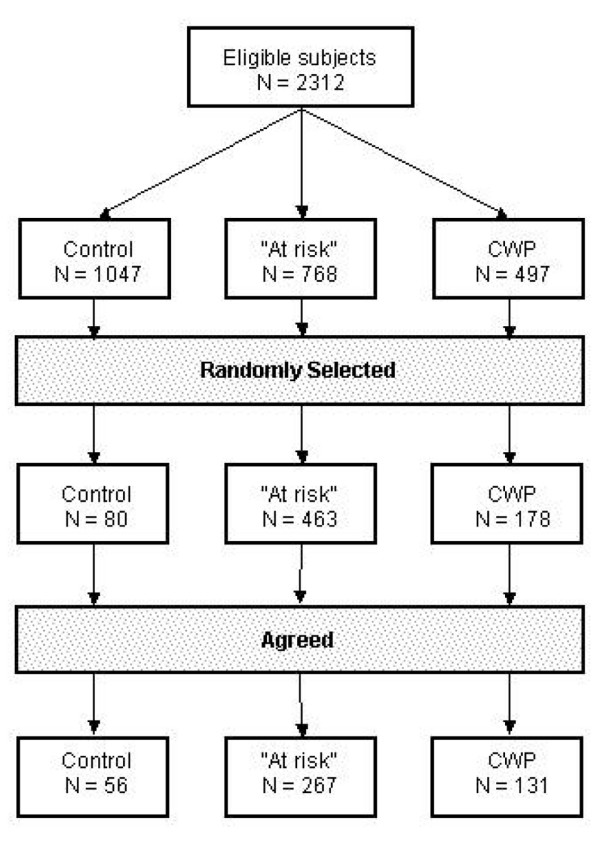
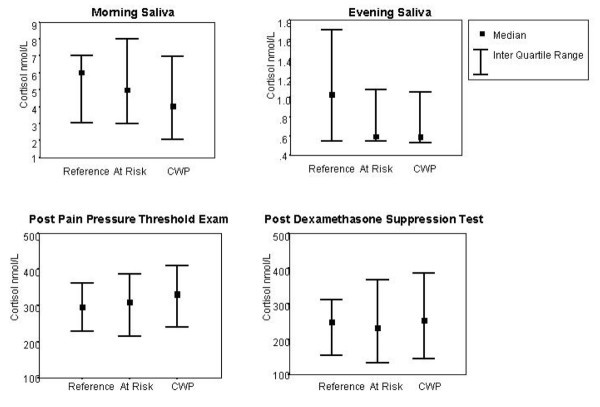
In clinic studies, altered hypothalamic-pituitary-adrenal (HPA) axis function has been associated with fibromyalgia, a syndrome characterised by chronic widespread body pain. These results may be explained by the associated high rates of psychological distress and somatisation. We address the hypothesis that the latter, rather than the pain, might explain the HPA results. A population study ascertained pain and psychological status in subjects aged 25 to 65 years. Random samples were selected from the following three groups: satisfying criteria for chronic widespread pain; free of chronic widespread pain but with strong evidence of somatisation ('at risk'); and a reference group. HPA axis function was assessed from measuring early morning and evening salivary cortisol levels, and serum cortisol after physical (pain pressure threshold exam) and chemical (overnight 0.25 mg dexamethasone suppression test) stressors. The relationship between HPA function with pain and the various psychosocial scales assessed was modelled using appropriate regression analyses, adjusted for age and gender. In all 131 persons with chronic widespread pain (participation rate 74%), 267 'at risk' (58%) and 56 controls (70%) were studied. Those in the chronic widespread pain and 'at risk' groups were, respectively, 3.1 (95% CI (1.3, 7.3)) and 1.8 (0.8, 4.0) times more likely to have a saliva cortisol score in the lowest third. None of the psychosocial factors measured were, however, associated with saliva cortisol scores. Further, those in the chronic widespread pain (1.9 (0.8, 4.7)) and 'at risk' (1.6 (0.7, 3.6)) groups were also more likely to have the highest serum cortisol scores. High post-stress serum cortisol was related to high levels of psychological distress (p = 0.05, 95% CI (0.02, 0.08)). After adjusting for levels of psychological distress, the association between chronic widespread pain and post-stress cortisol scores remained, albeit slightly attenuated. This is the first population study to demonstrate that those with established, and those psychologically at risk of, chronic widespread pain demonstrate abnormalities of HPA axis function, which are more marked in the former group. Although some aspects of the altered function are related to the psychosocial factors measured, we conclude that the occurrence of HPA abnormality in persons with chronic widespread pain is not fully explained by the accompanying psychological stress.
在临床研究中,下丘脑 - 垂体 - 肾上腺(HPA)轴功能改变与纤维肌痛有关,纤维肌痛是一种以慢性全身性疼痛为特征的综合征。这些结果可能由相关的高心理困扰率和躯体化来解释。我们探讨这样一种假设,即后者而非疼痛,可能解释HPA轴的结果。一项人群研究确定了25至65岁受试者的疼痛和心理状态。从以下三组中选取随机样本:符合慢性广泛性疼痛标准的;无慢性广泛性疼痛但有强烈躯体化证据的(“有风险”);以及一个参照组。通过测量清晨和傍晚的唾液皮质醇水平,以及在生理(疼痛压力阈值检查)和化学(过夜0.25毫克地塞米松抑制试验)应激源后的血清皮质醇来评估HPA轴功能。使用适当的回归分析对HPA功能与疼痛以及所评估的各种社会心理量表之间的关系进行建模,并对年龄和性别进行了调整。共研究了131名患有慢性广泛性疼痛的人(参与率74%)、267名“有风险”的人(58%)和56名对照者(70%)。慢性广泛性疼痛组和“有风险”组的人唾液皮质醇得分处于最低三分位的可能性分别是对照组的3.1倍(95%置信区间(1.3,7.3))和1.8倍(0.8,4.0)。然而,所测量的社会心理因素均与唾液皮质醇得分无关。此外,慢性广泛性疼痛组(1.9(0.8,4.7))和“有风险”组(1.6(0.7,3.6))的人血清皮质醇得分最高的可能性也更大。应激后血清皮质醇水平高与高水平的心理困扰有关(p = 0.05,95%置信区间(0.02,0.08))。在对心理困扰水平进行调整后,慢性广泛性疼痛与应激后皮质醇得分之间的关联仍然存在,尽管略有减弱。这是第一项人群研究,表明患有已确诊的慢性广泛性疼痛以及心理上有慢性广泛性疼痛风险的人存在HPA轴功能异常情况,且在前一组中更为明显。虽然功能改变的某些方面与所测量的社会心理因素有关,但我们得出结论,慢性广泛性疼痛患者中HPA异常的发生不能完全由伴随的心理压力来解释。