Wallden Brett, Emond Mary, Swift Mari E, Disis Mary L, Swisshelm Karen
Department of Pathology, University of Washington, Box 357470, Seattle, WA, USA.
BMC Cancer. 2005 Oct 28;5:140. doi: 10.1186/1471-2407-5-140.
The retinoic acid receptor beta 2 (RARbeta2) gene modulates proliferation and survival of cultured human breast cancer cells. Previously we showed that ectopic expression of RARbeta2 in a mouse xenograft model prevented metastasis, even in the absence of the ligand, all-trans retinoic acid. We investigated both cultured cells and xenograft tumors in order to delineate the gene expression profiles responsible for an antimetastatic phenotype.
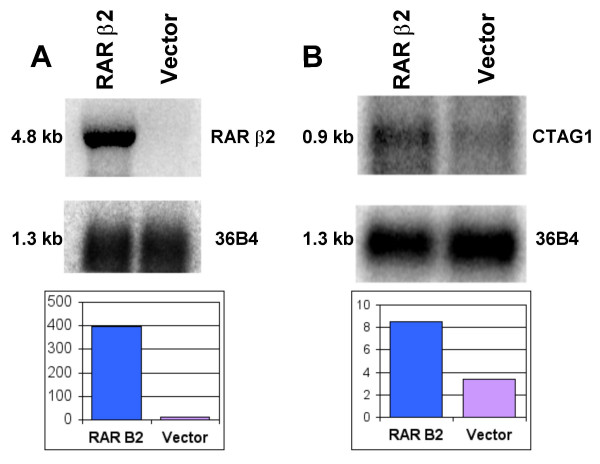
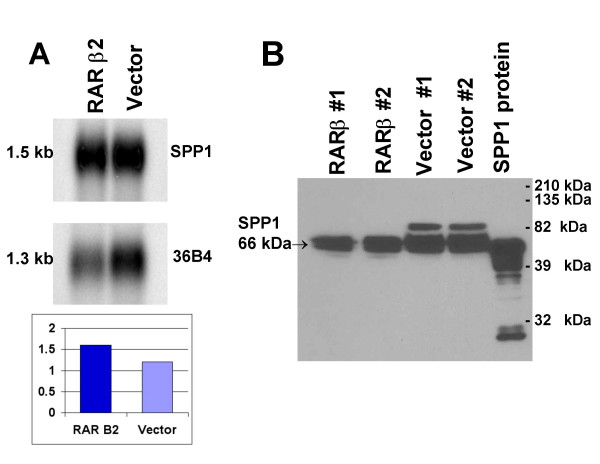
RNA from MDA-MB-435 human breast cancer cells transduced with RARbeta2 or empty retroviral vector (LXSN) was analyzed using Agilent Human 1A Oligo microarrays. The one hundred probes with the greatest differential intensity (p < 0.004, jointly) were determined by selecting the top median log ratios from eight-paired microarrays. Validation of differences in expression was done using Northern blot analysis and quantitative RT-PCR (qRT-PCR). We determined expression of selected genes in xenograft tumors.
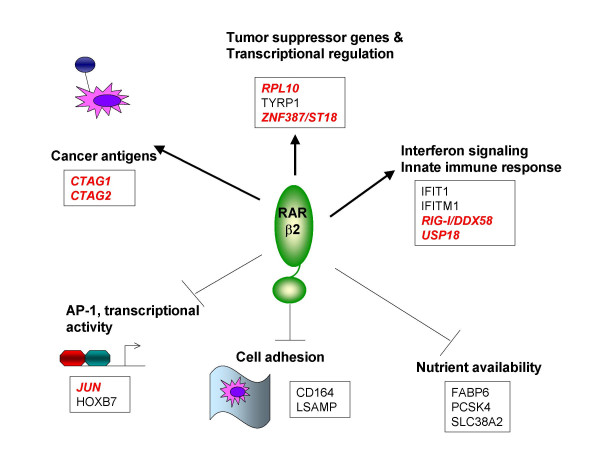
RARbeta2 cells exhibit gene profiles with overrepresentation of genes from Xq28 (p = 2 x 10(-8)), a cytogenetic region that contains a large portion of the cancer/testis antigen gene family. Other functions or factors impacted by the presence of exogenous RARbeta2 include mediators of the immune response and transcriptional regulatory mechanisms. Thirteen of fifteen (87%) of the genes evaluated in xenograft tumors were consistent with differences we found in the cell cultures (p = 0.007).
Antimetastatic RARbeta2 signalling, direct or indirect, results in an elevation of expression for genes such as tumor-cell antigens (CTAG1 and CTAG2), those involved in innate immune response (e.g., RIG-I/DDX58), and tumor suppressor functions (e.g., TYRP1). Genes whose expression is diminished by RARbeta2 signalling include cell adhesion functions (e.g, CD164) nutritional or metabolic processes (e.g., FABP6), and the transcription factor, JUN.
维甲酸受体β2(RARβ2)基因可调节培养的人乳腺癌细胞的增殖和存活。此前我们发现,在小鼠异种移植模型中,即使没有配体全反式维甲酸,RARβ2的异位表达也能防止转移。我们研究了培养细胞和异种移植肿瘤,以描绘出导致抗转移表型的基因表达谱。
使用安捷伦人类1A寡核苷酸微阵列分析用RARβ2或空逆转录病毒载体(LXSN)转导的MDA-MB-435人乳腺癌细胞的RNA。通过从八对微阵列中选择最高中位数对数比值,确定差异强度最大的100个探针(联合p < 0.004)。使用Northern印迹分析和定量逆转录-聚合酶链反应(qRT-PCR)验证表达差异。我们测定了异种移植肿瘤中选定基因的表达。
RARβ2细胞表现出基因谱,其中Xq28区域(p = 2×10⁻⁸)的基因过度表达,该细胞遗传学区域包含大部分癌胚抗原基因家族。受外源性RARβ2存在影响的其他功能或因子包括免疫反应介质和转录调控机制。在异种移植肿瘤中评估的15个基因中有13个(87%)与我们在细胞培养中发现的差异一致(p = 0.007)。
抗转移的RARβ2信号传导,直接或间接,导致肿瘤细胞抗原(CTAG1和CTAG2)、参与先天免疫反应的基因(如RIG-I/DDX58)和肿瘤抑制功能(如TYRP1)等基因的表达升高。其表达因RARβ2信号传导而降低的基因包括细胞粘附功能(如CD164)、营养或代谢过程(如FABP6)以及转录因子JUN。