Mathis J M, Simmons D M, He X, Swanson L W, Rosenfeld M G
Eukaryotic Regulatory Biology Program, University of California, San Diego, La Jolla 92093-0648.
EMBO J. 1992 Jul;11(7):2551-61. doi: 10.1002/j.1460-2075.1992.tb05320.x.
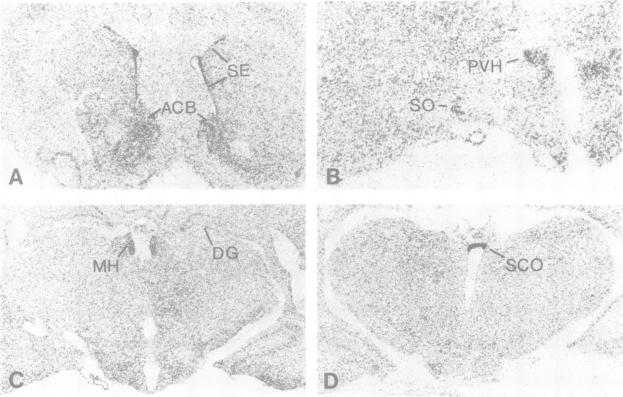
The POU domain gene family of transcription factors share a conserved bipartite DNA binding domain, and exhibit distinct temporal and spatial patterns of expression during development, particularly in the forebrain. A cDNA encoding a new member of the POU-III class of the POU domain gene family, referred to as Brn-4, was isolated from a rat hypothalamic cDNA library. Like other mammalian POU-III genes previously characterized (Brn-1, Brn-2, Tst-1), Brn-4 transcripts are initially widely expressed at all levels of the developing neural tube, but in contrast to other previously described POU-III genes, are subsequently restricted to only a few regions of the adult forebrain, including the supraoptic and paraventricular nuclei of the hypothalamus. Brn-4 was shown to bind to DNA sequences containing the octamer motif and to trans-activate promoters containing this DNA binding motif, based on the actions of a unique N-terminal information. This ontogenic pattern of Brn-4 expression in concert with that of Oct-2 and Pit-1, indicates that certain POU domain genes potentially exert their primary functions widely during early neural development, and in a very limited set of neurons in the mature brain.
POU结构域转录因子基因家族共享一个保守的双组分DNA结合结构域,并在发育过程中,尤其是在前脑,呈现出独特的时空表达模式。从大鼠下丘脑cDNA文库中分离出一个编码POU结构域基因家族POU-III类新成员的cDNA,称为Brn-4。与先前鉴定的其他哺乳动物POU-III基因(Brn-1、Brn-2、Tst-1)一样,Brn-4转录本最初在发育中的神经管各水平广泛表达,但与其他先前描述的POU-III基因不同的是,随后仅局限于成年前脑的少数区域,包括下丘脑的视上核和室旁核。基于独特的N端信息的作用,Brn-4被证明能与含有八聚体基序的DNA序列结合,并反式激活含有该DNA结合基序的启动子。Brn-4的这种个体发生表达模式与Oct-2和Pit-1的表达模式一致,表明某些POU结构域基因可能在神经发育早期广泛发挥其主要功能,而在成熟大脑中仅在非常有限的一组神经元中发挥作用。