School of Medicine, Medical Sciences and Nutrition, University of Aberdeen, Aberdeen AB25 2ZD, UK.
Department of Anatomy and Histology, School of Medicine, University of Albaha, Alaqiq 65779, Saudi Arabia.
G3 (Bethesda). 2024 May 7;14(5). doi: 10.1093/g3journal/jkae046.
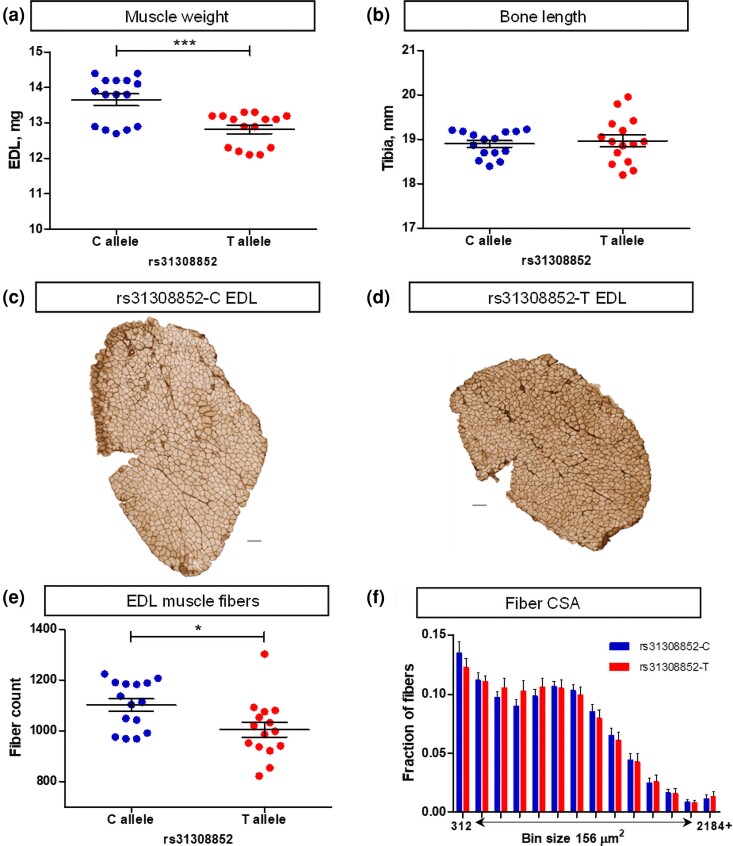
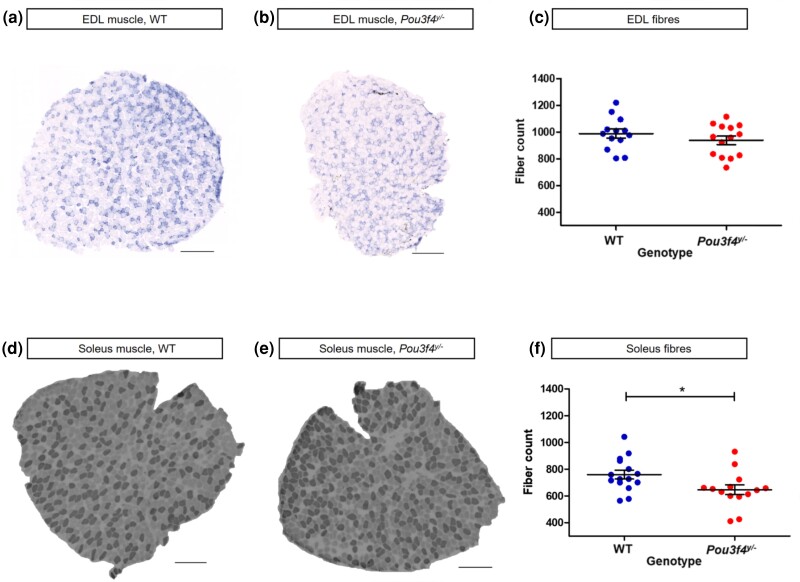
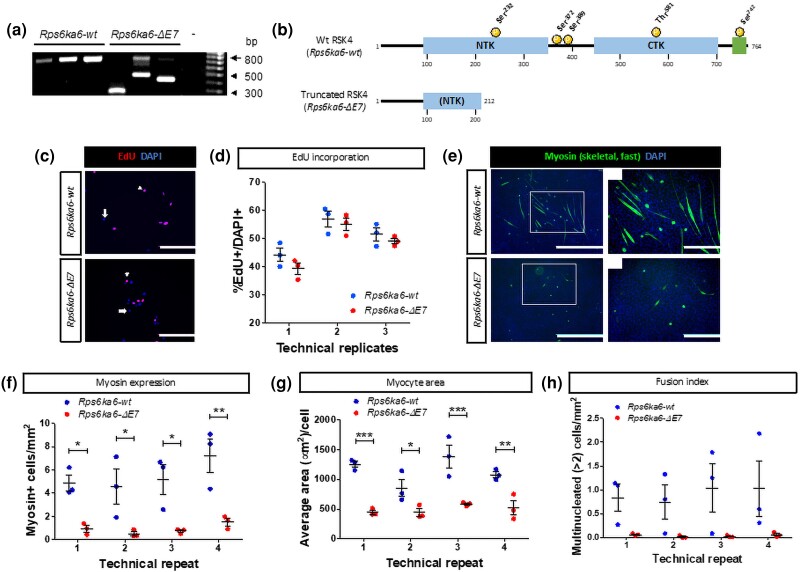
Genetic variability significantly contributes to individual differences in skeletal muscle mass; however, the specific genes involved in that process remain elusive. In this study, we examined the role of positional candidates, Rps6ka6 and Pou3f4, of a chromosome X locus, implicated in muscle mass variability in CFW laboratory mice. Histology of hindlimb muscles was studied in CFW male mice carrying the muscle "increasing" allele C (n = 15) or "decreasing" allele T (n = 15) at the peak marker of the locus, rs31308852, and in the Pou3f4y/- and their wild-type male littermates. To study the role of the Rps6ka6 gene, we deleted exon 7 (Rps6ka6-ΔE7) using clustered regularly interspaced palindromic repeats-Cas9 based method in H2Kb myogenic cells creating a severely truncated RSK4 protein. We then tested whether that mutation affected myoblast proliferation, migration, and/or differentiation. The extensor digitorum longus muscle was 7% larger (P < 0.0001) due to 10% more muscle fibers (P = 0.0176) in the carriers of the "increasing" compared with the "decreasing" CFW allele. The number of fibers was reduced by 15% (P = 0.0268) in the slow-twitch soleus but not in the fast-twitch extensor digitorum longus (P = 0.2947) of Pou3f4y/- mice. The proliferation and migration did not differ between the Rps6ka6-ΔE7 and wild-type H2Kb myoblasts. However, indices of differentiation (myosin expression, P < 0.0001; size of myosin-expressing cells, P < 0.0001; and fusion index, P = 0.0013) were significantly reduced in Rps6ka6-ΔE7 cells. This study suggests that the effect of the X chromosome locus on muscle fiber numbers in the fast-twitch extensor digitorum longus is mediated by the Rps6ka6 gene, whereas the Pou3f4 gene affects fiber number in slow-twitch soleus.
遗传变异性显著导致骨骼肌质量的个体差异;然而,涉及该过程的具体基因仍然难以捉摸。在这项研究中,我们研究了染色体 X 位置的位置候选基因 Rps6ka6 和 Pou3f4 在 CFW 实验室小鼠肌肉质量变异性中的作用。在携带该基因的 CFW 雄性小鼠中,研究了位于该基因峰标记 rs31308852 的肌肉“增加”等位基因 C(n = 15)或“减少”等位基因 T(n = 15)的后肢肌肉的组织学,以及 Pou3f4y/-及其野生型雄性同窝仔鼠。为了研究 Rps6ka6 基因的作用,我们使用簇状规则间隔的短回文重复序列-Cas9 基于方法在 H2Kb 成肌细胞中缺失外显子 7(Rps6ka6-ΔE7),创建了一个严重截断的 RSK4 蛋白。然后,我们测试了该突变是否影响成肌细胞的增殖、迁移和/或分化。与携带“减少”CFW 等位基因的小鼠相比,携带“增加”CFW 等位基因的小鼠伸趾长肌大 7%(P < 0.0001),因为肌肉纤维多 10%(P = 0.0176)。在慢肌比目鱼肌中,纤维数量减少 15%(P = 0.0268),但在快肌伸趾长肌中没有减少(P = 0.2947)。在 Rps6ka6-ΔE7 和野生型 H2Kb 成肌细胞之间,增殖和迁移没有差异。然而,分化指数(肌球蛋白表达,P < 0.0001;表达肌球蛋白的细胞大小,P < 0.0001;和融合指数,P = 0.0013)在 Rps6ka6-ΔE7 细胞中显著降低。这项研究表明,X 染色体基因座对快肌伸趾长肌中肌纤维数量的影响是由 Rps6ka6 基因介导的,而 Pou3f4 基因影响慢肌比目鱼肌中的纤维数量。