Apel I, Yu C L, Wang T, Dobry C, Van Antwerp M E, Jove R, Prochownik E V
Department of Pediatrics, University of Michigan School of Medicine, Ann Arbor 48109.
Mol Cell Biol. 1992 Aug;12(8):3356-64. doi: 10.1128/mcb.12.8.3356-3364.1992.
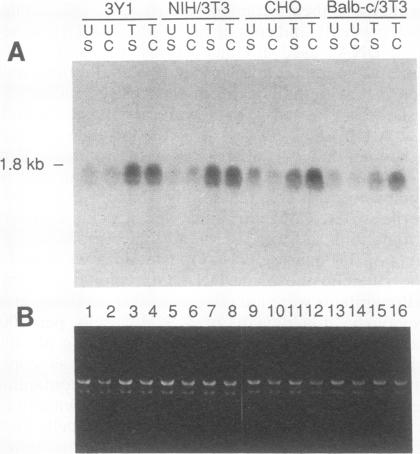
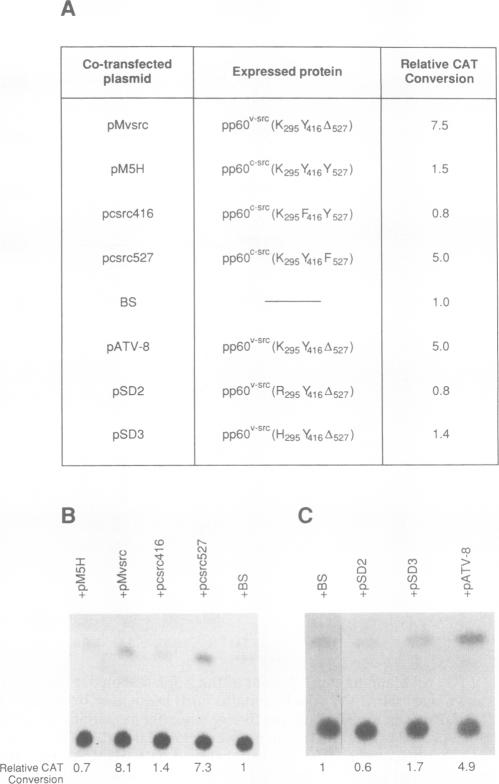
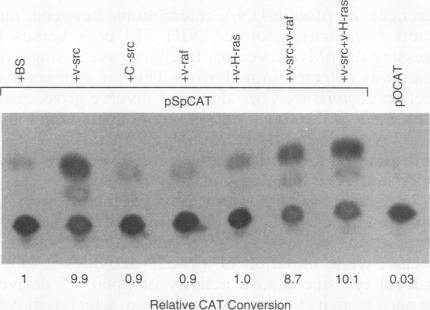
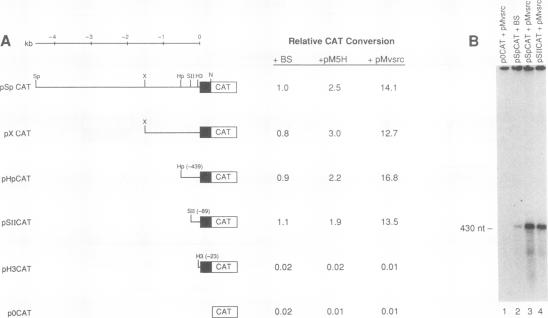
The proteins encoded by cellular and viral src genes are believed to be involved in the transmission of mitogenic signals, the nuclear recipients of which are largely unknown. In this work, we report that four different v-src-transformed cell lines from three different species possess elevated levels of junB transcripts. Transient expression of junB promoter-chloramphenicol acetyltransferase constructs in NIH 3T3 cells was used to demonstrate that the increase in junB transcripts was specifically associated with v-src expression and could not be recapitulated with a c-src, v-H-ras, or v-raf expression vector. Deletion mutants were used to localize the v-src-responsive region in the junB promoter to a 121-nucleotide region encompassing the CCAAT and TATAA elements. This region is distinct from one in the 5' untranslated region of the junB gene which is required to maintain its high-level basal expression. Point mutagenesis of the junB TATAA box completely abolished v-src responsiveness, suggesting that proteins which bind to this element are modified by src transformation. Several v-src and c-src mutants were used to demonstrate that elevated tyrosine kinase activity of src proteins is required for the observed effects on junB expression. Finally, homology between the TATAA box regions of junB and the unrelated but src-responsive gene 9E3/CEF-4 suggests that modulation of gene activity through proteins which bind to this region may be a recurrent, although not exclusive, theme in src transforming action. Our results suggest that src proteins may modulate some nuclear effectors through pathways not involving cellular ras or raf gene products.
细胞和病毒src基因编码的蛋白质被认为参与有丝分裂信号的传递,但其核内受体大多未知。在本研究中,我们报告来自三个不同物种的四种不同的v-src转化细胞系中junB转录本水平升高。通过在NIH 3T3细胞中瞬时表达junB启动子-氯霉素乙酰转移酶构建体,证明junB转录本的增加与v-src表达特异性相关,而c-src、v-H-ras或v-raf表达载体无法重现这种增加。缺失突变体用于将junB启动子中的v-src反应区域定位到一个包含CCAAT和TATAA元件的121个核苷酸区域。该区域与junB基因5'非翻译区中维持其高水平基础表达所需的区域不同。junB TATAA框的点突变完全消除了v-src反应性,表明与该元件结合的蛋白质被src转化修饰。使用几种v-src和c-src突变体证明,src蛋白升高的酪氨酸激酶活性是观察到的对junB表达影响所必需的。最后,junB与不相关但对src有反应的基因9E3/CEF-4的TATAA框区域之间的同源性表明,通过与该区域结合的蛋白质调节基因活性可能是src转化作用中一个反复出现(尽管不是唯一)的主题。我们的结果表明,src蛋白可能通过不涉及细胞ras或raf基因产物的途径调节一些核效应器。