Burns Malcolm J, Nixon Gavin J, Foy Carole A, Harris Neil
Bio-Molecular Innovation, LGC Limited, Queens Road, Teddington, Middlesex, TW11 0LY, UK.
BMC Biotechnol. 2005 Dec 7;5:31. doi: 10.1186/1472-6750-5-31.
As real-time quantitative PCR (RT-QPCR) is increasingly being relied upon for the enforcement of legislation and regulations dependent upon the trace detection of DNA, focus has increased on the quality issues related to the technique. Recent work has focused on the identification of factors that contribute towards significant measurement uncertainty in the real-time quantitative PCR technique, through investigation of the experimental design and operating procedure. However, measurement uncertainty contributions made during the data analysis procedure have not been studied in detail. This paper presents two additional approaches for standardising data analysis through the novel application of statistical methods to RT-QPCR, in order to minimise potential uncertainty in results.
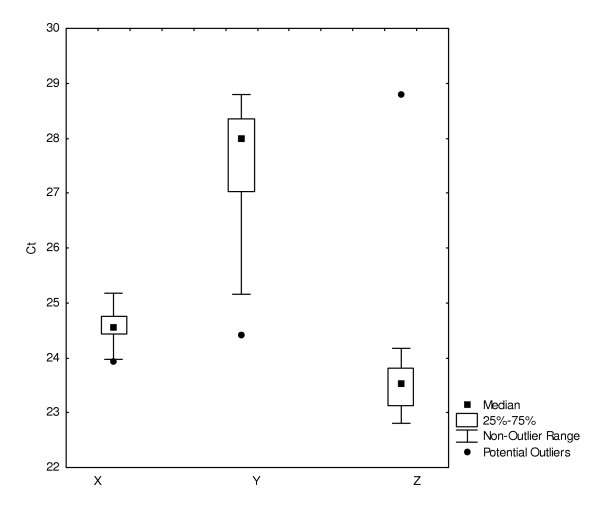
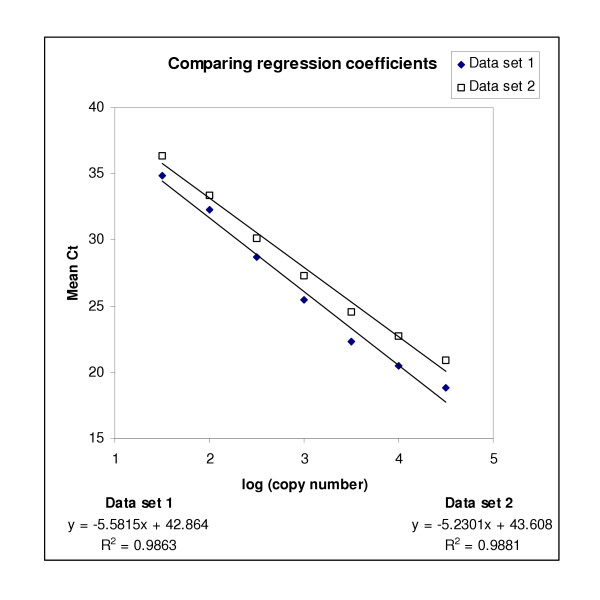
Experimental data was generated in order to develop the two aspects of data handling and analysis that can contribute towards measurement uncertainty in results. This paper describes preliminary aspects in standardising data through the application of statistical techniques to the area of RT-QPCR. The first aspect concerns the statistical identification and subsequent handling of outlying values arising from RT-QPCR, and discusses the implementation of ISO guidelines in relation to acceptance or rejection of outlying values. The second aspect relates to the development of an objective statistical test for the comparison of calibration curves.
The preliminary statistical tests for outlying values and comparisons between calibration curves can be applied using basic functions found in standard spreadsheet software. These two aspects emphasise that the comparability of results arising from RT-QPCR needs further refinement and development at the data-handling phase. The implementation of standardised approaches to data analysis should further help minimise variation due to subjective judgements. The aspects described in this paper will help contribute towards the development of a set of best practice guidelines regarding standardising handling and interpretation of data arising from RT-QPCR experiments.
由于实时定量聚合酶链反应(RT-QPCR)越来越多地被用于执行依赖于DNA痕量检测的法律法规,人们对该技术相关的质量问题关注度日益提高。最近的工作集中在通过对实验设计和操作程序的研究,来确定导致实时定量PCR技术中显著测量不确定度的因素。然而,数据分析过程中产生的测量不确定度贡献尚未得到详细研究。本文提出了另外两种通过将统计方法创新性地应用于RT-QPCR来规范数据分析的方法,以尽量减少结果中的潜在不确定度。
生成了实验数据,以开发可能导致结果测量不确定度的数据处理和分析的两个方面。本文描述了通过将统计技术应用于RT-QPCR领域来规范数据的初步方面。第一个方面涉及对RT-QPCR产生的异常值进行统计识别和后续处理,并讨论了与异常值接受或拒绝相关的ISO指南的实施情况。第二个方面涉及开发一种用于校准曲线比较的客观统计测试。
可以使用标准电子表格软件中的基本功能来应用异常值的初步统计测试以及校准曲线之间的比较。这两个方面强调,RT-QPCR结果的可比性在数据处理阶段需要进一步完善和发展。实施标准化的数据分析方法应有助于进一步减少因主观判断引起的变化。本文所述的方面将有助于制定一套关于规范RT-QPCR实验数据处理和解释的最佳实践指南。