Stefan Christopher P, Chase Kitty, Coyne Susan, Kulesh David A, Minogue Timothy D, Koehler Jeffrey W
Diagnostic Systems Division, United States Army Medical Research Institute of Infectious Disease, Fort Detrick, MD, USA.
Virol J. 2016 Mar 31;13:54. doi: 10.1186/s12985-016-0509-3.
Research with high biocontainment pathogens such as Rift Valley fever virus (RVFV) and Lassa virus (LASV) is expensive, potentially hazardous, and limited to select institutions. Surrogate pathogens such as Punta Toro virus (PTV) for RVFV infection and Pichinde virus (PICV) for LASV infection allow research to be performed under more permissive BSL-2 conditions. Although used as infection models, PTV and PICV have no standard real-time RT-qPCR assays to detect and quantify pathogenesis. PTV is also a human pathogen, making a standardized detection assay essential for biosurveillance. Here, we developed and characterized two real-time RT-qPCR assays for PICV and PTV by optimizing assay conditions and measuring the limit of detection (LOD) and performance in multiple clinical matrices.
Total nucleic acid from virus-infected Vero E6 cells was used to optimize TaqMan-minor groove binder (MGB) real-time RT-qPCR assays. A 10-fold dilution series of nucleic acid was used to perform analytical experiments with 60 replicates used to confirm assay LODs. Serum and whole blood spiked with 10-fold dilutions of PTV and PICV virus were assessed as matrices in a mock clinical context. The Cq, or cycle at which the fluoresce of each sample first crosses a threshold line, was determined using the second derivative method using Roche LightCycler 480 software version 1.5.1. Digital droplet PCR (ddPCR) was utilized to quantitatively determine RNA target counts/μl for PTV and PICV.
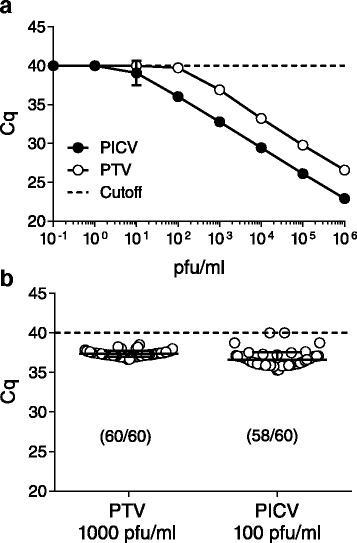
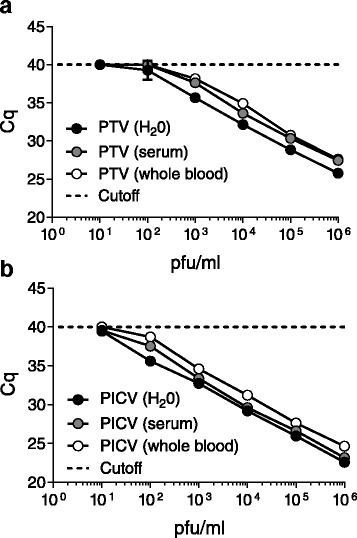
Optimized PTV and PICV assays had LODs of 1000 PFU/ml and 100 PFU/ml, respectively, and this LOD was confirmed in 60/60 (PTV) and 58/60 (PICV) positive replicates. Preliminary mock clinical LODs remained consistent in serum and whole blood for PTV and PICV at 1000 PFU/ml and 100 PFU/ml. An exclusivity panel showed no cross reaction with near neighbors.
PTV and PICV Taq-man MGB based real-time RT-qPCR assays developed here showed relevant sensitivity and reproducibility in samples extracted from a variety of clinical matrices. These assays will be useful as a standard by researchers for future experiments utilizing PTV and PICV as infection models, offering the ability to track infection and viral replication kinetics during research studies.
对诸如裂谷热病毒(RVFV)和拉沙病毒(LASV)等高生物安全病原体的研究成本高昂、具有潜在危险性,并且仅限于特定机构。用于RVFV感染的替代病原体如蓬塔托罗病毒(PTV)以及用于LASV感染的替代病原体如皮钦德病毒(PICV),使得研究能够在更宽松的生物安全二级(BSL-2)条件下进行。尽管PTV和PICV被用作感染模型,但它们没有用于检测和定量发病机制的标准实时逆转录定量聚合酶链反应(RT-qPCR)检测方法。PTV也是一种人类病原体,因此标准化的检测方法对于生物监测至关重要。在此,我们通过优化检测条件并测量检测限(LOD)以及在多种临床样本中的性能,开发并鉴定了针对PICV和PTV的两种实时RT-qPCR检测方法。
使用来自病毒感染的非洲绿猴肾细胞(Vero E6)的总核酸来优化TaqMan小沟结合剂(MGB)实时RT-qPCR检测方法。使用10倍稀释系列的核酸进行分析实验,共60个重复样本用于确认检测限。将添加了10倍稀释的PTV和PICV病毒的血清和全血作为模拟临床样本进行评估。使用罗氏LightCycler 480软件版本1.5.1的二阶导数法确定每个样本荧光首次越过阈值线时的循环数(Cq)。利用数字液滴聚合酶链反应(ddPCR)定量测定PTV和PICV的RNA靶标计数/微升。
优化后的PTV和PICV检测方法的检测限分别为1000 PFU/ml和100 PFU/ml,并且在60/60(PTV)和58/60(PICV)个阳性重复样本中得到了确认。PTV和PICV在血清和全血中的模拟临床初步检测限在1000 PFU/ml和100 PFU/ml时保持一致。特异性检测显示与近缘病毒无交叉反应。
在此开发的基于PTV和PICV Taq-Man MGB的实时RT-qPCR检测方法在从多种临床样本中提取的样本中显示出相关的灵敏度和可重复性。这些检测方法将为研究人员在未来利用PTV和PICV作为感染模型的实验中提供标准,使其能够在研究过程中追踪感染和病毒复制动力学。