Fermentation Biochemistry Research, Northern Regional Research Center, Agricultural Research Service, U.S. Department of Agriculture, 1815 North University Street, Peoria, Illinois 61604.
Appl Environ Microbiol. 1990 Nov;56(11):3435-8. doi: 10.1128/aem.56.11.3435-3438.1990.
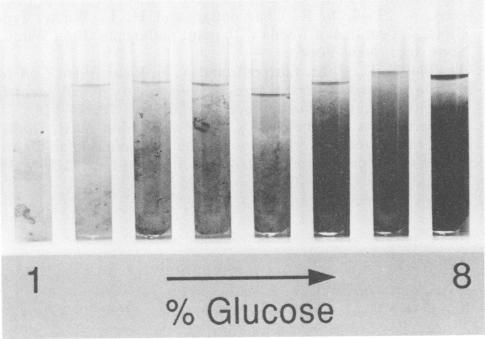
We assessed the influence of various carbon concentrations and carbon-to-nitrogen (C:N) ratios on Colletotrichum truncatum NRRL 13737 conidium formation in submerged cultures grown in a basal salts medium containing various amounts of glucose and Casamino Acids. Under the nutritional conditions tested, the highest conidium concentrations were produced in media with carbon concentrations of 4.0 to 15.3 g/liter. High carbon concentrations (20.4 to 40.8 g/liter) inhibited sporulation and enhanced the formation of microsclerotiumlike hyphal masses. At all the carbon concentrations tested, a culture grown in a medium with a C:N ratio of 15:1 produced more conidia than cultures grown in media with C:N ratios of 40:1 or 5:1. While glucose exhaustion was often coincident with conidium formation, cultures containing residual glucose sporulated and those with high carbon concentrations (>25 g/liter) exhausted glucose without sporulation. Nitrogen source studies showed that the levels of C. truncatum NRRL 13737 conidiation were similar for all protein hydrolysates tested. Reduced conidiation occurred when amino acid and inorganic nitrogen sources were used. Of the nine carbon sources evaluated, acetate as the sole carbon source resulted in the lowest level of sporulation.
我们评估了不同碳浓度和碳氮比(C:N)对 Colletotrichum truncatum NRRL 13737 分生孢子形成的影响,这些分生孢子是在含有不同量葡萄糖和氨基酸的基础盐培养基中进行的液体深层培养。在所测试的营养条件下,在碳浓度为 4.0 至 15.3 克/升的培养基中产生了最高的分生孢子浓度。高碳浓度(20.4 至 40.8 克/升)抑制了孢子形成并增强了类似小菌核的菌丝体团的形成。在所有测试的碳浓度下,以 C:N 比为 15:1 的培养基中培养的产孢量高于以 C:N 比为 40:1 或 5:1 的培养基中培养的产孢量。虽然葡萄糖耗尽通常与分生孢子形成同时发生,但含有残留葡萄糖的培养物进行了孢子形成,而高碳浓度(>25 克/升)的培养物在没有孢子形成的情况下耗尽了葡萄糖。氮源研究表明,所有测试的蛋白水解物的 C. truncatum NRRL 13737 分生孢子形成水平相似。当使用氨基酸和无机氮源时,分生孢子形成减少。在所评估的九种碳源中,仅以乙酸盐作为唯一碳源会导致最低水平的孢子形成。