Enevold Anders, Vestergaard Lasse S, Lusingu John, Drakeley Chris J, Lemnge Martha M, Theander Thor G, Bygbjerg Ib C, Alifrangis Michael
Centre for Medical Parasitology, Institute for Medical Microbiology and Immunology, Panum, 24.2, Blegdamsvej 3, 2200 Copenhagen N, Denmark.
Malar J. 2005 Dec 15;4:61. doi: 10.1186/1475-2875-4-61.
Mutations in the haemoglobin beta-globin (HbB) and glucose-6-phosphate dehydrogenase (G6PD) genes cause widespread human genetic disorders such as sickle cell diseases and G6PD deficiency. In sub-Saharan Africa, a few predominant polymorphic variants of each gene account for a majority of these deficiencies. Examining at a larger scale the clinical importance of these independent genetic disorders, their possible association with malaria pathogenesis and innate resistance, and their relevance for antimalarial drug treatment, would be easier if an accurate screening method with limited costs was available.
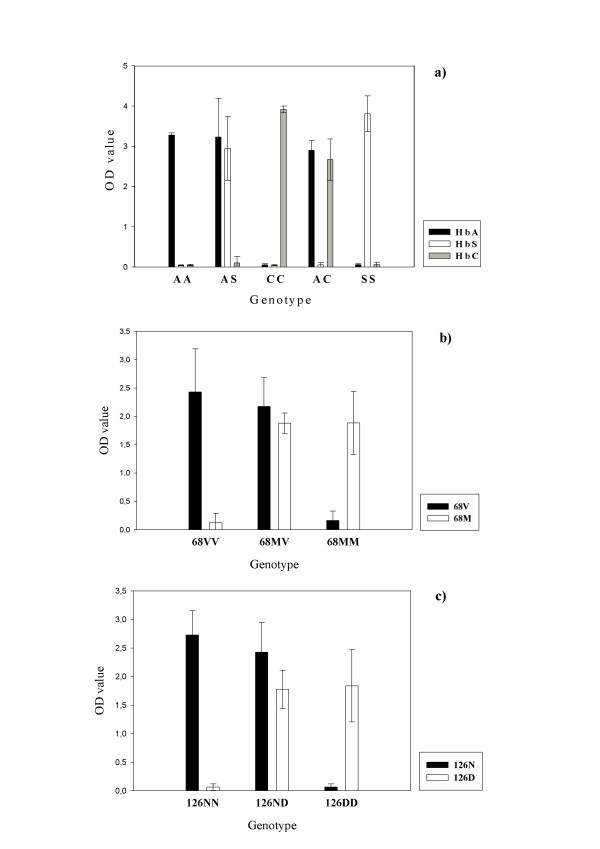
A simple and rapid technique was developed to detect the most prominent single nucleotide polymorphisms (SNPs) in the HbB and G6PD genes. The method is able to detect the different haemoglobin polymorphisms A, S, C and E, as well as G6PD polymorphisms B, A and A- based on PCR-amplification followed by a hybridization step using sequence-specific oligonucleotide probes (SSOPs) specific for the SNP variants and quantified by ELISA.
The SSOP-ELISA method was found to be specific, and compared well to the commonly used PCR-RFLP technique. Identical results were obtained in 98% (haemoglobin) and 95% (G6PD) of the tested 90 field samples from a high-transmission area in Tanzania, which were used to validate the new technique.
The simplicity and accuracy of the new methodology makes it suitable for application in settings where resources are limited. It would serve as a valuable tool for research purposes by monitoring genotype frequencies in relation to disease epidemiology.
血红蛋白β-珠蛋白(HbB)和葡萄糖-6-磷酸脱氢酶(G6PD)基因的突变会导致镰状细胞病和G6PD缺乏症等广泛的人类遗传疾病。在撒哈拉以南非洲,每个基因的一些主要多态性变体占这些缺陷的大部分。如果有成本有限的准确筛查方法,那么在更大规模上研究这些独立遗传疾病的临床重要性、它们与疟疾发病机制和先天抵抗力的可能关联以及它们对抗疟药物治疗的相关性将会更容易。
开发了一种简单快速的技术来检测HbB和G6PD基因中最突出的单核苷酸多态性(SNP)。该方法能够基于PCR扩增,然后使用针对SNP变体的序列特异性寡核苷酸探针(SSOP)进行杂交步骤,并通过ELISA定量,来检测不同的血红蛋白多态性A、S、C和E以及G6PD多态性B、A和A-。
发现SSOP-ELISA方法具有特异性,并且与常用的PCR-RFLP技术相比效果良好。在来自坦桑尼亚高传播地区的90个现场测试样本中,98%(血红蛋白)和95%(G6PD)的样本获得了相同的结果,这些样本用于验证新技术。
新方法的简单性和准确性使其适用于资源有限的环境。通过监测与疾病流行病学相关的基因型频率,它将成为研究目的的宝贵工具。