Christ-Crain Mirjam, Morgenthaler Nils G, Struck Joachim, Harbarth Stephan, Bergmann Andreas, Müller Beat
Department of Internal Medicine, University Hospital Basel, Petersgraben 4, 4031 Basel, Switzerland.
Crit Care. 2005;9(6):R816-24. doi: 10.1186/cc3885. Epub 2005 Nov 15.
Measurement of biomarkers is a potential approach to early assessment and prediction of mortality in patients with sepsis. The aim of the present study was to evaluate the prognostic value of mid-regional pro-adrenomedullin (MR-proADM) levels in a cohort of medical intensive care patients and to compare it with other biomarkers and physiological scores.
We evaluated blood samples from 101 consecutive critically ill patients admitted to the intensive care unit and from 160 age-matched healthy control individuals. The patients had initially been enrolled in a prospective observational study investigating the prognostic value of endocrine dysfunction in critically ill patients ("PEDCRIP" Study). The prognostic value of MR-proADM levels was compared with those of two physiological scores and of various biomarkers (for example C-reactive Protein, IL-6, procalcitonin). MR-proADM was measured in EDTA plasma from all patients using a new sandwich immunoassay.
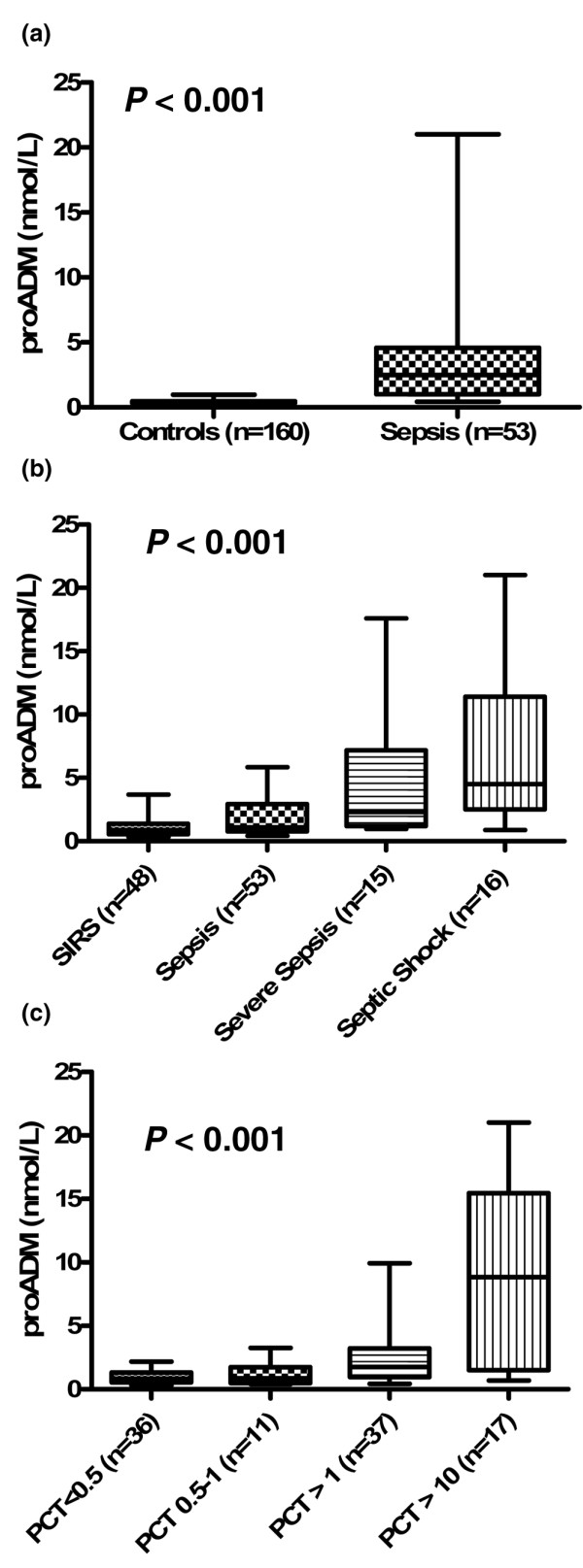
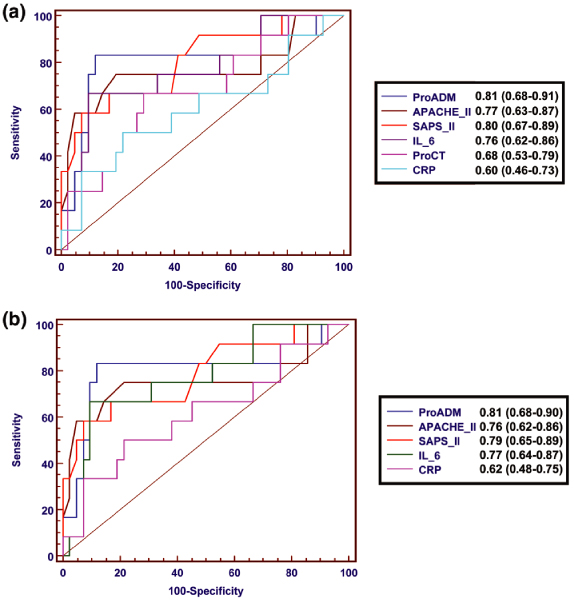
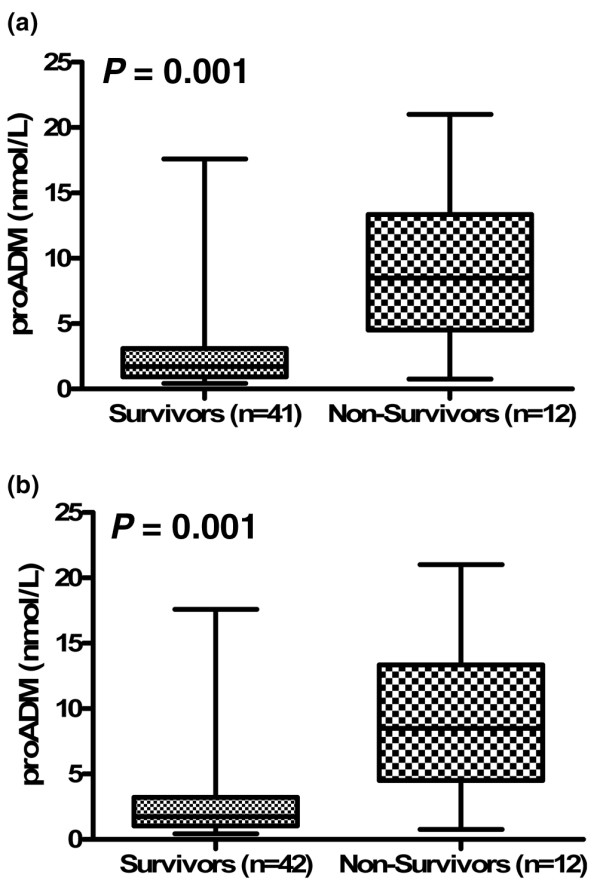
On admission, 53 patients had sepsis, severe sepsis, or septic shock, and 48 had systemic inflammatory response syndrome. Median MR-proADM levels on admission (nmol/l [range]) were 1.1 (0.3-3.7) in patients with systemic inflammatory response syndrome, 1.8 (0.4-5.8) in those with sepsis, 2.3 (1.0-17.6) in those with severe sepsis and 4.5 (0.9-21) in patients with septic shock. In healthy control individuals the median MR-proADM was 0.4 (0.21-0.97). On admission, circulating MR-proADM levels in patients with sepsis, severe sepsis, or septic shock were significantly higher in nonsurvivors (8.5 [0.8-21.0]; P < 0.001) than in survivors (1.7 [0.4-17.6]). In a receiver operating curve analysis of survival of patients with sepsis, the area under the curve (AUC) for MR-proADM was 0.81, which was similar to the AUCs for IL-6, Acute Physiology and Chronic Health Evaluation II score and Simplified Acute Physiology Score II. The prognostic value of MR-proADM was independent of the sepsis classification system used.
MR-proADM may be helpful in individual risk assessment in septic patients.
生物标志物的测量是早期评估和预测脓毒症患者死亡率的一种潜在方法。本研究的目的是评估中段肾上腺髓质素原(MR-proADM)水平在一组医学重症监护患者中的预后价值,并将其与其他生物标志物和生理评分进行比较。
我们评估了101例连续入住重症监护病房的危重症患者以及160例年龄匹配的健康对照个体的血样。这些患者最初被纳入一项前瞻性观察性研究,该研究旨在调查危重症患者内分泌功能障碍的预后价值(“PEDCRIP”研究)。将MR-proADM水平的预后价值与两种生理评分以及各种生物标志物(如C反应蛋白、白细胞介素-6、降钙素原)的预后价值进行比较。使用一种新的夹心免疫测定法对所有患者的乙二胺四乙酸血浆中的MR-proADM进行测量。
入院时,53例患者患有脓毒症、严重脓毒症或脓毒性休克,48例患有全身炎症反应综合征。全身炎症反应综合征患者入院时MR-proADM水平的中位数(nmol/l[范围])为1.1(0.3 - 3.7);脓毒症患者为1.8(0.4 - 5.8);严重脓毒症患者为2.3(1.0 - 17.6);脓毒性休克患者为4.5(0.9 - 21)。健康对照个体中MR-proADM的中位数为0.4(0.21 - 0.97)。入院时,脓毒症、严重脓毒症或脓毒性休克患者中,非存活者的循环MR-proADM水平(8.5[0.8 - 21.0];P < 0.001)显著高于存活者(1.7[0.4 - 17.6])。在对脓毒症患者生存情况的受试者工作特征曲线分析中,MR-proADM的曲线下面积(AUC)为0.81,这与白细胞介素-6、急性生理与慢性健康状况评分II以及简化急性生理评分II的AUC相似。MR-proADM的预后价值独立于所使用的脓毒症分类系统。
MR-proADM可能有助于脓毒症患者的个体风险评估。