Goumenos Dimitrios S, Kalliakmani Pantelitsa, Tsakas Sotiris, Sotsiou Florentia, Vlachojannis John G
Department of Internal Medicine-Nephrology, University Hospital, Patras, Greece.
BMC Nephrol. 2005 Dec 20;6:16. doi: 10.1186/1471-2369-6-16.
Crescentic nephritis is characterized by formation of cellular crescents that soon become fibrotic and result in irreversible damage, unless an effective immunosuppressive therapy is rapidly commenced. TGF-beta1 is involved in the development of crescents through various pathways. The aim of this study was to identify whether the determination of urinary TGF-beta1 levels in patients with crescentic nephritis could be used as a marker of response to treatment.
Fifteen patients with crescentic nephritis were included in the study. The renal expression of TGF-beta1 was estimated in biopsy sections by immunohistochemistry and urinary TGF-beta1 levels were determined by quantitative sandwich enzyme immunoassay (EIA). TGF-beta1 levels were determined at the time of renal biopsy, before the initiation of immunosuppressive treatment (corticosteroids, cyclophosphamide and plasma exchange). Twelve patients with other types of proliferative glomerulonephritis and ten healthy subjects were used as controls.
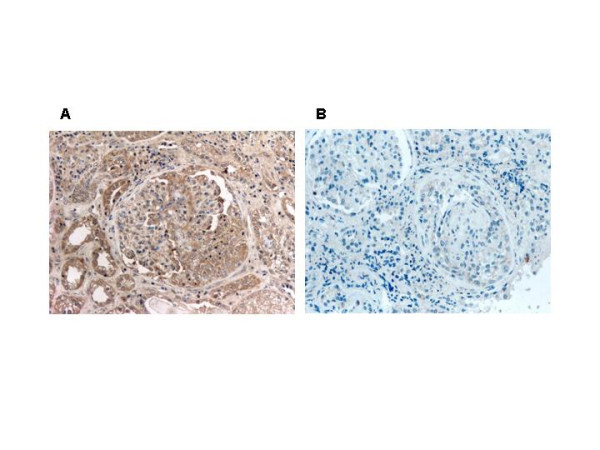
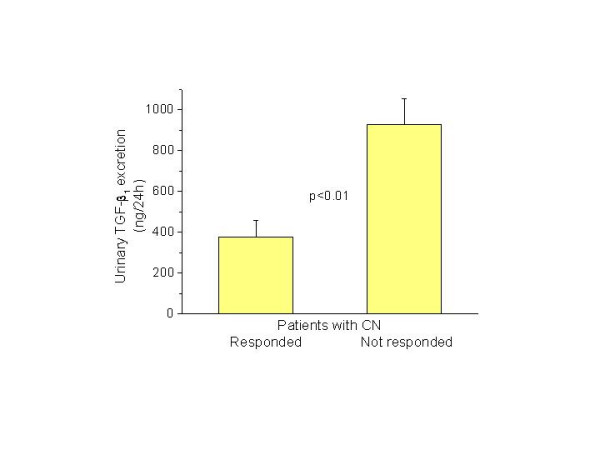
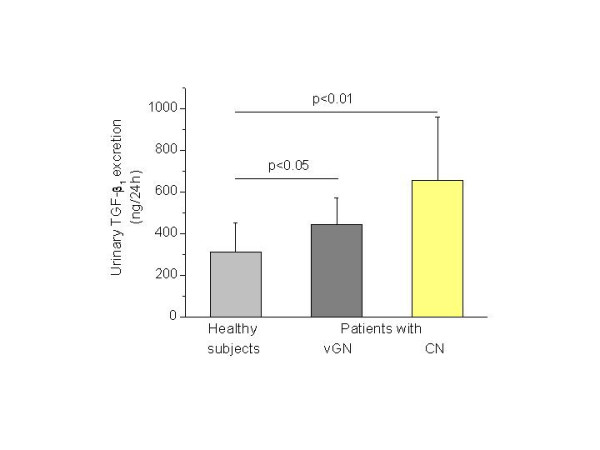
Improvement of renal function with immunosuppressive therapy was observed in 6 and stabilization in 4 patients (serum creatinine from 3.2 +/- 1.5 to 1.4 +/- 0.1 mg/dl and from 4.4 +/- 1.2 to 4.1 +/- 0.6 mg/dl, respectively). In 5 patients, with severe impairment of renal function who started on dialysis, no improvement was noted. The main histological feature differentiating these 5 patients from others with improved or stabilized renal function was the percentage patients with poor response to treatment were the percentage of glomeruli with crescents and the presence of ruptured Bowman's capsule and glomerular necrosis. Urinary TGF-beta1 levels were significantly higher in patients who showed no improvement of renal function with immunosuppressive therapy (930 +/- 126 ng/24 h vs. 376 +/- 84 ng/24 h, p < 0.01). TGF-beta1 was identified in crescents and tubular epithelial cells, whereas a significant correlation of TGF-beta1 immunostaining with the presence of fibrocellular cresents was observed (r = 0.531, p < 0,05).
Increased TGF-beta1 renal expression and urinary excretion that is related to the response to immunosuppressive therapy was observed in patients with crescentic nephritis. Evaluation of urinary TGF-beta1 levels may be proved a useful marker of clinical outcome in patients with crescentic nephritis.
新月体性肾炎的特征是形成细胞性新月体,这些新月体很快会纤维化,导致不可逆的损伤,除非迅速开始有效的免疫抑制治疗。转化生长因子-β1(TGF-β1)通过多种途径参与新月体的形成。本研究的目的是确定新月体性肾炎患者尿TGF-β1水平的测定是否可作为治疗反应的标志物。
15例新月体性肾炎患者纳入本研究。通过免疫组织化学法评估肾活检切片中TGF-β1的肾表达,采用定量夹心酶免疫测定法(EIA)测定尿TGF-β1水平。在肾活检时、免疫抑制治疗(皮质类固醇、环磷酰胺和血浆置换)开始前测定TGF-β1水平。12例其他类型增生性肾小球肾炎患者和10名健康受试者作为对照。
6例患者经免疫抑制治疗后肾功能改善,4例患者肾功能稳定(血清肌酐分别从3.2±1.5降至1.4±0.1mg/dl和从4.4±1.2降至4.1±0.6mg/dl)。5例开始透析的肾功能严重受损患者未见改善。将这5例患者与肾功能改善或稳定的其他患者区分开来的主要组织学特征是对治疗反应不佳患者中新月体肾小球的百分比以及鲍曼囊破裂和肾小球坏死的存在。免疫抑制治疗后肾功能无改善的患者尿TGF-β1水平显著更高(930±126ng/24h对376±84ng/24h,p<0.01)。在新月体和肾小管上皮细胞中鉴定出TGF-β1,同时观察到TGF-β1免疫染色与纤维细胞性新月体的存在显著相关(r=0.531,p<0.05)。
在新月体性肾炎患者中观察到与免疫抑制治疗反应相关的TGF-β1肾表达和尿排泄增加。尿TGF-β1水平的评估可能被证明是新月体性肾炎患者临床结局的有用标志物。