Shi Xiaochun, Chaires Jonathan B
Department of Biochemistry, University of Mississippi Medical Center, 2500 N. State St. Jackson, MS 39216-4505, USA.
Nucleic Acids Res. 2006 Jan 23;34(2):e14. doi: 10.1093/nar/gnj012.
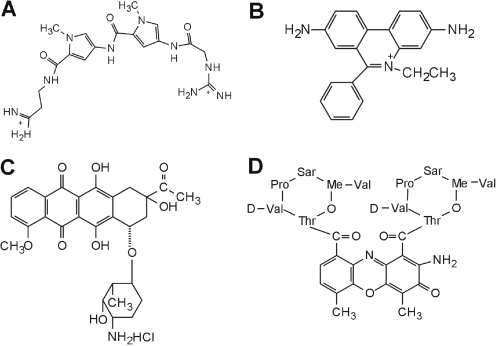
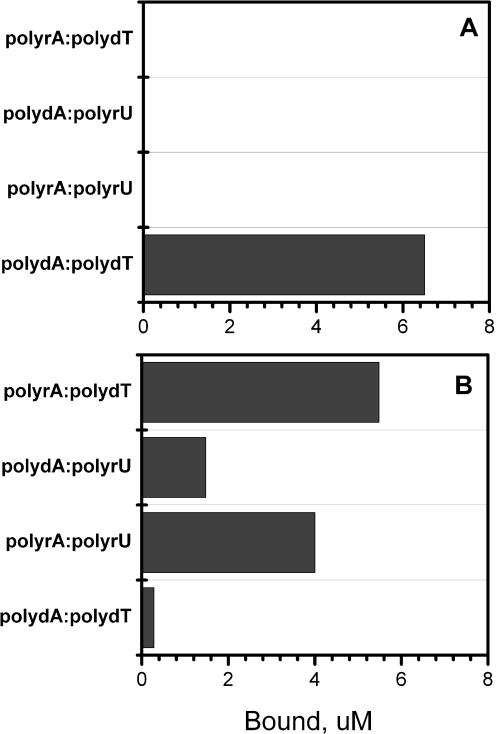
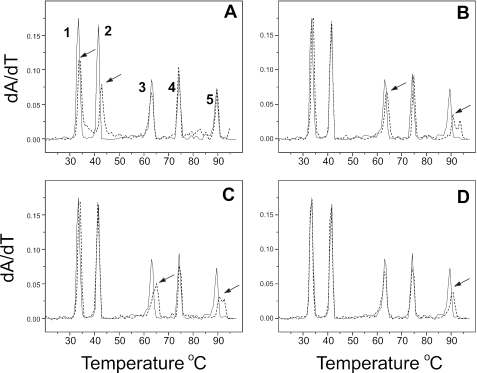
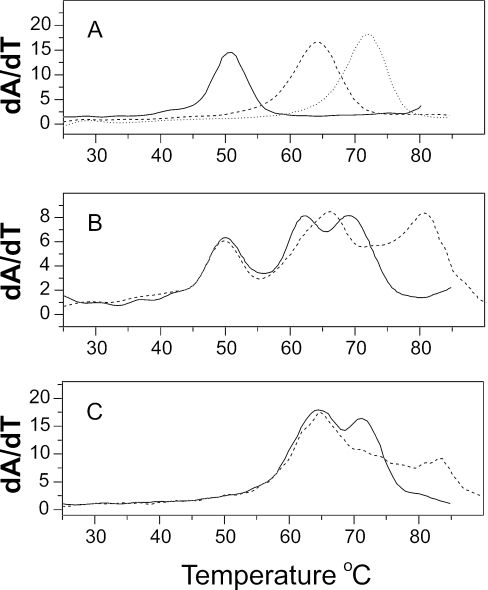
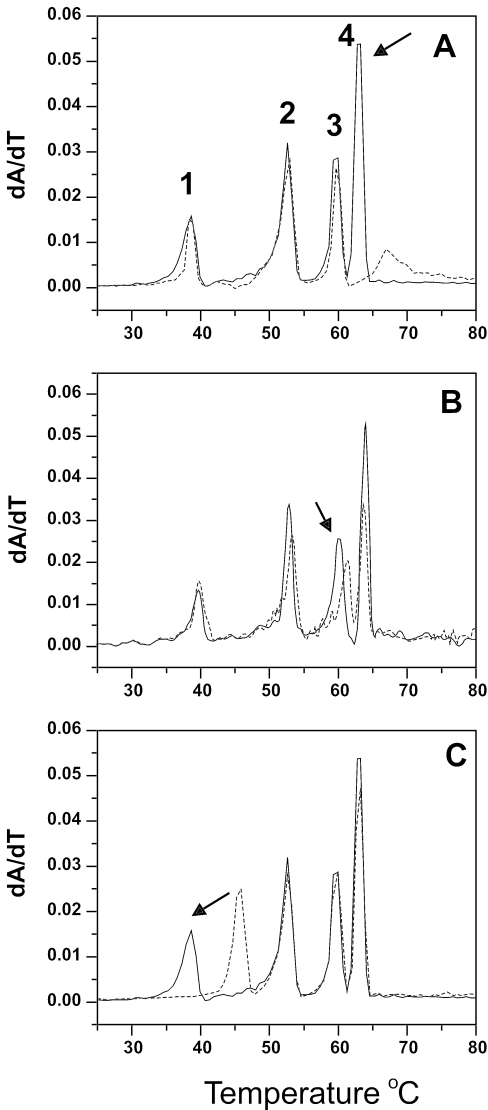
A simple method for the detection of sequence- and structural-selective ligand binding to nucleic acids is described. The method is based on the commonly used thermal denaturation method in which ligand binding is registered as an elevation in the nucleic acid melting temperature (T(m)). The method can be extended to yield a new, higher -throughput, assay by the simple expediency of melting designed mixtures of polynucleotides (or oligonucleotides) with different sequences or structures of interest. Upon addition of ligand to such mixtures at low molar ratios, the T(m) is shifted only for the nucleic acid containing the preferred sequence or structure. Proof of principle of the assay is provided using first a mixture of polynucleotides with different sequences and, second, with a mixture containing DNA, RNA and two types of DNA:RNA hybrid structures. Netropsin, ethidium, daunorubicin and actinomycin, ligands with known sequence preferences, were used to illustrate the method. The applicability of the approach to oligonucleotide systems is illustrated by the use of simple ternary and binary mixtures of defined sequence deoxyoligonucleotides challenged by the bisanthracycline WP631. The simple mixtures described here provide proof of principle of the assay and pave the way for the development of more sophisticated mixtures for rapidly screening the selectivity of new nucleic acid binding compounds.
本文描述了一种检测与核酸结合的序列和结构选择性配体的简单方法。该方法基于常用的热变性方法,其中配体结合表现为核酸解链温度(T(m))的升高。通过简单地熔化具有不同感兴趣序列或结构的多核苷酸(或寡核苷酸)设计混合物,该方法可以扩展为一种新的、高通量的检测方法。以低摩尔比向此类混合物中添加配体时,T(m)仅针对含有优选序列或结构的核酸发生变化。首先使用具有不同序列的多核苷酸混合物,其次使用含有DNA、RNA和两种类型DNA:RNA杂交结构的混合物,来提供该检测方法的原理证明。使用已知序列偏好的配体纺锤菌素、溴化乙锭、柔红霉素和放线菌素来说明该方法。通过使用由双蒽环类药物WP631挑战的特定序列脱氧寡核苷酸的简单三元和二元混合物,来说明该方法在寡核苷酸系统中的适用性。本文所述的简单混合物提供了该检测方法的原理证明,并为开发更复杂的混合物以快速筛选新核酸结合化合物的选择性铺平了道路。