Lee Jae-il, Kim Myung-jin, Park Chang-sik, Kim Myung-cheol
Laboratory of Veterinary Surgery, College of Veterinary Medicine, Chungnam National University, Daejeon 305-764, Korea.
J Vet Sci. 2006 Mar;7(1):79-81. doi: 10.4142/jvs.2006.7.1.79.
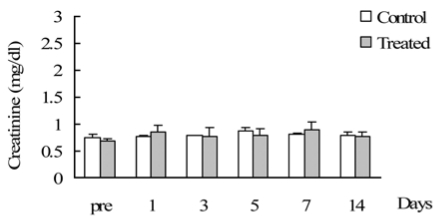
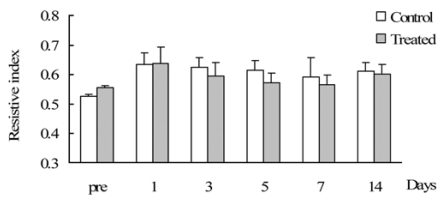
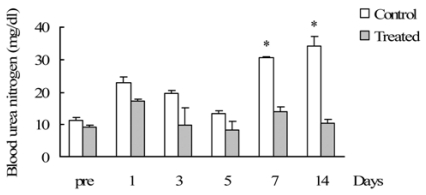
Renal ischemia as a course of renal transplantation is a common cause of renal dysfunction as renal failure. The purpose of this study was to investigate the influence of ascorbic acid on blood urea nitrogen (BUN), creatinine (Cr) and resistive index (RI) for dog models with renal ischemia-reperfusion (I/R) injury. Renal ischemia was induced on 6 Beagle dogs. The left kidney was exposed to normothermic ischemia for a short period at 30 min followed by reperfusion. On the blood Cr level and RI, there was no significant difference comparing both groups. 14 days after I/R injury a significant reduction on the blood BUN level was observed in the vehicle group (34.06 mg/dl) compared to that of ischemia induced treated group (10.3 mg/dl) (p < 0.05). In conclusion, administration of ascorbic acid for renal ischemic-reperfusion injury had influence on blood BUN level, but it was not revealed the influence on blood Cr and RI.
肾缺血作为肾移植过程中的一个环节,是导致肾功能障碍乃至肾衰竭的常见原因。本研究旨在探讨抗坏血酸对肾缺血再灌注(I/R)损伤犬模型血尿素氮(BUN)、肌酐(Cr)和阻力指数(RI)的影响。对6只比格犬进行肾缺血诱导。左肾暴露于常温缺血30分钟,随后进行再灌注。在血Cr水平和RI方面,两组之间无显著差异。I/R损伤14天后,与缺血诱导治疗组(10.3mg/dl)相比,载体组血BUN水平显著降低(34.06mg/dl)(p<0.05)。综上所述,抗坏血酸用于肾缺血再灌注损伤对血BUN水平有影响,但未显示对血Cr和RI有影响。