Moureau-Zabotto L, Ricci S, Lefranc J P, Coulet F, Genestie C, Antoine M, Uzan S, Lotz J P, Touboul E, Lacave R
Service d'Oncologie Radiothérapie, Hôpital Tenon, AP-HP, Cancerest, GHU EST, Université Paris VI, 4 rue de la Chine, Paris 75020, France.
Br J Cancer. 2006 Feb 27;94(4):473-80. doi: 10.1038/sj.bjc.6602958.
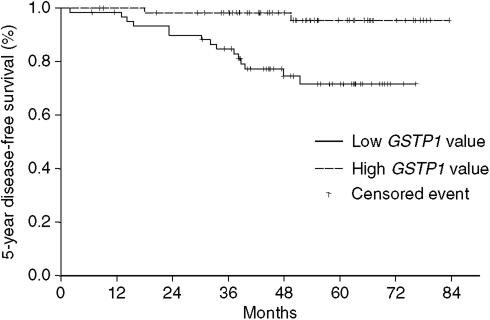
Study of the prognostic impact of multidrug resistance gene expression in the management of breast cancer in the context of adjuvant therapy. This study involved 171 patients treated by surgery, adjuvant chemotherapy+/-radiotherapy+/-hormonal therapy (mean follow-up: 55 months). We studied the expression of multidrug resistance gene 1 (MDR1), multidrug resistance-associated protein (MRP1), and glutathione-S-transferase P1 (GSTP1) using a standardised, semiquantitative rt-PCR method performed on frozen samples of breast cancer tissue. Patients were classified as presenting low or high levels of expression of these three genes. rt-PCR values were correlated with T stage, N stage, Scarff-Bloom-Richardson (SBR) grade, age and hormonal status. The impact of gene expression levels on 5-year disease-free survival (DFS) and overall survival (OS) was studied by univariate and multivariate Cox analysis. No statistically significant correlation was demonstrated between MDR1, MRP1 and GSTP1 expressions. On univariate analysis, DFS was significantly decreased in a context of low GSTP1 expression (P = 0.0005) and high SBR grade (P = 0.003), size > or = 5 cm (P = 0.038), high T stage (P = 0.013), presence of intravascular embolus (P = 0.034), and >3 N+ (P = 0.05). On multivariate analysis, GSTP1 expression and the presence of ER remained independent prognostic factors for DFS. GSTP1 expression did not affect OS. The levels of MDR1 and MRP1 expression had no significant influence on DFS or OS. GSTP1 expression can be considered to be an independent prognostic factor for DFS in patients receiving adjuvant chemotherapy for breast cancer.
辅助治疗背景下多药耐药基因表达对乳腺癌治疗预后影响的研究。本研究纳入了171例接受手术、辅助化疗±放疗±激素治疗的患者(平均随访时间:55个月)。我们采用标准化的半定量逆转录聚合酶链反应(rt-PCR)方法,对乳腺癌组织的冷冻样本进行检测,研究多药耐药基因1(MDR1)、多药耐药相关蛋白(MRP1)和谷胱甘肽-S-转移酶P1(GSTP1)的表达情况。将患者分为这三个基因表达水平低或高的两组。rt-PCR值与肿瘤T分期、N分期、斯卡夫-布卢姆-理查森(SBR)分级、年龄及激素状态相关。通过单因素和多因素Cox分析,研究基因表达水平对5年无病生存期(DFS)和总生存期(OS)的影响。未发现MDR1、MRP1和GSTP1表达之间存在统计学显著相关性。单因素分析显示,GSTP1低表达(P = 0.0005)、高SBR分级(P = 0.003)、肿瘤大小≥5 cm(P = 0.038)、高T分期(P = 0.013)、存在血管内栓子(P = 0.034)及3个以上阳性淋巴结(P = 0.05)时,DFS显著降低。多因素分析表明,GSTP1表达和雌激素受体(ER)状态仍是DFS的独立预后因素。GSTP1表达不影响OS。MDR1和MRP1表达水平对DFS或OS无显著影响。对于接受乳腺癌辅助化疗的患者,GSTP1表达可被视为DFS的独立预后因素。