Tsuiji Makoto, Yurasov Sergey, Velinzon Klara, Thomas Saskia, Nussenzweig Michel C, Wardemann Hedda
Laboratory of Molecular Immunology, The Rockefeller University, New York, NY 10021, USA.
J Exp Med. 2006 Feb 20;203(2):393-400. doi: 10.1084/jem.20052033. Epub 2006 Jan 30.
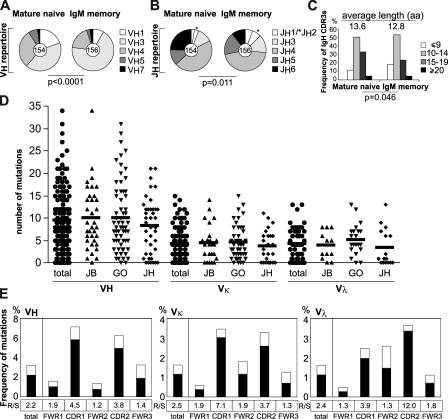
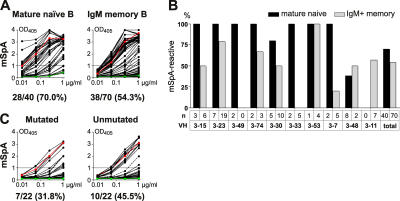
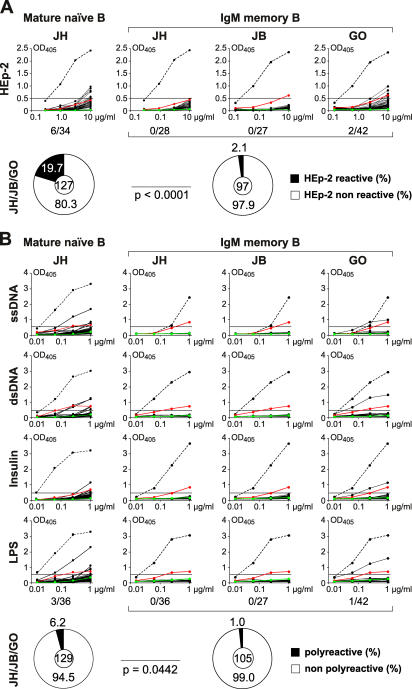
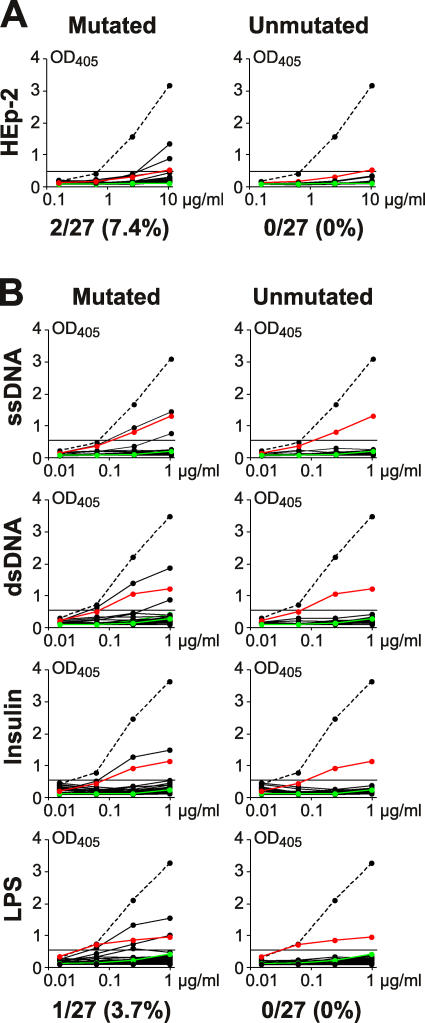
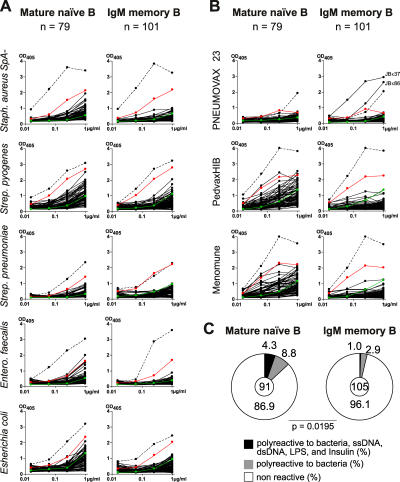
Autoantibodies are removed from the repertoire at two checkpoints during B cell development in the bone marrow and the periphery. Despite these checkpoints, up to 20% of the antibodies expressed by mature naive B cells in healthy humans show low levels of self-reactivity. To determine whether self-reactive antibodies are also part of the antigen-experienced memory B cell compartment, we analyzed recombinant antibodies cloned from single circulating human IgM+ memory B cells. Cells expressing antibodies specific for individual bacterial polysaccharides were expanded in the IgM+ memory compartment. In contrast, B cells expressing self-reactive and broadly bacterially reactive antibodies were removed from the repertoire in the transition from naive to IgM+ memory B cell. Selection against self-reactive antibodies was implemented before the onset of somatic hypermutation. We conclude that a third checkpoint selects against self-reactivity during IgM+ memory B cell development in humans.
自身抗体在骨髓和外周B细胞发育的两个检查点从抗体库中被清除。尽管有这些检查点,但在健康人类中,成熟幼稚B细胞表达的抗体中高达20%显示出低水平的自身反应性。为了确定自身反应性抗体是否也是抗原经验性记忆B细胞区室的一部分,我们分析了从单个循环人IgM⁺记忆B细胞克隆的重组抗体。表达针对个别细菌多糖特异性抗体的细胞在IgM⁺记忆区室中扩增。相比之下,表达自身反应性和广泛细菌反应性抗体的B细胞在从幼稚B细胞向IgM⁺记忆B细胞转变过程中从抗体库中被清除。针对自身反应性抗体的选择在体细胞高频突变开始之前就已实施。我们得出结论,在人类IgM⁺记忆B细胞发育过程中,第三个检查点针对自身反应性进行选择。