Institut für Botanik, Universität Hannover, D-3000 Hannover 21, FRG.
EMBO J. 1985 Aug;4(8):1901-9. doi: 10.1002/j.1460-2075.1985.tb03869.x.
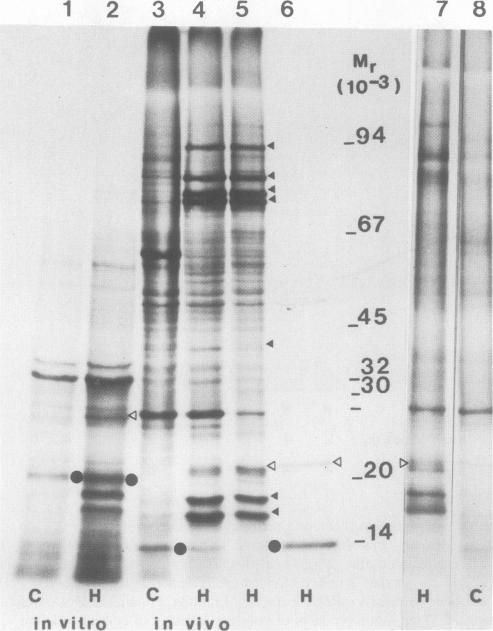
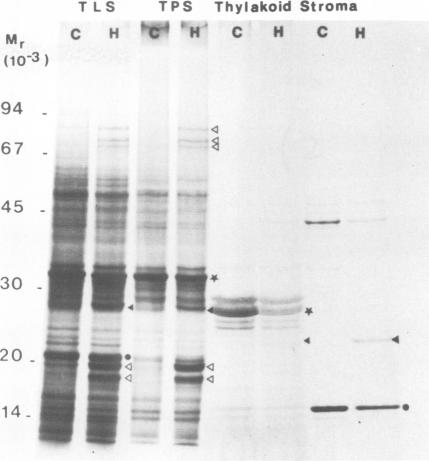
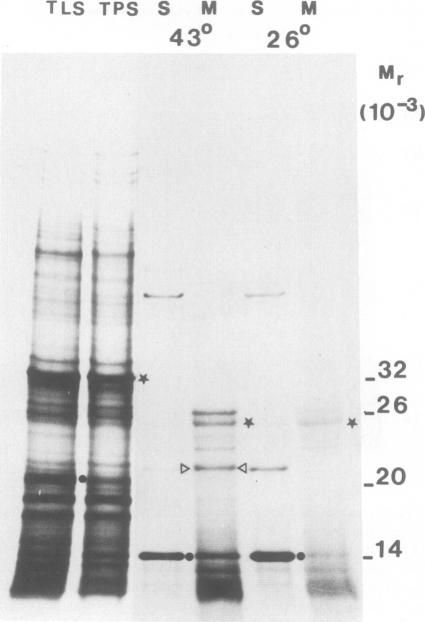
The synthesis, transport and localization of a nuclear coded 22-kd heat-shock protein (HSP) in the chloroplast membranes was studied in pea plants and Chlamydomonas reinhardi. HSPs were detected in both systems by in vivo labeling and in vitro translation of poly(A)RNA, using the wheat-germ and reticulocyte lysate systems. Heat-shock treatment of pea plants for 2 h at 42-45 degrees C induces the expression of 10 nuclear coded proteins, among which several (18 kd, 19 kd, 22 kd) are predominant. A 22-kd protein is synthesized as a 26-kd precursor protein and is localized in a chloroplast membrane fraction in vivo. Following post-translational transport into intact chloroplasts in vitro of the 26-kd precursor, the protein is processed but the resulting 22-kd mature protein is localized in the chloroplast stroma. If, however, the in vitro transport is carried out with chloroplasts from heat-shocked plants, the 22-kd protein is preferentially transported to the chloroplast membrane fraction. In C. reinhardi the synthesis of poly(A)RNAs coding for several HSPs is progressively and sequentially induced when raising the temperature for 1.5 h from 36 degrees C to 42 degrees C, while that of several preexisting RNAs is reduced. Various pre-existing poly(A)RNAs endure in the cells at 42 degrees C up to 5 h but are no longer translated in vivo, whereas some poly(A)RNAs persist and are translated. As in pea, a poly(A)RNA coded 22-kd HSP is localized in the chloroplast membranes in vivo, although it is translated as a 22-kd protein in vitro. The in vitro translated protein is not transported in isolated pea chloroplast which, however, processes and transports other nuclear coded chloroplast proteins of Chlamydomonas. The poly(A)RNA coding for the 22-kd HSP appears after 1 h at 36 degrees C. Its synthesis increases with the temperature of incubation up to 42 degrees C, although it decreases after 2 h of heat treatment and the already synthesized RNA is rapidly degraded. The degradation is faster upon return of the cells to 26 degrees C. None of the heat-induced proteins is identical to the light-inducible proteins of the chloroplast membranes.
我们研究了豌豆植物和衣藻叶绿体膜中核编码的 22kD 热休克蛋白(HSP)的合成、转运和定位。在这两个系统中,我们通过体内标记和使用小麦胚和网织红细胞裂解物系统的体外翻译,检测到 HSP。在 42-45°C 下对豌豆植物进行 2 小时的热休克处理会诱导 10 种核编码蛋白的表达,其中几种(18kD、19kD、22kD)是主要的。22kD 蛋白作为 26kD 前体蛋白合成,并在体内定位于叶绿体膜部分。体外将 26kD 前体的翻译产物转入完整的叶绿体后,该蛋白发生加工,但产生的 22kD 成熟蛋白定位于叶绿体基质中。然而,如果用热休克植物的叶绿体进行体外转运,22kD 蛋白则优先转运到叶绿体膜部分。在衣藻中,当将温度从 36°C 升高到 42°C 时,几种 HSP 的编码 poly(A)RNA 逐渐、顺序地被诱导合成,而几种现有 RNA 的合成则减少。在 42°C 下,各种现有 poly(A)RNA 可在细胞中存活长达 5 小时,但不再在体内翻译,而一些 poly(A)RNA 则持续存在并被翻译。与豌豆一样,体内定位于叶绿体膜的 poly(A)RNA 编码的 22kD HSP 尽管在体外翻译为 22kD 蛋白,但在体内被翻译。体外翻译的蛋白不能在分离的豌豆叶绿体中转运,然而,该叶绿体可以加工和转运衣藻的其他核编码叶绿体蛋白。编码 22kD HSP 的 poly(A)RNA 在 36°C 下 1 小时后出现。其合成随孵育温度升高至 42°C 而增加,但在热处理 2 小时后减少,并且已经合成的 RNA 迅速降解。当细胞返回 26°C 时,降解速度更快。热诱导的蛋白中没有一种与叶绿体膜的光诱导蛋白相同。