Cetina Lucely, Rivera Lesbia, Hinojosa José, Poitevin Adela, Uribe Jesús, López-Graniel Carlos, Cantú David, Candelaria Myrna, de la Garza Jaime, Dueñas-González Alfonso
Division of Clinical Research, Instituto Nacional de Cancerología (INCan), Mexico City, Mexico.
BMC Womens Health. 2006 Feb 7;6:3. doi: 10.1186/1472-6874-6-3.
Globally, cervical cancer primarily affects socially disadvantaged women. Five randomized trials were the foundation for adopting cisplatin-based chemotherapy during radiation as the standard of care for high-risk patients after primary radical hysterectomy who require adjuvant radiation and for locally advanced patients treated with definitive radiation. These results were obtained in clinical trials performed in carefully prepared academic centers; hence, we sought to determine whether these results could be reproduced when patients were treated on an out-of-protocol basis.
We reviewed the files of 294 patients with locally advanced cervical cancer who received radiation plus weekly cisplatin as routine management between 1999 to 2003, and analyzed treatment compliance, response rate, toxicity, and survival.
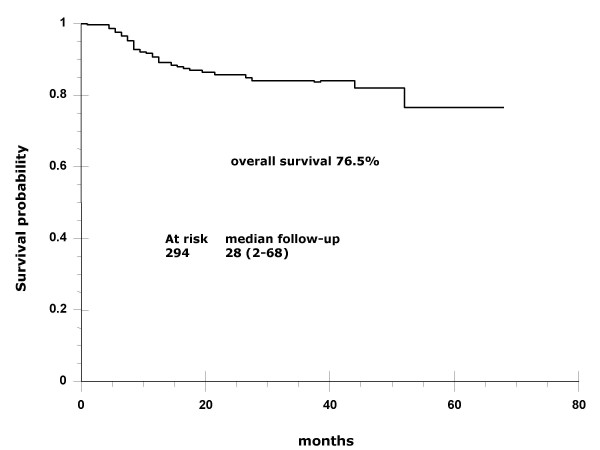
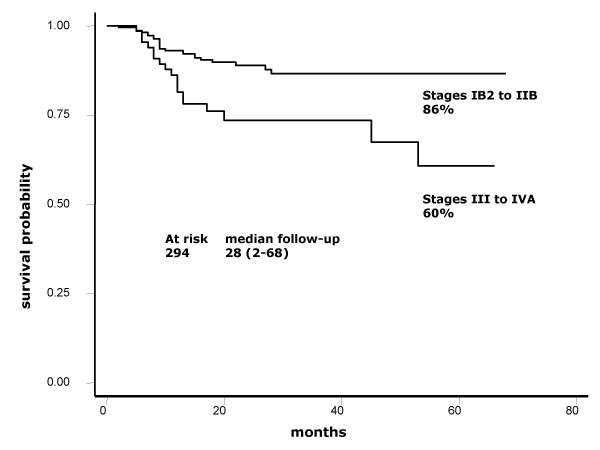
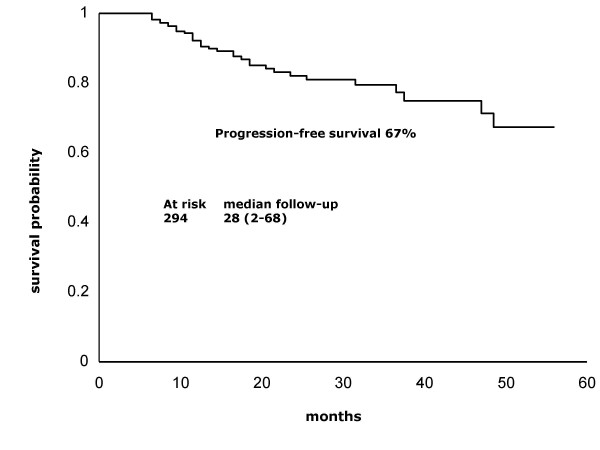
A total of 294 patients who received radiation and cisplatin were analyzed. Mean age was 43.8 years (range, 26-68 years). The majority of cases were squamous cell carcinoma (87.8%), and distribution according to International Federation of Gynecology and Obstetrics (FIGO) stage was as follows: IB2-IIA, 23%; IIB, 53.3%, and IIIB, 23%; there were only two IVA cases. Overall, 96% of patients completed external beam, and intracavitary therapy. The majority of patients (67%) received the planned six courses of weekly cisplatin. Complete responses were achieved in 243 (83%) patients, whereas 51 (17%) had either persistent (32 patients, 10.8%) or progressive (19 patients, 6.4%) disease. At median follow-up (28 months; range, 2-68 months), 36 patients (12.2%) have relapsed (locally 30.5, and systemically, 69.5%). The most common toxicities were hematologic and gastrointestinal, in the majority of cases considered mild-moderate. At median follow-up (28 months; range, 2-68 months), overall and progression-free survival are 76.5 and 67%, respectively.
Our results support use of chemoradiation with six weekly applications of cisplatin at 40 mg/m2 during external radiation for routine management of locally advanced cervical cancer.
在全球范围内,宫颈癌主要影响社会经济地位低下的女性。五项随机试验为采用以顺铂为基础的同步放化疗作为标准治疗方案奠定了基础,该方案适用于根治性子宫切除术后需要辅助放疗的高危患者以及接受根治性放疗的局部晚期患者。这些结果来自在精心准备的学术中心进行的临床试验;因此,我们试图确定当患者在非方案治疗的情况下接受治疗时,这些结果是否能够重现。
我们回顾了1999年至2003年间接受放疗加每周顺铂作为常规治疗的294例局部晚期宫颈癌患者的病历,并分析了治疗依从性、缓解率、毒性和生存率。
共分析了294例接受放疗和顺铂治疗的患者。平均年龄为43.8岁(范围26 - 68岁)。大多数病例为鳞状细胞癌(87.8%),根据国际妇产科联盟(FIGO)分期分布如下:IB2-IIA期,23%;IIB期,53.3%,IIIB期,23%;仅有2例IVA期病例。总体而言,96%的患者完成了外照射和腔内治疗。大多数患者(67%)接受了计划的六个周期的每周顺铂治疗。243例(83%)患者获得完全缓解,而51例(17%)患者有持续性(32例,10.8%)或进展性(19例,6.4%)疾病。在中位随访期(28个月;范围2 - 68个月),36例患者(12.2%)复发(局部复发占30.5%,全身复发占69.5%)。最常见的毒性反应是血液学和胃肠道反应,大多数病例为轻至中度。在中位随访期(28个月;范围2 - 68个月),总生存率和无进展生存率分别为76.5%和67%。
我们的结果支持在局部晚期宫颈癌的常规治疗中,在体外放疗期间每周应用六次40mg/m²顺铂进行同步放化疗。