Cui Liying, Leebens-Mack Jim, Wang Li-San, Tang Jijun, Rymarquis Linda, Stern David B, dePamphilis Claude W
Department of Biology, Institute of Molecular Evolutionary Genetics, Huck Institutes of Life Sciences, The Pennsylvania State University, University Park, PA 16802, USA.
BMC Evol Biol. 2006 Feb 9;6:13. doi: 10.1186/1471-2148-6-13.
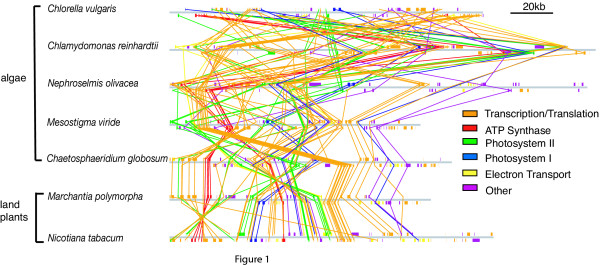
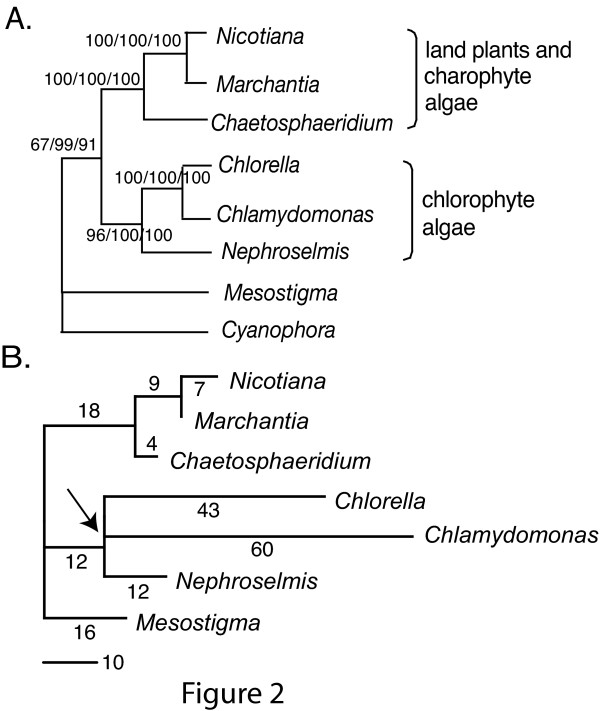
Genome rearrangements influence gene order and configuration of gene clusters in all genomes. Most land plant chloroplast DNAs (cpDNAs) share a highly conserved gene content and with notable exceptions, a largely co-linear gene order. Conserved gene orders may reflect a slow intrinsic rate of neutral chromosomal rearrangements, or selective constraint. It is unknown to what extent observed changes in gene order are random or adaptive. We investigate the influence of natural selection on gene order in association with increased rate of chromosomal rearrangement. We use a novel parametric bootstrap approach to test if directional selection is responsible for the clustering of functionally related genes observed in the highly rearranged chloroplast genome of the unicellular green alga Chlamydomonas reinhardtii, relative to ancestral chloroplast genomes.
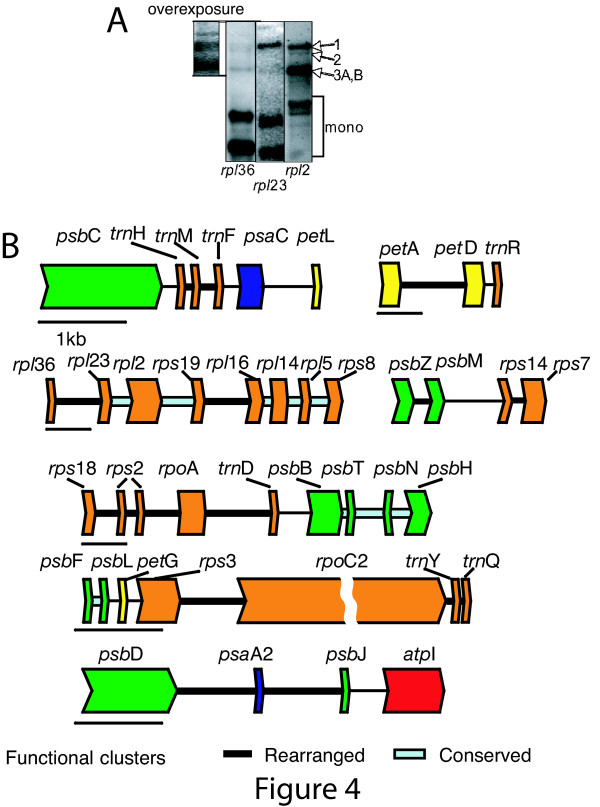
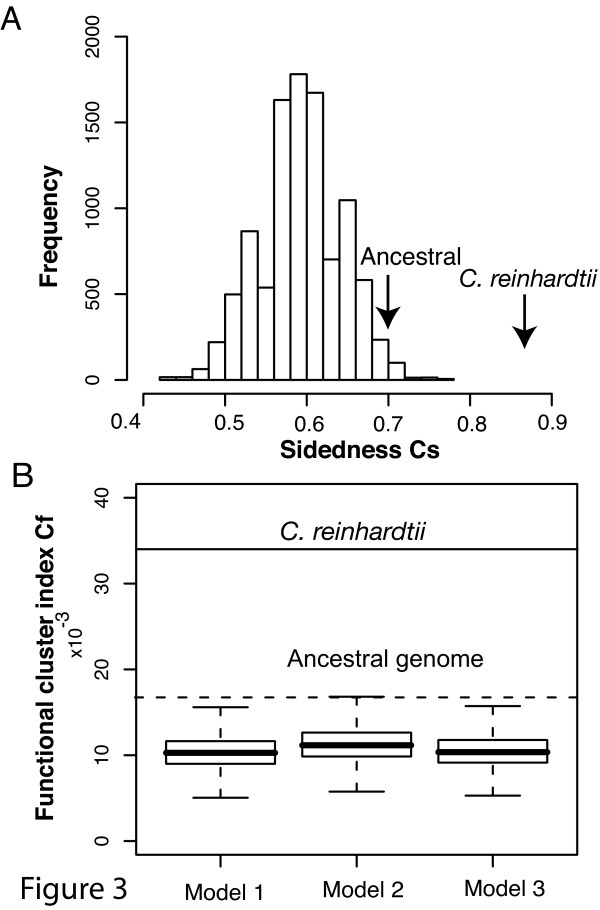
Ancestral gene orders were inferred and then subjected to simulated rearrangement events under the random breakage model with varying ratios of inversions and transpositions. We found that adjacent chloroplast genes in C. reinhardtii were located on the same strand much more frequently than in simulated genomes that were generated under a random rearrangement processes (increased sidedness; p < 0.0001). In addition, functionally related genes were found to be more clustered than those evolved under random rearrangements (p < 0.0001). We report evidence of co-transcription of neighboring genes, which may be responsible for the observed gene clusters in C. reinhardtii cpDNA.
Simulations and experimental evidence suggest that both selective maintenance and directional selection for gene clusters are determinants of chloroplast gene order.
基因组重排影响所有基因组中基因的顺序和基因簇的结构。大多数陆地植物的叶绿体DNA(cpDNA)具有高度保守的基因组成,并且除了少数显著的例外情况,基因顺序在很大程度上是共线性的。保守的基因顺序可能反映了中性染色体重排的内在缓慢速率,或者是选择性限制。目前尚不清楚观察到的基因顺序变化在多大程度上是随机的或适应性的。我们研究自然选择对基因顺序的影响,并结合染色体重排速率的增加进行研究。我们使用一种新颖的参数化自举方法来测试定向选择是否导致了在单细胞绿藻莱茵衣藻高度重排的叶绿体基因组中观察到的功能相关基因的聚类,相对于祖先叶绿体基因组而言。
推断出祖先基因顺序,然后在随机断裂模型下,以不同的倒位和转座比例进行模拟重排事件。我们发现,莱茵衣藻中相邻的叶绿体基因位于同一条链上的频率比在随机重排过程中产生的模拟基因组中要高得多(链偏向性增加;p < 0.0001)。此外,发现功能相关的基因比在随机重排中进化的基因聚类程度更高(p < 0.0001)。我们报告了相邻基因共转录的证据,这可能是莱茵衣藻cpDNA中观察到的基因簇的原因。
模拟和实验证据表明,基因簇的选择性维持和定向选择都是叶绿体基因顺序的决定因素。