Wilson Christopher B, Merkenschlager Matthias
Departments of Immunology and Pediatrics, University of Washington, Seattle, WA 98195, USA.
Curr Opin Immunol. 2006 Apr;18(2):143-51. doi: 10.1016/j.coi.2006.01.013. Epub 2006 Feb 10.
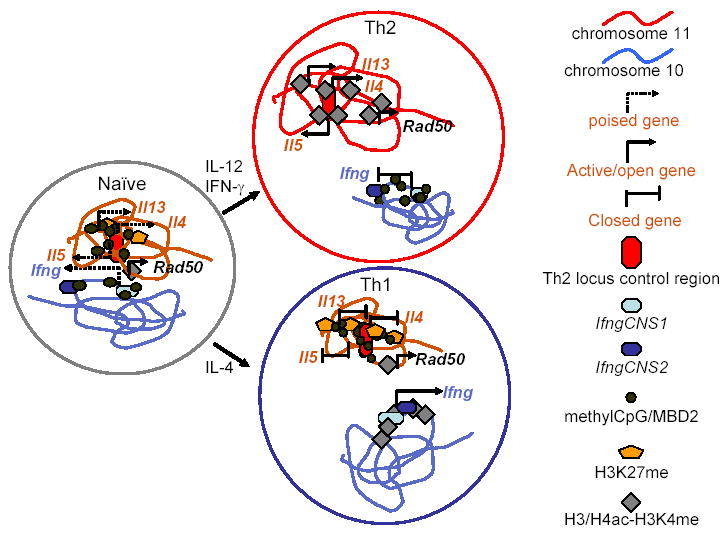
Transcription factors control gene expression programs in the context of the chromatin structure of their target genes. DNA methylation, post-translational histone modifications such as acetylation and methylation, and higher order chromatin organization allow the maintenance of gene expression patterns through mitosis, but how do they accommodate developmentally regulated changes in gene expression programs? Although histone acetylation and deacetylation are in dynamic equilibrium and mechanisms for the removal of methyl groups from histones are emerging, the extent to which there is active demethylation of DNA remains controversial. Looking at chromatin in the three-dimensional space of the nucleus, recent work demonstrates that gene regulation involves contacts between regulatory elements within genes or gene clusters on the same chromosome (in cis) and between different chromosomes (in trans). Finally, non-coding RNAs make a significant contribution to transcriptional and post-transcriptional gene silencing. Together, these advances contribute to an understanding of how gene expression programs are established, maintained and modified during development.
转录因子在其靶基因的染色质结构背景下控制基因表达程序。DNA甲基化、翻译后组蛋白修饰(如乙酰化和甲基化)以及高阶染色质组织使得基因表达模式能够通过有丝分裂得以维持,但是它们如何适应基因表达程序中受发育调控的变化呢?尽管组蛋白乙酰化和去乙酰化处于动态平衡,并且从组蛋白上去除甲基的机制也不断涌现,但DNA主动去甲基化的程度仍存在争议。从细胞核三维空间的角度观察染色质,最近的研究表明,基因调控涉及同一染色体上基因或基因簇内的调控元件之间(顺式)以及不同染色体之间(反式)的相互作用。最后,非编码RNA对转录和转录后基因沉默做出了重大贡献。这些进展共同有助于理解基因表达程序在发育过程中是如何建立、维持和修饰的。