Chanchevalap Sengthong, Nandan Mandayam O, McConnell Beth B, Charrier Laetitia, Merlin Didier, Katz Jonathan P, Yang Vincent W
Division of Digestive Diseases, Department of Medicine, Emory University School of Medicine Atlanta, GA, USA.
Nucleic Acids Res. 2006 Feb 25;34(4):1216-23. doi: 10.1093/nar/gkl014. Print 2006.
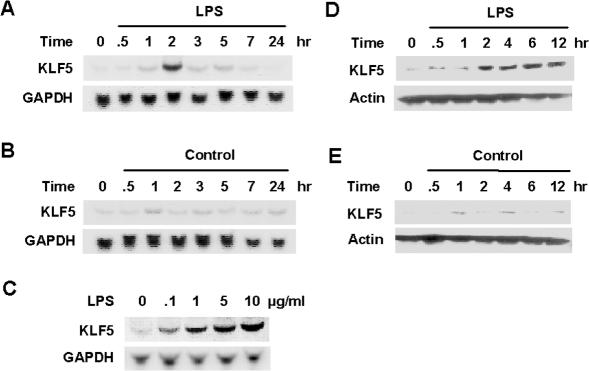
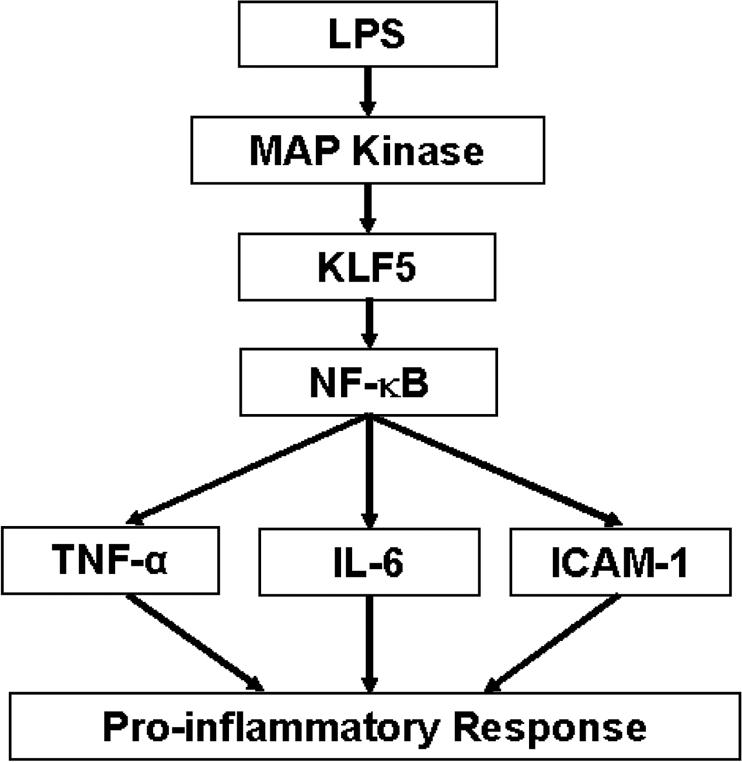
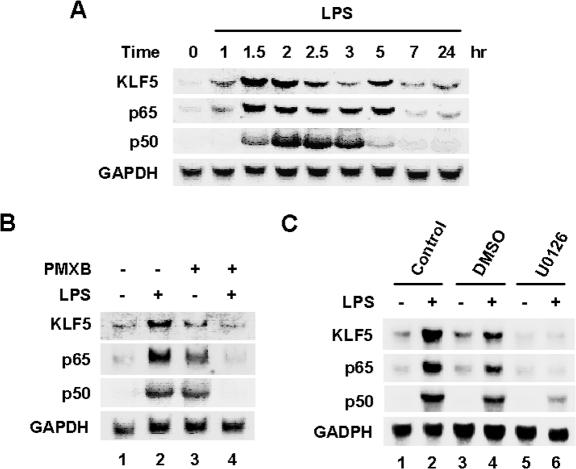
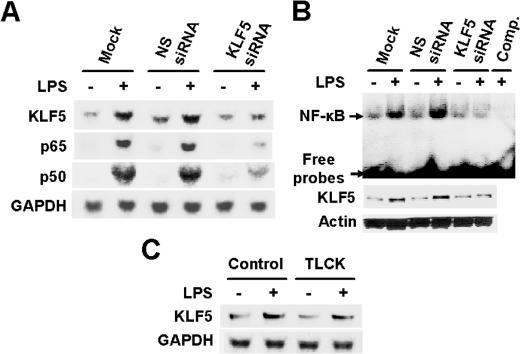
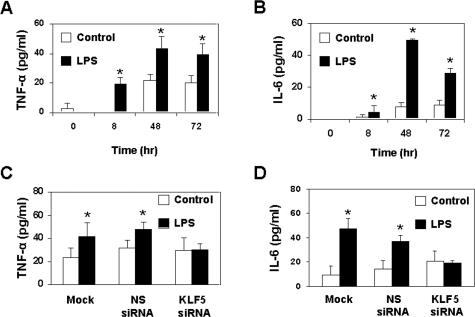
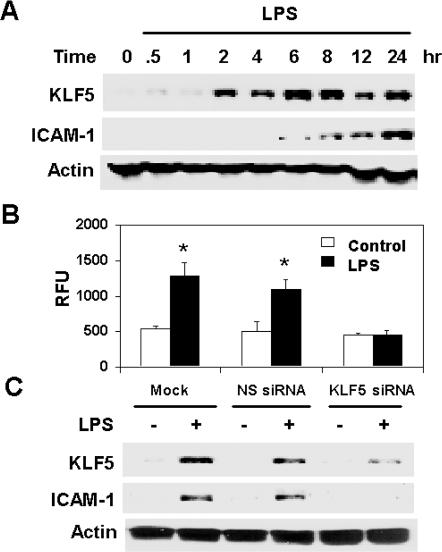
Lipopolysaccharide (LPS) is a bacterially-derived endotoxin that elicits a strong proinflammatory response in intestinal epithelial cells. It is well established that LPS activates this response through NF-kappaB. In addition, LPS signals through the mitogen-activated protein kinase (MAPK) pathway. We previously demonstrated that the Krüppel-like factor 5 [KLF5; also known as intestine-enriched Krüppel-like factor (IKLF)] is activated by the MAPK. In the current study, we examined whether KLF5 mediates the signaling cascade elicited by LPS. Treatment of the intestinal epithelial cell line, IEC6, with LPS resulted in a dose- and time-dependent increase in KLF5 messenger RNA (mRNA) and protein levels. Concurrently, mRNA levels of the p50 and p65 subunits of NF-kappaB were increased by LPS treatment. Pretreatment with the MAPK inhibitor, U0126, or the LPS antagonist, polymyxin B, resulted in an attenuation of KLF5, p50 and p65 NF-kappaB subunit mRNA levels from LPS treatment. Importantly, suppression of KLF5 by small interfering RNA (siRNA) resulted in a reduction in p50 and p65 subunit mRNA levels and NF-kappaB DNA binding activity in response to LPS. LPS treatment also led to an increase in secretion of TNF-alpha and IL-6 from IEC6, both of which were reduced by siRNA inhibition of KLF5. In addition, intercellular adhesion molecule-1 (ICAM-1) levels were increased in LPS-treated IEC6 cells and this increase was associated with increased adhesion of Jurkat lymphocytes to IEC6. The induction of ICAM-1 expression and T cell adhesion to IEC6 by LPS were both abrogated by siRNA inhibition of KLF5. These results indicate that KLF5 is an important mediator for the proinflammatory response elicited by LPS in intestinal epithelial cells.
脂多糖(LPS)是一种源自细菌的内毒素,可在肠道上皮细胞中引发强烈的促炎反应。众所周知,LPS通过核因子κB(NF-κB)激活这种反应。此外,LPS通过丝裂原活化蛋白激酶(MAPK)途径发出信号。我们之前证明,Krüppel样因子5 [KLF5;也称为肠道富集Krüppel样因子(IKLF)] 被MAPK激活。在本研究中,我们研究了KLF5是否介导LPS引发的信号级联反应。用LPS处理肠道上皮细胞系IEC6,导致KLF5信使核糖核酸(mRNA)和蛋白质水平呈剂量和时间依赖性增加。同时,LPS处理使NF-κB的p50和p65亚基的mRNA水平升高。用MAPK抑制剂U0126或LPS拮抗剂多粘菌素B预处理,可使LPS处理后的KLF5、p50和p65 NF-κB亚基mRNA水平降低。重要的是,小干扰RNA(siRNA)抑制KLF5导致p50和p65亚基mRNA水平降低以及对LPS反应时NF-κB DNA结合活性降低。LPS处理还导致IEC6分泌肿瘤坏死因子-α(TNF-α)和白细胞介素-6(IL-6)增加,而siRNA抑制KLF5可使二者均减少。此外,LPS处理的IEC6细胞中细胞间黏附分子-1(ICAM-1)水平升高,且这种升高与Jurkat淋巴细胞与IEC6的黏附增加有关。LPS诱导的ICAM-1表达和T细胞与IEC6的黏附均被siRNA抑制KLF5所消除。这些结果表明,KLF5是LPS在肠道上皮细胞中引发促炎反应的重要介质。