Toyabe Shin-ichi, Kouhei Akazawa
Department of Medical Informatics, Niigata University Medical and Dental Hospital, Asahimachi-dori 1-754, Niigata 951-8520, Japan.
BMC Health Serv Res. 2006 Feb 17;6:11. doi: 10.1186/1472-6963-6-11.
In Japan, all citizens are covered by the national insurance system in which universal free access to healthcare services is promised to everybody. There are no general physicians or gatekeepers in the Japanese healthcare system.
We studied the pattern of referral of inpatients from secondary care hospitals to a tertiary care university hospital and the reverse referral under the situations using a geographic information system (GIS), taking paediatric inpatients as an example.
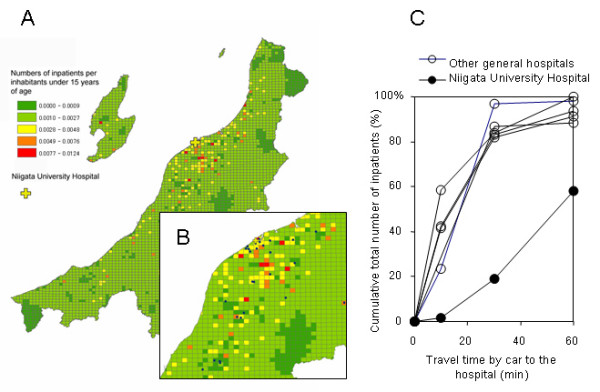
The results showed that 61.2% of the patients were directly admitted to the hospital without referral from other hospitals or clinics and that 82.8% of the inpatients were referred to the outpatient department of the hospital to which they had been admitted. GIS analysis for the inpatients service area showed the hospital functions as both a secondary care hospital and tertiary care hospital. Patients who lived near the hospital tended to be admitted directly to the hospital, and patients who lived far from the hospital tended to utilize the hospital as a tertiary care provider. There were territorial disputes with other secondary care hospitals. To estimate spatial differences in referral to aftercare, we analyzed the spatial distribution of inpatients with focus on their length of hospital stay (LOS). GIS analysis revealed apparent foci of patients with long LOS and those with low LOS.
These results suggest that the function of university hospital in Japan is unspecialized and that the referral route from the university hospital to aftercare is also unequipped.
在日本,所有公民都纳入国民保险体系,该体系承诺让每个人都能免费普遍获得医疗服务。日本医疗体系中没有全科医生或守门人。
我们以儿科住院患者为例,使用地理信息系统(GIS)研究了二级护理医院的住院患者转诊至三级护理大学医院的模式以及相反方向的转诊情况。
结果显示,61.2%的患者未经其他医院或诊所转诊而直接入院,82.8%的住院患者被转诊至其入院医院的门诊部。对住院患者服务区域的GIS分析表明,该医院兼具二级护理医院和三级护理医院的功能。住在医院附近的患者倾向于直接入院,而住在远离医院地区的患者倾向于将该医院作为三级护理机构。与其他二级护理医院存在地域争端。为估计后续护理转诊中的空间差异,我们以住院时间(LOS)为重点分析了住院患者的空间分布。GIS分析揭示了住院时间长和住院时间短的患者的明显聚集区域。
这些结果表明,日本大学医院的功能不具有专业性,且从大学医院到后续护理的转诊途径也不完善。