Mello Fernanda Carvalho de Queiroz, Bastos Luiz Gustavo do Valle, Soares Sérgio Luiz Machado, Rezende Valéria M C, Conde Marcus Barreto, Chaisson Richard E, Kritski Afrânio Lineu, Ruffino-Netto Antonio, Werneck Guilherme Loureiro
Tuberculosis Research Unit, Clementino Fraga Filho Hospital, Federal University of Rio de Janeiro, Rio de Janeiro, Brazil.
BMC Public Health. 2006 Feb 23;6:43. doi: 10.1186/1471-2458-6-43.
Smear negative pulmonary tuberculosis (SNPT) accounts for 30% of pulmonary tuberculosis cases reported yearly in Brazil. This study aimed to develop a prediction model for SNPT for outpatients in areas with scarce resources.
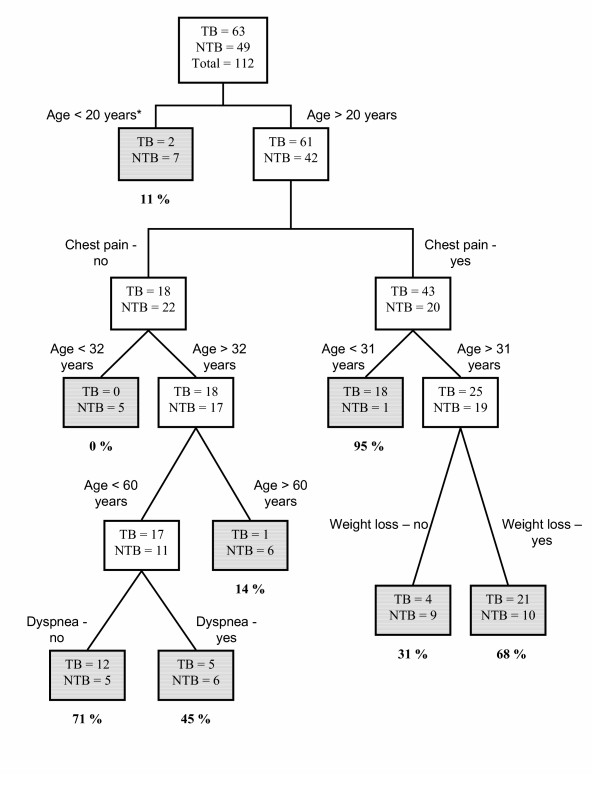
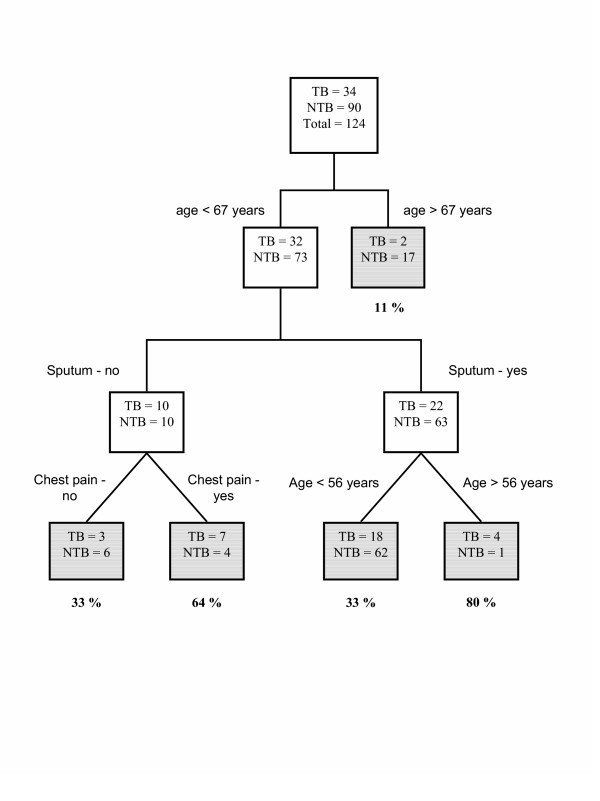
The study enrolled 551 patients with clinical-radiological suspicion of SNPT, in Rio de Janeiro, Brazil. The original data was divided into two equivalent samples for generation and validation of the prediction models. Symptoms, physical signs and chest X-rays were used for constructing logistic regression and classification and regression tree models. From the logistic regression, we generated a clinical and radiological prediction score. The area under the receiver operator characteristic curve, sensitivity, and specificity were used to evaluate the model's performance in both generation and validation samples.
It was possible to generate predictive models for SNPT with sensitivity ranging from 64% to 71% and specificity ranging from 58% to 76%.
The results suggest that those models might be useful as screening tools for estimating the risk of SNPT, optimizing the utilization of more expensive tests, and avoiding costs of unnecessary anti-tuberculosis treatment. Those models might be cost-effective tools in a health care network with hierarchical distribution of scarce resources.
涂片阴性肺结核(SNPT)占巴西每年报告的肺结核病例的30%。本研究旨在为资源匮乏地区的门诊患者开发一种SNPT预测模型。
该研究纳入了巴西里约热内卢551例临床放射学怀疑为SNPT的患者。原始数据被分为两个相等的样本,用于生成和验证预测模型。症状、体征和胸部X光片用于构建逻辑回归模型以及分类与回归树模型。从逻辑回归中,我们生成了一个临床和放射学预测评分。使用受试者操作特征曲线下面积、敏感性和特异性来评估模型在生成样本和验证样本中的性能。
有可能生成SNPT预测模型,其敏感性范围为64%至71%,特异性范围为58%至76%。
结果表明,这些模型可能作为筛查工具有用,可用于估计SNPT风险、优化更昂贵检查的使用,并避免不必要的抗结核治疗成本。在资源稀缺且分层分布的医疗保健网络中,这些模型可能是具有成本效益的工具。