Nurkiewicz Timothy R, Porter Dale W, Barger Mark, Millecchia Lyndell, Rao K Murali K, Marvar Paul J, Hubbs Ann F, Castranova Vincent, Boegehold Matthew A
Department of Physiology and Pharmacology, West Virginia University School of Medicine, Morgantown, West Virginia 26506-9229, USA.
Environ Health Perspect. 2006 Mar;114(3):412-9. doi: 10.1289/ehp.8413.
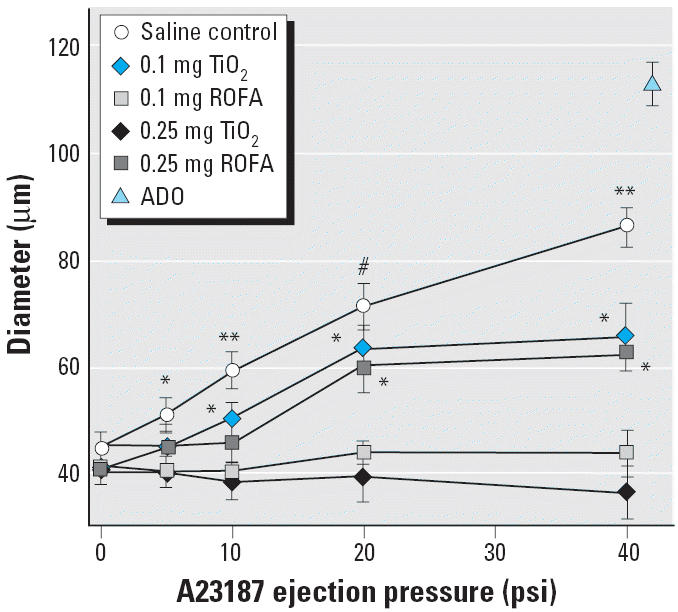
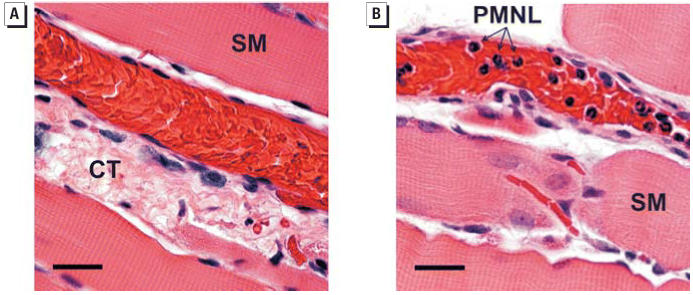
The epidemiologic association between pulmonary exposure to ambient particulate matter (PM) and cardiovascular dysfunction is well known, but the systemic mechanisms that drive this effect remain unclear. We have previously shown that acute pulmonary exposure to PM impairs or abolishes endothelium-dependent arteriolar dilation in the rat spinotrapezius muscle. The purpose of this study was to further characterize the effect of pulmonary PM exposure on systemic microvascular function and to identify local inflammatory events that may contribute to these effects. Rats were intratracheally instilled with residual oil fly ash (ROFA) or titanium dioxide at 0.1 or 0.25 mg/rat 24 hr before measurement of pulmonary and systemic microvascular responses. In vivo microscopy of the spinotrapezius muscle was used to study systemic arteriolar responses to intraluminal infusion of the Ca2+ ionophore A23187 or iontophoretic abluminal application of the adrenergic agonist phenylephrine (PHE). Leukocyte rolling and adhesion were quantified in venules paired with the studied arterioles. Histologic techniques were used to assess pulmonary inflammation, characterize the adherence of leukocytes to systemic venules, verify the presence of myeloperoxidase (MPO) in the systemic microvascular wall, and quantify systemic microvascular oxidative stress. In the lungs of rats exposed to ROFA or TiO2, changes in some bronchoalveolar lavage markers of inflammation were noted, but an indication of cellular damage was not found. In rats exposed to 0.1 mg ROFA, focal alveolitis was evident, particularly at sites of particle deposition. Exposure to either ROFA or TiO2 caused a dose-dependent impairment of endothelium-dependent arteriolar dilation. However, exposure to these particles did not affect microvascular constriction in response to PHE. ROFA and TiO2 exposure significantly increased leukocyte rolling and adhesion in paired venules, and these cells were positively identified as polymorphonuclear leukocytes (PMNLs). In ROFA- and TiO2-exposed rats, MPO was found in PMNLs adhering to the systemic microvascular wall. Evidence suggests that some of this MPO had been deposited in the microvascular wall. There was also evidence for oxidative stress in the microvascular wall. These results indicate that after PM exposure, the impairment of endothelium-dependent dilation in the systemic microcirculation coincides with PMNL adhesion, MPO deposition, and local oxidative stress. Collectively, these microvascular observations are consistent with events that contribute to the disruption of the control of peripheral resistance and/or cardiac dysfunction associated with PM exposure.
肺部暴露于环境颗粒物(PM)与心血管功能障碍之间的流行病学关联已为人熟知,但驱动这种效应的全身机制仍不清楚。我们之前已经表明,大鼠斜方肌急性肺部暴露于PM会损害或消除内皮依赖性小动脉扩张。本研究的目的是进一步表征肺部PM暴露对全身微血管功能的影响,并确定可能导致这些影响的局部炎症事件。在测量肺部和全身微血管反应前24小时,给大鼠气管内注入0.1或0.25mg/只的残油飞灰(ROFA)或二氧化钛。使用斜方肌的体内显微镜来研究全身小动脉对腔内注入Ca2+离子载体A23187或肾上腺素能激动剂去氧肾上腺素(PHE)的离子电渗法腔外应用的反应。在与研究的小动脉配对的微静脉中对白细胞滚动和黏附进行定量。组织学技术用于评估肺部炎症、表征白细胞对全身微静脉的黏附、验证全身微血管壁中髓过氧化物酶(MPO)的存在,并定量全身微血管氧化应激。在暴露于ROFA或TiO2的大鼠肺部,注意到一些支气管肺泡灌洗炎症标志物的变化,但未发现细胞损伤的迹象。在暴露于0.1mg ROFA的大鼠中,局灶性肺泡炎明显,尤其是在颗粒沉积部位。暴露于ROFA或TiO2均导致内皮依赖性小动脉扩张出现剂量依赖性损害。然而,暴露于这些颗粒并未影响对PHE的微血管收缩反应。ROFA和TiO2暴露显著增加配对微静脉中的白细胞滚动和黏附,并且这些细胞被明确鉴定为多形核白细胞(PMNLs)。在暴露于ROFA和TiO2的大鼠中,在黏附于全身微血管壁的PMNLs中发现了MPO。有证据表明,部分这种MPO已沉积在微血管壁中。在微血管壁中也有氧化应激的证据。这些结果表明,PM暴露后,全身微循环中内皮依赖性扩张的损害与PMNL黏附、MPO沉积和局部氧化应激同时出现。总体而言,这些微血管观察结果与导致外周阻力控制破坏和/或与PM暴露相关的心脏功能障碍的事件一致。