Valjent Emmanuel, Corvol Jean-Christophe, Trzaskos James M, Girault Jean-Antoine, Hervé Denis
INSERM, U536, F-75005, Université Pierre et Marie Curie (UPMC-Paris 6), F-75005, Paris.
BMC Neurosci. 2006 Mar 2;7:20. doi: 10.1186/1471-2202-7-20.
Repeated exposure to psychostimulants results in a progressive and long-lasting facilitation of the locomotor response that is thought to have implications for addiction. Psychostimulants and other drugs of abuse activate in specific brain areas extracellular signal-regulated kinase (ERK), an essential component of a signaling pathway involved in synaptic plasticity and long-term effects of drugs of abuse. Here we have investigated the role of ERK activation in the behavioral sensitization induced by repeated administration of psychostimulants in mice, using SL327, a brain-penetrating selective inhibitor of MAP-kinase/ERK kinase (MEK), the enzyme that selectively activates ERK.
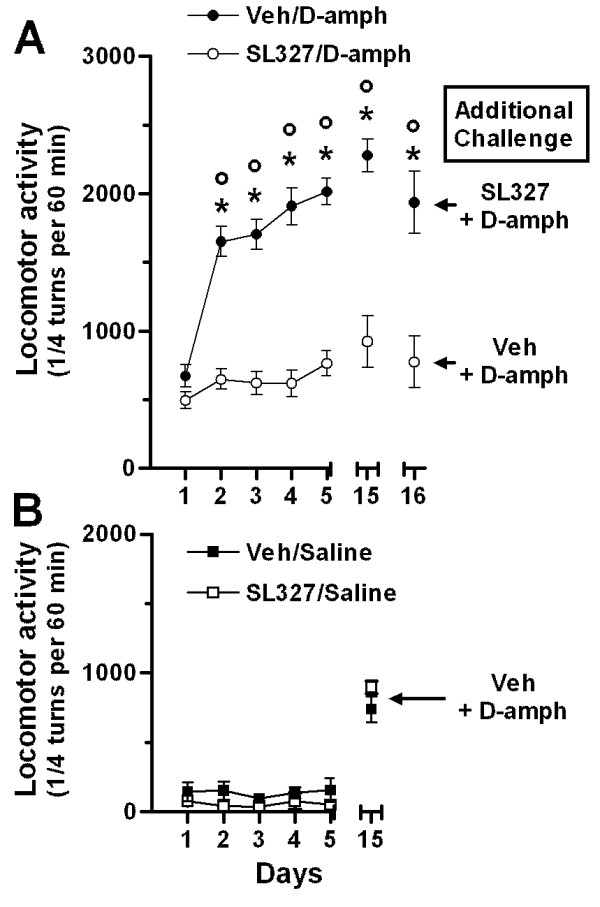
A dose of SL327 (30 mg/kg) that reduced the number of activated ERK-positive neurons by 62 to 89% in various brain areas, had virtually no effect on the spontaneous locomotor activity or the acute hyperlocomotion induced by cocaine or D-amphetamine. Pre-treatment with SL327 (30 mg/kg) prior to each drug administration prevented the locomotor sensitization induced by repeated injections of D-amphetamine or cocaine. The SL327 pre-treatment abolished also conditioned locomotor response of mice placed in the context previously paired with cocaine or D-amphetamine. In contrast, SL327 did not alter the expression of sensitized response to D-amphetamine or cocaine.
Altogether these results show that ERK has a minor contribution to the acute locomotor effects of psychostimulants or to the expression of sensitized responses, whereas it is crucial for the acquisition of locomotor sensitization and psychostimulant-conditioned locomotor response. This study supports the important role of the ERK pathway in long-lasting behavioral alterations induced by drugs of abuse.
反复接触精神兴奋剂会导致运动反应逐渐增强且持久,这被认为与成瘾有关。精神兴奋剂和其他滥用药物会在特定脑区激活细胞外信号调节激酶(ERK),ERK是参与突触可塑性和滥用药物长期效应的信号通路的重要组成部分。在此,我们使用SL327(一种可穿透大脑的丝裂原活化蛋白激酶/ERK激酶(MEK)的选择性抑制剂,MEK是选择性激活ERK的酶),研究了ERK激活在小鼠反复给予精神兴奋剂诱导的行为敏化中的作用。
一剂SL327(30毫克/千克)可使不同脑区中活化的ERK阳性神经元数量减少62%至89%,但对自发运动活动或可卡因或D-苯丙胺诱导的急性运动亢进几乎没有影响。在每次给药前用SL327(30毫克/千克)预处理可预防反复注射D-苯丙胺或可卡因诱导的运动敏化。SL327预处理还消除了置于先前与可卡因或D-苯丙胺配对环境中的小鼠的条件性运动反应。相比之下,SL327并未改变对D-苯丙胺或可卡因敏化反应的表达。
总之,这些结果表明,ERK对精神兴奋剂的急性运动效应或敏化反应的表达贡献较小,而对运动敏化和精神兴奋剂条件性运动反应的获得至关重要。本研究支持ERK通路在滥用药物诱导的长期行为改变中的重要作用。