Turner Kevin B, Hagan Nathan A, Fabris Daniele
Department of Chemistry and Biochemistry, University of Maryland Baltimore County, 1000 Hilltop Circle, Baltimore, MD 21228, USA.
Nucleic Acids Res. 2006 Mar 6;34(5):1305-16. doi: 10.1093/nar/gkl004. Print 2006.
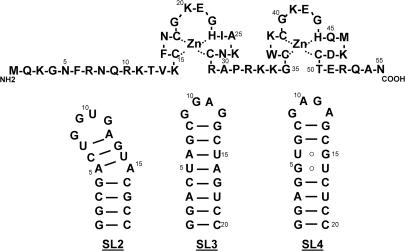
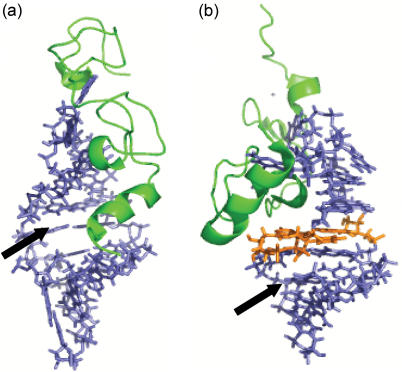
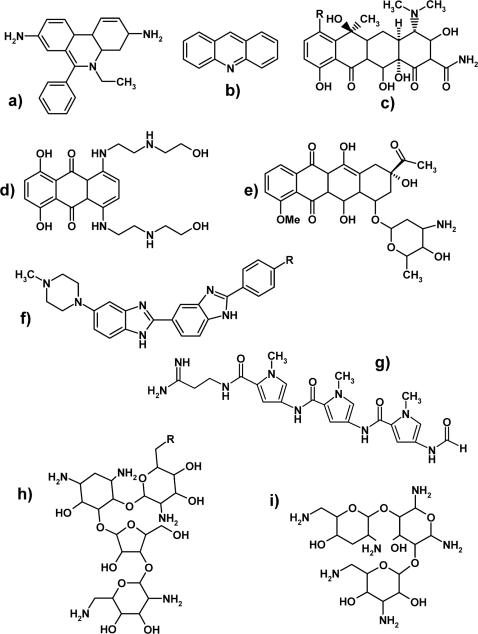
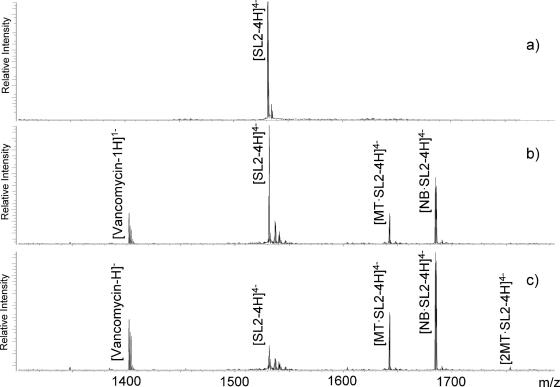
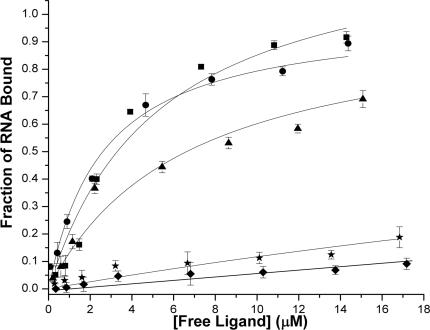
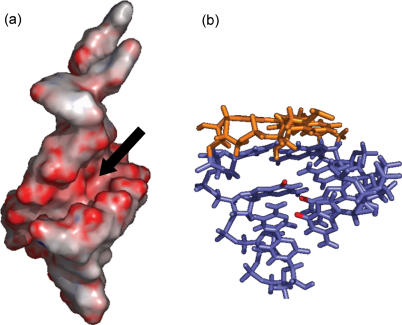
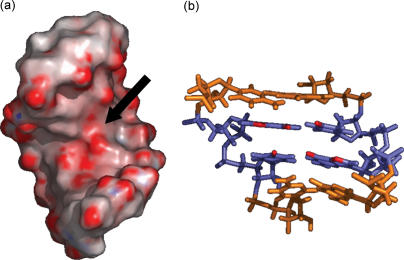
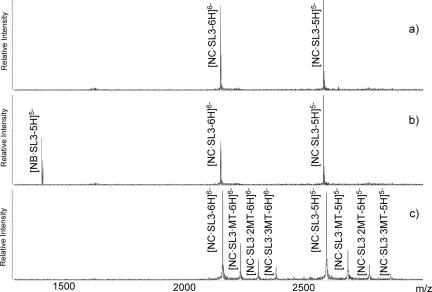
Disrupting the interactions between human immunodeficiency virus type 1 (HIV-1) nucleocapsid (NC) protein and structural elements of the packaging signal (Psi-RNA) could constitute an ideal strategy to inhibit the functions of this region of the genome leader in the virus life cycle. We have employed electrospray ionization (ESI) Fourier transform mass spectrometry (FTMS) to assess the ability of a series of nucleic acid ligands to bind selected structures of Psi-RNA and inhibit their specific interactions with NC in vitro. We found that the majority of the ligands included in the study were able to form stable non-covalent complexes with stem-loop 2, 3 and 4 (SL2-4), consistent with their characteristic nucleic acid binding modes. However, only aminoglycosidic antibiotics were capable of dissociating preformed NCSL3 and NCSL4 complexes, but not NCSL2. The apparent specificity of these inhibitory effects is closely dependent on distinctive structural features of the different NCRNA complexes. The trends observed for the IC50 values correlate very well with those provided by the ligand binding affinities and the dissociation constants of target NC*RNA complexes. This systematic investigation of archetypical nucleic acid ligands provides a valid framework to support the design of novel ligand inhibitors for HIV-1 treatment.
破坏人类免疫缺陷病毒1型(HIV-1)核衣壳(NC)蛋白与包装信号(Psi-RNA)结构元件之间的相互作用,可能构成一种理想策略,以抑制基因组前导区在病毒生命周期中的功能。我们采用电喷雾电离(ESI)傅里叶变换质谱(FTMS)来评估一系列核酸配体结合Psi-RNA特定结构并在体外抑制其与NC特异性相互作用的能力。我们发现,研究中包含的大多数配体能够与茎环2、3和4(SL2-4)形成稳定的非共价复合物,这与其特征性的核酸结合模式一致。然而,只有氨基糖苷类抗生素能够解离预先形成的NCSL3和NCSL4复合物,而不能解离NCSL2复合物。这些抑制作用的明显特异性紧密依赖于不同NCRNA复合物的独特结构特征。观察到的IC50值趋势与配体结合亲和力以及目标NC*RNA复合物的解离常数所提供的趋势非常吻合。对典型核酸配体的这一系统研究为支持设计用于HIV-1治疗的新型配体抑制剂提供了一个有效的框架。