Wilson Alex C C, Dunbar Helen E, Davis Gregory K, Hunter Wayne B, Stern David L, Moran Nancy A
Department of Ecology and Evolutionary Biology, University of Arizona, Tucson, AZ 85721, USA.
BMC Genomics. 2006 Mar 14;7:50. doi: 10.1186/1471-2164-7-50.
The best studied insect-symbiont system is that of aphids and their primary bacterial endosymbiont Buchnera aphidicola. Buchnera inhabits specialized host cells called bacteriocytes, provides nutrients to the aphid and has co-speciated with its aphid hosts for the past 150 million years. We have used a single microarray to examine gene expression in the pea aphid, Acyrthosiphon pisum, and its resident Buchnera. Very little is known of gene expression in aphids, few studies have examined gene expression in Buchnera, and no study has examined simultaneously the expression profiles of a host and its symbiont. Expression profiling of aphids, in studies such as this, will be critical for assigning newly discovered A. pisum genes to functional roles. In particular, because aphids possess many genes that are absent from Drosophila and other holometabolous insect taxa, aphid genome annotation efforts cannot rely entirely on homology to the best-studied insect systems. Development of this dual-genome array represents a first attempt to characterize gene expression in this emerging model system.
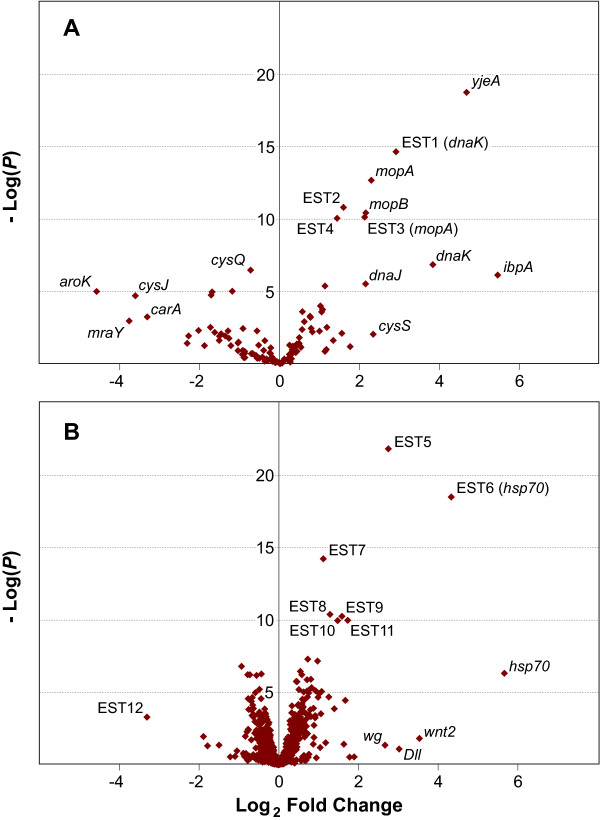
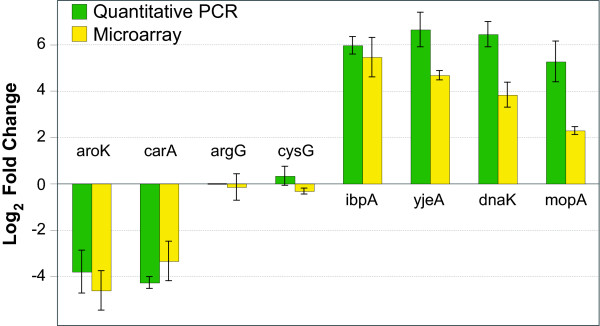
We chose to examine heat shock response because it has been well characterized both in Buchnera and in other insect species. Our results from the Buchnera of A. pisum show responses for the same gene set as an earlier study of heat shock response in Buchnera for the host aphid Schizaphis graminum. Additionally, analyses of aphid transcripts showed the expected response for homologs of known heat shock genes as well as responses for several genes with unknown functional roles.
We examined gene expression under heat shock of an insect and its bacterial symbiont in a single assay using a dual-genome microarray. Further, our results indicate that microarrays are a useful tool for inferring functional roles of genes in A. pisum and other insects and suggest that the pea aphid genome may contain many gene paralogs that are differentially regulated.
研究最为深入的昆虫 - 共生体系统是蚜虫及其主要细菌内共生体蚜虫内共生菌(Buchnera aphidicola)。蚜虫内共生菌栖息于称为含菌细胞的特殊宿主细胞中,为蚜虫提供营养,并且在过去的1.5亿年里与蚜虫宿主共同进化。我们使用了单一微阵列来检测豌豆蚜(Acyrthosiphon pisum)及其体内的蚜虫内共生菌的基因表达。目前对于蚜虫基因表达的了解非常少,对蚜虫内共生菌基因表达的研究也很少,并且没有研究同时检测宿主及其共生体的表达谱。在这样的研究中,蚜虫的表达谱分析对于确定新发现的豌豆蚜基因的功能作用至关重要。特别是,由于蚜虫拥有许多在果蝇和其他全变态昆虫类群中不存在的基因,蚜虫基因组注释工作不能完全依赖于与研究最深入的昆虫系统的同源性。这种双基因组阵列的开发代表了在这个新兴模型系统中表征基因表达的首次尝试。
我们选择检测热休克反应,因为它在蚜虫内共生菌和其他昆虫物种中都已有充分的表征。我们对豌豆蚜的蚜虫内共生菌的研究结果显示,与早期对宿主蚜虫麦二叉蚜(Schizaphis graminum)的蚜虫内共生菌热休克反应的研究中相同的基因集出现了反应。此外,对蚜虫转录本的分析显示,已知热休克基因的同源物出现了预期的反应,以及几个功能未知基因的反应。
我们使用双基因组微阵列在单一检测中检测了昆虫及其细菌共生体在热休克条件下的基因表达。此外,我们的结果表明微阵列是推断豌豆蚜和其他昆虫中基因功能作用的有用工具,并表明豌豆蚜基因组可能包含许多受差异调节的基因旁系同源物。